







































Description
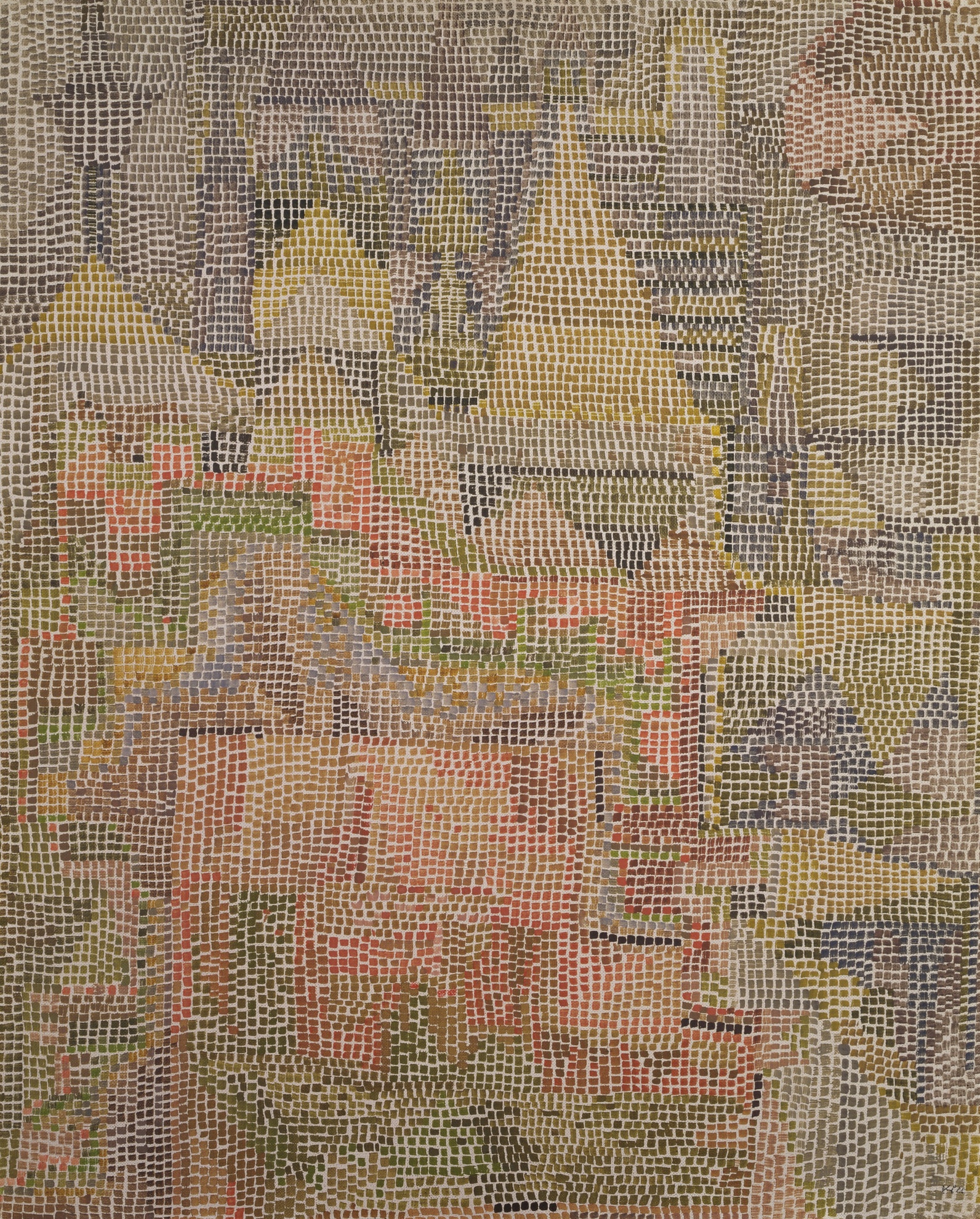
Castle Garden is a painting by Paul Klee from 1931: the whole canvas is covered in small dabs of colour laid like the pieces of a mosaic, and out of them rise the towers and pointed roofs of a castle in ochre and pale yellow at the top, with terraces and garden beds in rose, coral, moss green and grey-violet below. The original is oil on canvas, 67.2 x 54.9 cm, and belongs to the Museum of Modern Art in New York. Our painter recreates it by hand on canvas, in oil or acrylic, in 4 upright sizes from 70 x 87 to 130 x 162 cm or made to measure. Before we pack the castle and its garden, we send you a photograph of the finished painting.
| Title: | Castle Garden |
| Other titles: | Schlossgarten (German title) · Giardino del castello (Italian title) |
| Painter: | Paul Klee (1879–1940) |
| Year painted: | 1931 |
| Original size: | 67.2 cm x 54.9 cm (height x width) |
| Original technique: | Oil on canvas |
| Painting style: | Modernism |
| Located at: | Museum of Modern Art (MoMA), New York, USA |
| Our reproduction: | Hand-painted in oil or acrylic on canvas, 4 sizes or made to measure |
Castle Garden – Paul Klee
What does Castle Garden show?
From a distance the canvas looks like woven cloth or a mosaic. Small, irregular rectangles of colour run across the entire surface, row after row, and between them the pale ground stays visible like a fine net of grout lines.
In the upper half, pointed roofs, gables and towers in ochre and pale yellow rise out of the grid, with grey-violet turrets among them. This is the castle, which Klee does not draw in outline but assembles from triangles and vertical bands.
The lower half belongs to the garden. Terraces and beds step down in rose, coral, moss green and grey-violet, and short dark lines between them read as steps, edgings or paths. In the top right corner a soft rose patch glows. The whole is gentle, faintly shimmering and dreamy, as if you were looking at the garden through summer haze.
What does the title Castle Garden mean?
The title tells you what is there: the castle above, the garden below. Klee writes no further story into it. Castle and garden are built from the same material, the same small stones of colour, so building and nature meet without a hard border.
Klee played the violin from childhood and later in an orchestra too, and the poet Rilke likened his drawings to musical transcriptions. Here the comparison is almost tangible: the rows of dabs run like bars of music, and the colours return and alternate like voices in a quiet piece.
Why is Castle Garden so compelling?
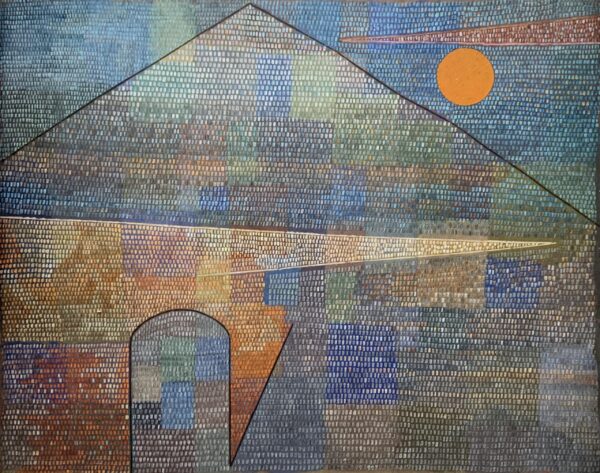
In 1931 Klee left the Bauhaus, where he had taught since January 1921, and moved to teach at the Düsseldorf Academy. In those years he made a group of works built from small dabs of colour. The best known is Ad Parnassum of 1932, which English Wikipedia calls his masterpiece and the best example of his pointillist style; Castle Garden belongs to the same family.
The secret is the grid. The dabs are not scattered at random but stand in rows like tiles, and the pale ground between them keeps breathing. From afar the colours merge into castle and garden; up close they break into hundreds of separate strokes, so the painting shifts a little with every step you take.
For more on the painter himself, see the English-language Wikipedia article on Paul Klee; it covers the artist, as this work has no article of its own.
Where is the original kept?
The original belongs to the Museum of Modern Art (MoMA) in New York, under accession number 106.1982. It is painted in oil on canvas and measures 67.2 x 54.9 cm (height x width).
Klee’s breakthrough in colour came in 1914, on a trip to Tunisia with August Macke and Louis Moilliet. By the time he painted Castle Garden he was already teaching in Düsseldorf.
From the same year comes Boy in Fancy Dress, also built of rows of small dabs, but with a boy in carnival costume drawn over them in thin lines.
Castle Garden or another Klee?
Castle Garden is a canvas painting for people who love calm. It has no loud colours or harsh contrasts, so it sits easily with wood, linen, stone and warm white walls.
If tiny dots appeal to you, look at Equals Infinity of 1932, where an equals sign and the sign for infinity float in a coloured haze. For something more playful, Mask of Fear sets one big mask on thin legs. And for a warmer, louder rhythm there is Redgreen and Violet-Yellow Rhythms of 1920, pieced together from coloured rectangles.
More famous Paul Klee paintings, each painted to order by our painters, are waiting on our Paul Klee page.
How do we hand-paint Castle Garden?
Klee’s original is oil on canvas, so the road to ours is short: ours is made on canvas too, in oil or acrylic. It is an oil painting reproduction that the painter builds up layer by layer, in the size you choose.
First he lays a pale ground, which will stay visible between the dabs at the end, like grout between mosaic stones. Then he sketches the main shapes in pencil or with a fine brush: roofs and towers above, terraces below. Only then does he start setting the dabs, row by row, giving each its own shade.
Which size suits which wall?
In short: 70 x 87 or 90 x 107 cm above a chest of drawers, a bed or in a dining room, 99 x 125 cm above a sofa, and 130 x 162 cm for a tall, empty wall that the garden should fill.
We paint Castle Garden in 4 upright sizes (width x height): 70 x 87, 90 x 107, 99 x 125 and 130 x 162 cm. The original measures 54.9 x 67.2 cm (width x height), so even our smallest size is a little larger, and the largest takes it to more than twice its width.
Why nothing smaller? The little dabs need room. On a small format they would blur into an uneven grey and the grid would vanish, so we offer Castle Garden from 70 x 87 cm upwards only.
As a painting for the living room it is at its best at 99 x 125 or 130 x 162 cm: from the sofa it melts into a soft garden, and as you step closer it opens into hundreds of coloured stones.
Can I order another size or a frame?
Yes. If you need different proportions, we extend or shorten the grid so that the castle stays at the top, the garden at the bottom, and no roof is cut off. Send us the measurements you need and we will reply with a price and a date.
Castle Garden travels to you rolled, stretched on a stretcher bar or framed. Our workshop in Slovenia does the stretching and framing and prepares every painting safely for the road. The moulding for Castle Garden is chosen in our 3D app, which handles frame choice only; seeing the painting on your own wall is a separate service.
When will my painting arrive?
The painter starts as soon as you confirm your order, and Castle Garden is ready to ship within 15 to 45 working days. Before it is packed, a photograph of the finished garden comes to you, and any change you ask for is made.
Within the EU, including Slovenia, the painting travels without customs duties, and every order is covered by our returns policy.
The dreamy garden makes a lovely gift for a new home, a wedding or anyone who loves gardens and quiet colours. Unsure how much wall space they have? A wall art voucher lets them choose the size of their garden themselves.
Frequently asked questions
Which museum holds the original?
The Museum of Modern Art (MoMA) in New York, under accession number 106.1982.
What can I see in the painting?
A castle with pointed roofs and towers at the top and a terraced garden below, all laid in small dabs of colour.
Is it a print?
No. You get a hand-painted copy in which every small dab is placed with a brush, in oil or acrylic.
How large is the original?
It measures 67.2 x 54.9 cm (height x width); our sizes run from 70 x 87 to 130 x 162 cm.
Why are there no smaller sizes?
The small dabs of colour need space; on a smaller format they would blur together and the grid would be lost.
How long will I wait for my painting?
From 15 to 45 working days, since the dense grid needs patience; a photograph reaches you before dispatch.
Does Castle Garden suit a bedroom?
Yes. The soft rose, green and ochre tones are calm, so it suits a bedroom as well as a living room or dining room.
Does the painting have a hidden meaning?
The title names a castle and a garden; the work imposes no other reading, so everyone finds their own in the mosaic of dabs.
- Subject: a castle with pointed roofs above a terraced garden, built of small dabs in ochre, rose, green and grey-violet.
- Original: oil on canvas, 1931, 67.2 x 54.9 cm, Museum of Modern Art, New York.
- Ours: a Paul Klee reproduction brushed in oil or acrylic on canvas; 4 upright sizes from 70 x 87 to 130 x 162 cm, or made to measure.
- Worth knowing: Klee painted it in his Düsseldorf years, in the same group of dabbed works as Ad Parnassum.