







































Description
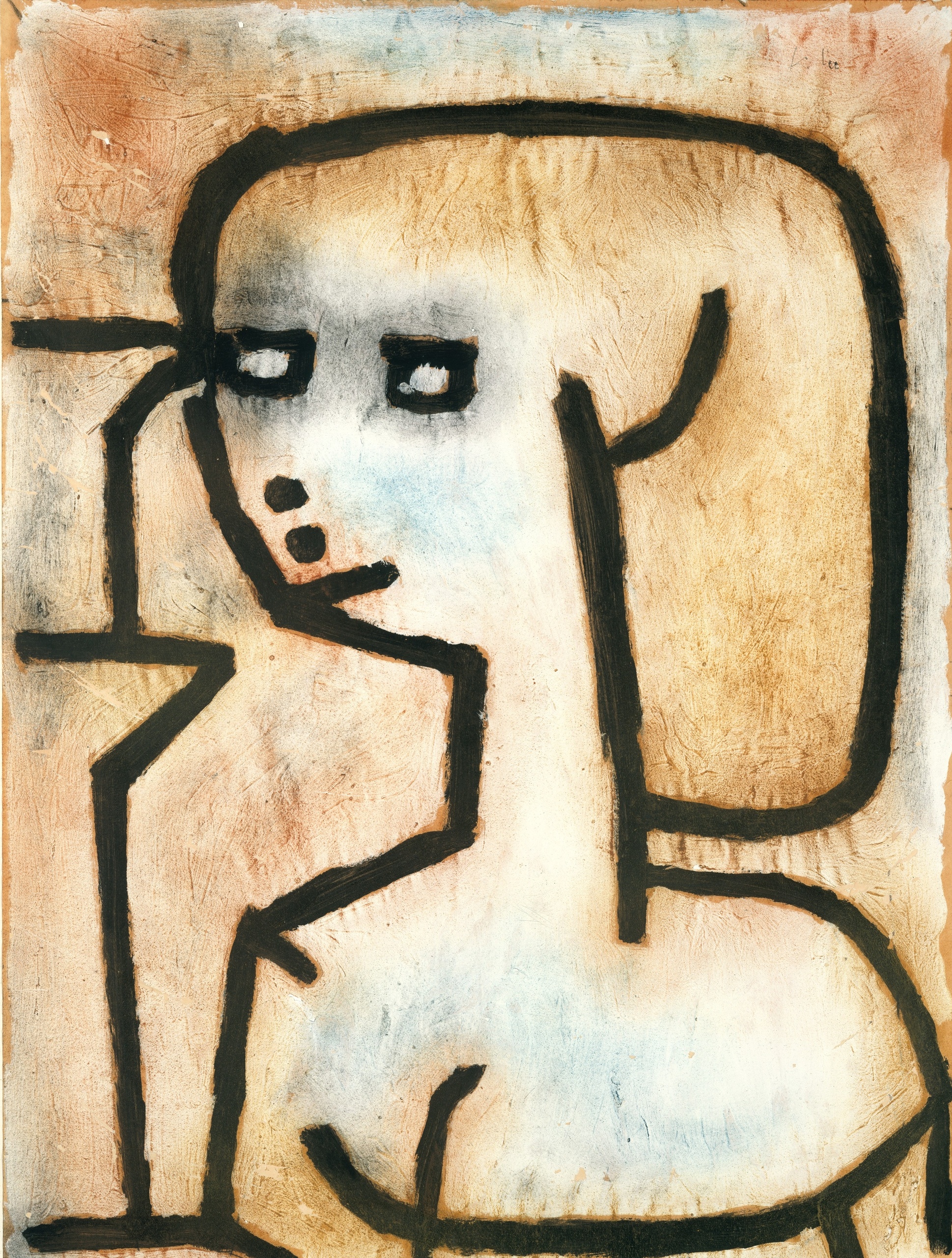
Girl in Mourning is a painting by Paul Klee from 1939: thick, soft black brushstrokes draw the head and shoulders of a girl with a large rounded mass of warm ochre hair, a pale bluish-white face and two dark, square eyes that look to the side, while a raised hand props up her chin. The original is gouache with pastel and charcoal on paper mounted on cardboard, 66.4 x 50.2 cm, and it belongs to The Metropolitan Museum of Art in New York. We paint it for you by hand on canvas, in oil or acrylic, in 8 upright sizes from 30 x 40 to 156 x 200 cm or made to measure. Before the girl travels to you, we send you a photograph of her.
| Title: | Girl in Mourning |
| Other titles: | Mädchen in Trauer (German title, Klee’s inscription) · Ragazza in lutto (Italian title) |
| Painter: | Paul Klee (1879–1940) |
| Year painted: | 1939 |
| Original size: | 66.4 cm x 50.2 cm (height x width) |
| Original technique: | Gouache, pastel and charcoal on paper mounted on cardboard |
| Painting style: | Modernism |
| Located at: | The Metropolitan Museum of Art, New York, USA |
| Our reproduction: | Hand-painted in oil or acrylic on canvas, 8 sizes or made to measure |
Girl in Mourning – Paul Klee
What does Girl in Mourning show?
Klee drew the girl with a handful of thick black brushstrokes whose edges are soft and slightly frayed. The right half of the sheet is taken up by a big rounded shape of warm ochre hair, which falls like a heavy hood down to her shoulder. On the left peeps out a pale, bluish-white face.
The eyes are two dark squares with a tiny white fleck at the centre, wrapped in a grey haze, and both glance sideways, past the viewer. The nose is just two black dots and the mouth a short horizontal stroke. A bent, angular arm climbs to her chin, as though her face rests in her hand.
At the bottom her shoulders open into a wide curve. Around the figure the ground is misty and diffuse, as if the colour had been sprayed on: rose, sky blue and ochre melt softly into one another. At the upper right Klee signed his name in small letters.
What do the title and the face tell us?
Klee wrote the title himself, in German, on the sheet the museum now keeps. It does not say for whom or why the girl mourns.
A hand under the chin is the pose of someone thinking or waiting. The mood is not dramatic: the girl does not weep or lament, she is simply turned quietly inward.
The English article on Klee says that the works of these years dealt with ambivalent themes, expressing his personal fate, the political situation and his wit. Klee left no note on this sheet, so we impose no meaning; every viewer finds something of their own in the face.
Why does this quiet girl hold the eye?
Because she says a great deal with very little. Two dots, a stroke and two squares are enough for a face we read at once as thoughtful.
The colours are soft and warm, so despite its title the painting never feels gloomy.
Expressionism, cubism and surrealism all shaped Klee; he was born in 1879 in Münchenbuchsee near Bern, and it was in Bern that this girl took shape sixty years later. The Wikipedia article on Paul Klee, in English, tells more of his life; it is about the painter, since this sheet has no article of its own.
Where is the original, and when was it made?
The original belongs to The Metropolitan Museum of Art in New York, under accession number 1984.315.61. The museum received it in 1984 as part of The Berggruen Klee Collection.
The sheet measures 66.4 x 50.2 cm (height x width), fairly large by Klee’s standards. It is a work on paper in gouache, pastel and charcoal, not an oil on canvas.
It was made in 1939 in Bern, where Klee had settled for good after leaving Germany in 1933. According to English Wikipedia, 1939 was his most productive year, with no fewer than 1,254 works. He died the following year, on 29 June 1940.
From this last period also comes The Hour Before One Night of 1940, one of his very last works, in which thick black bars frame fields of red and blue.
Girl in Mourning or another Klee?
Girl in Mourning is a canvas painting for anyone who wants one calm face on the wall, with no crowd and no noise.
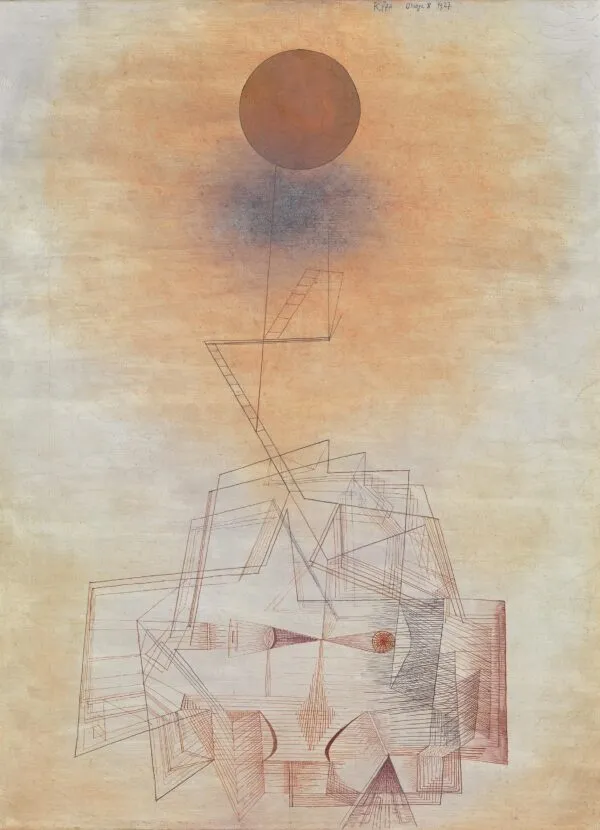
If you are after something more playful, look at The Barbed Noose with the Mice, where four mice scurry around a knotted ribbon. A delicate, story-like drawing comes in Episode Before an Arab Town, and for a calm wall without figures there is Clarification, covered in rows of tiny dots.
Browse the other famous Paul Klee paintings we can paint for you on our Paul Klee page.
How do we hand-paint Girl in Mourning on canvas?
Klee’s original is a work on paper in gouache, pastel and charcoal. Ours is an oil painting reproduction on canvas: the painter makes it in oil or acrylic, at the size you choose, so it hangs on the wall like any painting stretched on a stretcher bar.
First comes the misty ground: thin, translucent layers of rose, blue and ochre, softened until the tones flow together. Then come the ochre hair, the pale face and a grey shadow around the eyes.
The black lines come last, pulled with a broad brush in long strokes so they keep their weight and their frayed ends.
Which size fits which wall?
In short: 30 x 40 or 36 x 48 cm above a bedside table, on a shelf or in a hallway, 47 x 62 and 60 x 81 cm above a bed or a chest of drawers, 77 x 100 and 95 x 128 cm above a sofa, and 120 x 160 or 156 x 200 cm for a tall wall the girl should command.
We paint Girl in Mourning in 8 upright sizes (width x height): 30 x 40, 36 x 48, 47 x 62, 60 x 81, 77 x 100, 95 x 128, 120 x 160 and 156 x 200 cm. The original sheet measures 50.2 x 66.4 cm (width x height): the three smallest sizes are more compact than the sheet, from 60 x 81 cm upwards we enlarge the work, and at 156 x 200 cm it is about three times as wide.
As a painting for the living room it looks best at 95 x 128 or 120 x 160 cm, where the calm fields of colour and the thick black lines carry to the far side of the room.
Can I have a different size or a frame?
Yes. For other proportions we keep the face, arm and hair whole and widen or narrow only the misty ground. Tell us the size you have in mind and we will quote a price and a delivery date for the girl.
The girl travels to you rolled, stretched on a stretcher bar or already in her frame, all prepared by our workshop in Slovenia. The moulding is chosen in our 3D app, which does that one job; a view of the painting on your own wall is a separate service.
Dark wood or plain black suits the lines; pale natural wood brings out the ochre.
When will the painting arrive?
When you confirm, the painter begins with the misty ground, and the girl is ready to travel within 15 to 45 working days. You see her first in a photograph, and anything you want changed is changed before packing.
No customs charges apply to the girl’s journey within Slovenia or the EU, and our returns policy covers the order.
The quiet girl makes a lovely present for someone who likes Klee. If you do not know their walls, a wall art voucher lets them pick her size themselves.
Frequently asked questions
Where can the original be seen?
At The Metropolitan Museum of Art in New York, under accession number 1984.315.61.
What is in the picture?
A girl with a big mass of ochre hair and a pale face, resting her chin on her hand and looking to the side.
Is it a print?
No. It is a hand-painted copy: our painter works it with brushes on canvas, in oil or acrylic.
How big is the original?
It measures 66.4 x 50.2 cm (height x width); our sizes run from 30 x 40 to 156 x 200 cm.
Can I order it in another size?
Yes. Tell us the width and height you need and we will reply with a price and a delivery time.
How long do making and delivery take?
Within 15 to 45 working days the girl is ready to travel, and you see a photograph of her before we pack.
Does it suit a bedroom or a living room?
Both: a smaller size calms a bedroom, and a larger one holds a living-room wall.
Is it a sad painting?
The title speaks of mourning, but the face is above all thoughtful and tender, and the colours are warm and light.
- Subject: a girl with a big mass of ochre hair, a pale face and her hand under her chin, on a misty rose and blue ground.
- Original: gouache, pastel and charcoal on paper mounted on cardboard, 1939, 66.4 x 50.2 cm, The Metropolitan Museum of Art.
- Ours: a Paul Klee reproduction on canvas, hand-painted in oil or acrylic in 8 upright sizes from 30 x 40 to 156 x 200 cm, or made to measure.
- Worth knowing: Klee wrote the title on the sheet himself; he made it in Bern in 1939, his most productive year.