



Description
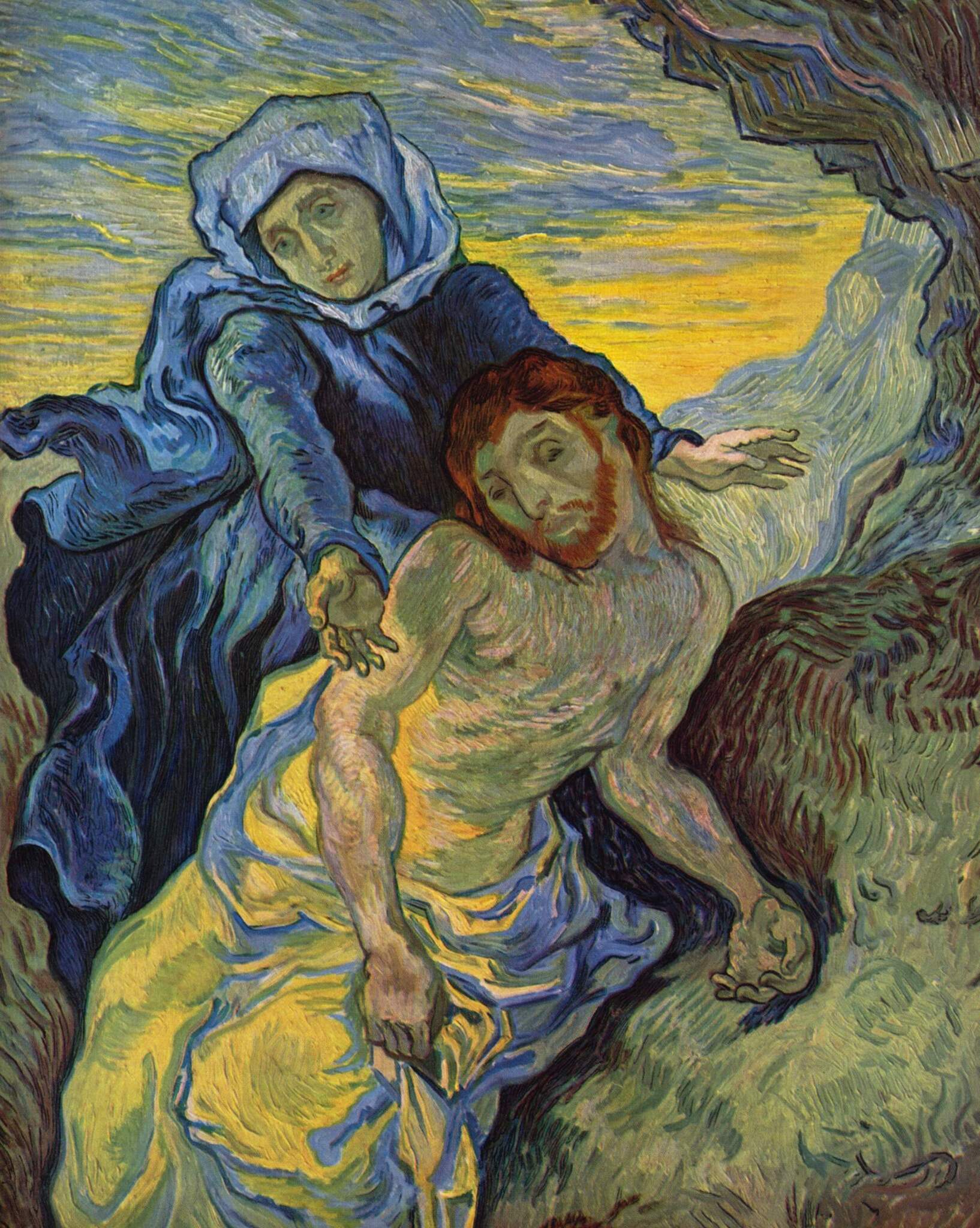
Pietà (after Delacroix) is the painting Vincent van Gogh made in September 1889 in Saint-Rémy-de-Provence, after a lithograph of a work by Eugène Delacroix: the Virgin Mary in a blue robe, her arms spread wide, mourning the dead Christ at the entrance of a cave under a stormy evening sky. The original measures 73 x 60.5 cm and hangs in the Van Gogh Museum in Amsterdam. We paint it by hand in oil on canvas, in 16 sizes from 40 x 50 to 135 x 160 cm or to your own measurements, and send you a photograph of the finished painting for approval before dispatch.
| Title: | Pietà (after Delacroix) |
| Other titles: | Pietà · Pieta (po Delacroixu) · Pietà (nach Delacroix) |
| Painter: | Vincent van Gogh (1853–1890) |
| Year painted: | September 1889, Saint-Rémy-de-Provence |
| Original size: | 73 cm x 60.5 cm |
| Original technique: | Oil on canvas |
| Painting style: | Post-Impressionism |
| Located at: | Van Gogh Museum, Amsterdam (inv. s0168V1962) |
| Our reproduction: | Hand-painted oil on canvas, 16 sizes or made to measure |
Pietà (after Delacroix) – Vincent van Gogh
What does Pietà (after Delacroix) show?
The Virgin Mary sits at the entrance of a dark cave in a rocky landscape, dressed in a blue robe with a pale headscarf. She spreads her empty arms wide in a gesture of grief. In front of her lies the dead Christ, his body pale and heavy, his head with its red hair and beard sunk against her, his legs wrapped in a light cloth. On the right the rock rises steeply; above the figures the evening sky is laid down in long streaks of yellow, green and blue.
Van Gogh described the scene himself in a letter: the exhausted body lies on the ground at the entrance of a cave, the woman is behind it, and it is evening after a thunderstorm. Her blue clothes are blown by the wind and stand out sharply against a sky with violet clouds edged in gold. He saw the two heads as one dark flower and one pale flower, placed so that each makes the other stronger.
How did a stained lithograph become a painting?
In September 1889 Van Gogh was living at the Saint-Paul asylum near Saint-Rémy. Among his prints he kept a lithograph of a Pietà by Eugène Delacroix, and one day it fell, together with other sheets, into oil and paint and was spoiled. He wrote that he was sad about it and that in the meantime he had occupied himself painting it, adding: “you’ll see it one day”.
The lithograph has survived. The painting became the first of a series of copies he made at the asylum after artists he admired, among them Jean-François Millet, Honoré Daumier and Rembrandt. In the months that followed, confined to the asylum, without models and with winter too cold for painting outdoors, he found in copying a way to keep working. He wrote that the copies gave him a kind of comfort and that his brush moved through his fingers like a bow over the strings of a violin.
What does the Pietà mean?
A pietà shows the Virgin Mary mourning her dead son: the Mater Dolorosa, the sorrowing mother. Van Gogh took the theme and the composition from Delacroix and added his own colour and his own way of painting, so the museum calls it more a variation on the original than a copy. Religious subjects are rare in his work.
The asylum was housed in an old monastery, which may have played a part in the choice of subject. He wrote that he was not indifferent and that pious thoughts often consoled him in his suffering. The Van Gogh Museum suggests he may have identified with Christ, who had also suffered and been misunderstood. Some scholars see the painter’s features in the red-bearded Christ, but whether he intended this is not known.
Where does the original hang, and how did it reach Amsterdam?
The original hangs in the Van Gogh Museum in Amsterdam under the object number s0168V1962; it belongs to the Vincent van Gogh Foundation.
After September 1889 the canvas was with his brother Theo in Paris. After Theo’s death in January 1891 it passed to his widow, Jo van Gogh-Bonger, and their son Vincent Willem van Gogh. It was on loan to the Rijksmuseum from 1917 to 1919 and to the Stedelijk Museum from 1931, until Vincent Willem gave it to the Vincent van Gogh Foundation in 1952. Another version of the composition is in the Vatican’s Collection of Modern Religious Art; the one we paint is the Amsterdam canvas.
Pietà (after Delacroix) or The Starry Night – which should you choose?
Both paintings come from the same months at the asylum in Saint-Rémy in 1889. The Starry Night, painted in June, is the view from his window: a swirling sky, a village and a cypress. The Pietà, painted in September, is a figure scene with a religious subject, quieter and more inward.
For a large, moving night sky above a sofa, choose The Starry Night; for a calm, contemplative subject in a quieter room, choose the Pietà. From the same year in Saint-Rémy we also paint Cypresses and Irises, and from the January before, in Arles, the Self-Portrait with Bandaged Ear.
How is our hand-painted Pietà made?
The painter first draws the two figures, the cave and the rocks, and checks the proportions against the original. Then come the sky in long, flowing strokes of yellow and blue, the dark rock, the Virgin’s blue robe with its folds blown by the wind, and last the pale body of Christ and the two faces. Our oil painting reproduction is painted by hand on canvas, with real impasto: the paint goes on thickly, so the brushstrokes stand up from the canvas as they do in the original and catch the light.
That matters here, because Van Gogh built the whole scene from long, curving strokes that follow the forms: the folds of the robe, the streaks of the sky, the rounded rocks. A print is completely flat; on our painting the brushstrokes and the layers of paint are real.
Every painting is a hand-painted copy made for your order, so no two are quite the same.
Which size for which wall?
Short answer: 60 x 70 or 64 x 80 cm above a chest of drawers or a desk, 80 x 100 or 90 x 110 cm above a sofa or a bed, and 120 x 140 cm for a large empty wall. The upright format suits a narrow wall, the space between two windows or a hallway.
There are 16 sizes: 40 x 50, 55 x 66, 60 x 70, 64 x 80, 70 x 85, 75 x 90, 80 x 100, 85 x 105, 90 x 110, 93 x 115, 100 x 120, 105 x 125, 110 x 130, 120 x 140, 127 x 150 and 135 x 160 cm (width x height). The original is 60.5 cm wide and 73 cm high; our 60 x 70 cm size is the closest to it, so the painting on your wall is almost as large as it is in the museum. A painting for the living room should cover about two thirds of the width of the furniture below it; an upright canvas can be narrower when it hangs above a slim piece of furniture.
Hang it with the centre of the canvas about 150 cm above the floor. Above a sofa or a headboard, leave 20 to 30 cm between the top of the furniture and the bottom of the canvas.
What if I need a custom size or a frame?
If none of the 16 sizes fits your wall, we paint it to measure. We recommend keeping the proportions close to the original, otherwise the figures get squeezed or stretched. Send us the width and height you want and we will quote you a price and a delivery time. Every painting we make is mounted on a wooden stretcher, ready to hang.
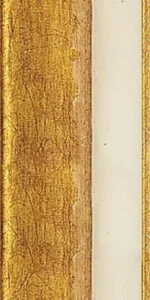
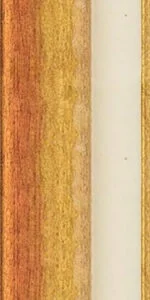
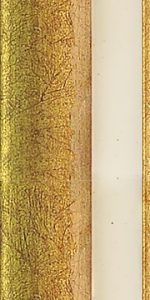
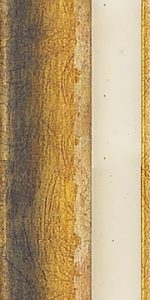
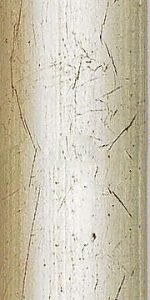
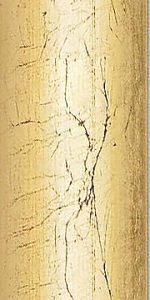
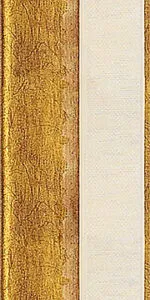
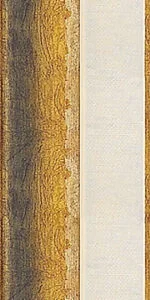
Our 3D app shows each of our frame profiles on this painting, so you can compare gold, silver, black, white and natural wood before you decide. The app is for choosing the frame only. If you would like to see how the painting will look on your own wall, we offer that through our separate room placement service. The deep blue of the robe and the golden sky suit a warm gold profile or a dark wooden frame.
How does delivery work, and what is the guarantee?
Every painting is made to order in our studio in Slovenia, so allow 15 to 45 days depending on the size you choose. We ship it on its stretcher, carefully packed (and framed, if you chose a frame), across the EU with no customs duty. Before dispatch we send you a photograph of the finished painting to approve; if anything is not right, we correct it while the canvas is still in our workshop. Our returns policy applies to every order.
You will find more of Van Gogh’s famous paintings in our Vincent van Gogh gallery, and there is more about the painter in our article on Vincent van Gogh. If it is a gift and you are not sure of the size, a wall art voucher lets the recipient choose the size and the subject.
Frequently asked questions
Where does the original Pietà (after Delacroix) hang?
In the Van Gogh Museum in Amsterdam. The museum lists it under the object number s0168V1962, and it belongs to the Vincent van Gogh Foundation. It is not in the Vatican: the Vatican Museums hold a different version of the same composition.
When and where did Van Gogh paint the Pietà?
In September 1889, at the Saint-Paul asylum near Saint-Rémy-de-Provence where he had been living since May. It was the first of the copies he painted there after works by other artists, and it came only a few months after The Starry Night, which he painted in the same place in June.
Why did Van Gogh paint a Pietà after Delacroix?
Because of an accident. His lithograph of the Pietà by Eugène Delacroix fell, together with other sheets, into oil and paint and was spoiled. He wrote that he was sad about it and had occupied himself painting it in the meantime. The lithograph has survived, complete with the stain, and still shows how the painting began.
Is Van Gogh’s Pietà a copy of Delacroix’s painting?
Not exactly. Van Gogh worked from a lithograph of Delacroix’s painting, not from the painting itself. He kept the theme and the composition but chose his own colours and painted it with his own brushwork, which is why the Van Gogh Museum calls it more a variation on the original than a copy.
Who are the figures in the Pietà (after Delacroix)?
The Virgin Mary and the dead Christ. Mary, the sorrowing mother or Mater Dolorosa, sits in a blue robe at the entrance of a cave and spreads her empty arms in a gesture of grief. Christ lies in front of her, his head with its red hair and beard sunk in shadow, while her pale face stands out against a cloud.
Is there a second Van Gogh Pietà in the Vatican?
Yes. Another version of the same composition is in the Vatican’s Collection of Modern Religious Art, catalogued as F757; the Amsterdam canvas is F630. The page you are reading is about the Amsterdam composition, which is the one we paint. More about his copies after Delacroix and other artists is on Wikipedia.
Does Christ in the Pietà have Van Gogh’s face?
No one can say for certain. Some scholars see the painter’s features in the red-bearded Christ, and the Van Gogh Museum suggests he may have identified with Christ, who had also suffered and been misunderstood. Whether he intended the resemblance is not known, so it remains one possible way of reading the painting.
How big is the original Pietà (after Delacroix)?
The original is 73 cm high and 60.5 cm wide, an upright format that already works above a desk or a chest of drawers. Our 60 x 70 cm size is the closest to the original, and there are smaller and larger sizes from 40 x 50 up to 135 x 160 cm, as well as custom sizes.
Is the original Pietà for sale, and what is it worth?
No, the original is not for sale. It belongs to the Vincent van Gogh Foundation and hangs in the Van Gogh Museum in Amsterdam, so it has no market price. What we can tell you is the price of our hand-painted version, shown on this page for the size you choose: a real canvas painting in oil for your own wall.
Does your Pietà (after Delacroix) have the raised brushstrokes of the original?
Yes. We paint it in impasto, building up each brushstroke in thick oil, so the surface is raised like Van Gogh’s original. You see the relief best in the streaked evening sky and in the folds of the blue robe, where the long strokes catch the light.
- Subject: the Virgin Mary in a blue robe mourning the dead Christ at the entrance of a cave, under a stormy evening sky.
- Original: September 1889, Saint-Rémy, 73 x 60.5 cm, Van Gogh Museum, Amsterdam.
- Ours: a Van Gogh reproduction painted by hand in oil on canvas, in 16 sizes from 40 x 50 to 135 x 160 cm or made to measure.