







































Description
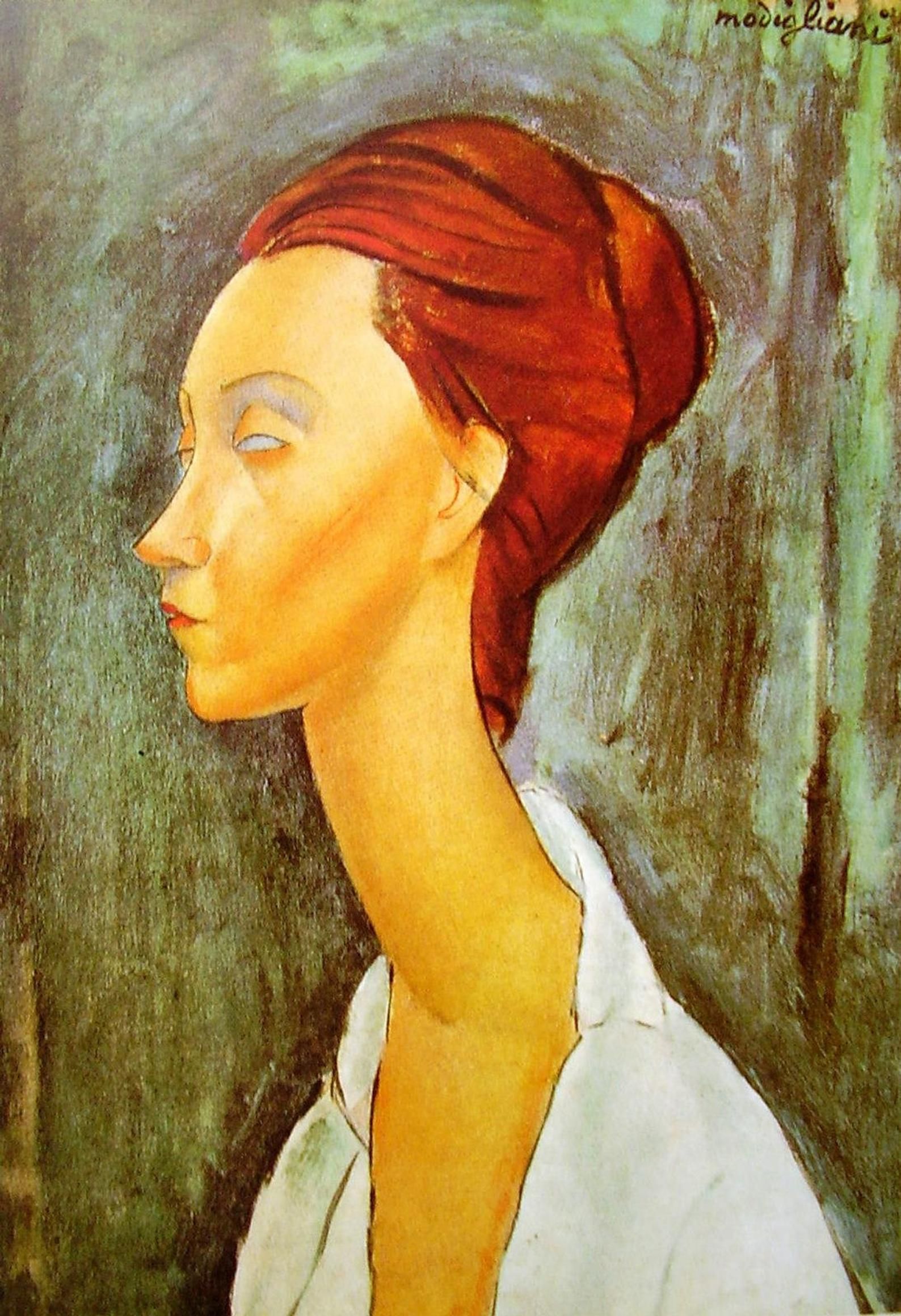
Portrait of Lunia Czechowska is an oil on canvas painted by Amedeo Modigliani in 1919; the original measures 46 × 33 cm and is privately held. It shows Lunia Czechowska, a Polish woman from the circle around the painter’s dealer Léopold Zborowski, in strict left profile. Our canvas painting is a hand-painted copy of that work: an academy-trained painter makes it in oils on cotton canvas, in eight sizes from 33 × 46 cm to 120 × 170 cm or in a measurement you give us, and before dispatch we photograph it and send you the photograph for approval.
| Title: | Portrait of Lunia Czechowska |
| Other titles: | Ritratto di Lunia Czechowska · Portrait de Lunia · Bildnis Lunia Czechowska |
| Painter: | Amedeo Modigliani (1884–1920) |
| Year: | 1919 |
| Original size (height × width): | 46 × 33 cm |
| Original technique: | Oil on canvas |
| Style: | Modern art, École de Paris |
| Location: | Private collection – record of the work (no accession number) |
| Our reproduction: | hand-painted oil on canvas, eight sizes from 33 × 46 cm to 120 × 170 cm, made to measure on request |
Portrait of Lunia Czechowska – Amedeo Modigliani
Who is the sitter?
Lunia Czechowska, a Polish woman from the circle that gathered in Paris around the dealer Léopold Zborowski. Zborowski paid Modigliani’s studio, models and paint; Lunia belonged to his household and was a friend of the painter. He painted her several times, in different years and different arrangements, which is rare for him: apart from Jeanne Hébuterne, few people return to his canvases so often. So we know the name, and that is exactly what separates this portrait from works carrying a title with no name — here we know who we are looking at.
What is on the canvas?
The head is painted in strict left profile, a rarity in Modigliani: most of his portraits are frontal or in three-quarter turn. The hair is chestnut red, gathered into a large, smoothly shaped knot at the nape; the painter built it with broad, visible strokes, so the red mass works as a form in its own right and not merely as a hairstyle. The neck is very long and calmly extended, which emphasises the profile further. The face is pale and elongated, the line of nose and chin drawn in a single stroke, the eye a closed dark area without a pupil. The ground is smooth and neutral, with no objects. The canvas is small, barely larger than a sheet of paper, and for that reason reads as something made quickly and close up.
Why does this work matter?
Because in Modigliani the profile is almost an exception. His portraits look straight out or to the side, drawing the viewer in while giving nothing away; the profile, by contrast, shuts the viewer out. Here the sitter does not know about them — or acts as if she does not — and the work becomes observation rather than an encounter. Behind the form stand his years as a sculptor, and behind the colour a post-impressionist painting of Cézanne’s kind, in which a head is built from planes and not from details. In Paris Modigliani belonged to the circle of immigrant painters we now call the École de Paris, and it was in that circle, among the Poles around Zborowski, that this portrait was made.
What does the work mean?
It means the portrait of a friend, not of a client. So there is nothing to indicate rank: no jewellery, no setting, no object in the hands. What remains is the face and the mass of the hair, which is in fact the main event of the picture — a red form weighing as much as the head. In the last year of his life Modigliani painted fast and a great deal; small canvases like this one were made in a sitting or two. If you want one thought to take away: a profile says less about the gaze and more about the form, and form is exactly what interested Modigliani.
Is this the same work as Portrait of a Polish Woman?
No. Portrait of a Polish Woman carries a title with no name and is a larger canvas; here we know who the sitter is. Both portraits come from the same Polish circle in Paris, which is why they are easy to confuse. The circle is completed by Madame Hanka Zborowska, which São Paulo now lists as another portrait of this same sitter, and Portrait of Léopold Zborowski, the dealer himself. Close in year and arrangement are Portrait of Beatrice Hastings, an English poet and not a Pole, and Lolotte, where the title gives a nickname. The full selection is in the Amedeo Modigliani gallery, and about the painter we have written a longer article; an Italian encyclopaedia entry on this work is available away from our pages.
How is our hand-painted version made?
The work is made by an academy-trained painter in oils on cotton canvas, stretched over a wooden frame. It is not a print and not a machine reproduction: every stroke is laid on by hand, so your canvas always differs a little from our reference in brushwork and in the thickness of the paint. The painter begins with the ground, then sets the red mass of the hair, and only at the end draws the contour of the face. With this subject the order matters: the profile is a single long line from forehead to chin and cannot be mended piece by piece, so the ground must be dry and correctly toned before the painter draws it. Once the paint is dry we photograph the work and send you the photograph for approval.
Which size for which wall?
For most homes 50 × 70 cm is the right choice. What is particular about this work is the smallest size: 33 × 46 cm is exactly the size of the original, so you receive a canvas at one to one — sensible on a shelf, above a desk, or on a narrow hallway wall where it is seen close up. The middle sizes, 40 × 60 and 60 × 80 cm, go above a chest of drawers or in a bedroom. The large ones, 70 × 100, 80 × 110, 100 × 140 and 120 × 170 cm, ask for an empty wall and distance; at those sizes the head is larger than life and the profile becomes almost an architectural form. The format is upright and carries a narrow, tall wall well. Since the only strong colour is the red of the hair, the work asks for no strong wall colour — on the contrary, that red only comes alive against a quiet ground.
Custom size, stretcher bar and frame
If your wall calls for a measurement not on the list, we will make it. Give us height and width in centimetres; we check whether the ratio carries the crop of the original and tell you what changes at the edges — on a profile it shows first in front of the face, where there is least room. You can also choose whether we send it stretched on a wooden stretcher, ready to hang, or rolled in a tube, which ships cheaper and suits you if your own framer will stretch it. This work is offered without a frame, so you choose the frame yourself. With placement we help by visualisation, setting the work into a photograph of your wall before you buy. If you are looking for a work we do not carry, see paintings made by order.
Delivery and guarantee
We deliver across Europe to your address, the canvas held away from the outer wall of the packaging. Making time depends on the size and on how busy the studio is; we give an estimate when you order and tell you if it changes. We stand behind workmanship and material: if the work arrives damaged or does not match the photograph you approved, we put it right or repaint it at our cost. Because you see it photographed before dispatch, most questions are settled before the parcel leaves.
Frequently asked questions
Where is the original?
In a private collection. As the work is not in a public museum it has no accession number, and we give none.
Who was Lunia Czechowska?
A Polish woman from the circle of the dealer Léopold Zborowski and a friend of the painter. Modigliani painted her several times.
Is Portrait de Lunia the same work?
Yes. That is the French title of the same canvas; in Italian it is Ritratto di Lunia Czechowska.
Which size should I choose?
If you cannot decide, 50 × 70 cm. For a shelf or a desk, 33 × 46 cm, the size of the original; above a chest of drawers, 60 × 80 cm.
What is it about, in one sentence?
That the outline of a person can be enough, even when the gaze is not given to us.
Is the original for sale and what is it worth?
We neither sell nor value the original. It is privately held and not on the market.
How high should I hang it?
The centre about 145 cm above the floor. The profile faces left, so the work sits well at the right-hand end of a wall, where the look has somewhere to go.
Is it suitable as a gift?
It is. The subject is quiet and just impersonal enough, and the smallest size is that of the original — a gift explained in one sentence.
How closely does it follow the original’s proportions?
The original measures 33 × 46 cm, and that is exactly the size we list: 33 x 46 cm. The proportions are the original’s, with no deviation.
- Subject: Lunia Czechowska in strict left profile, chestnut-red hair in a large knot at the nape, a very long neck, neutral ground
- Original: 46 × 33 cm, oil on canvas, 1919, private collection, no accession number
- Ours: hand-painted oil on canvas, eight sizes from 33 × 46 to 120 × 170 cm; the smallest is one to one with the original
- Worth knowing: the strict profile is a rarity in Modigliani — here the viewer observes the sitter instead of meeting her
The eyes on this canvas are painted without pupils. We counted all 76 Modigliani works on this shelf: 53 are like that, 17 are not – work by work.