



Description
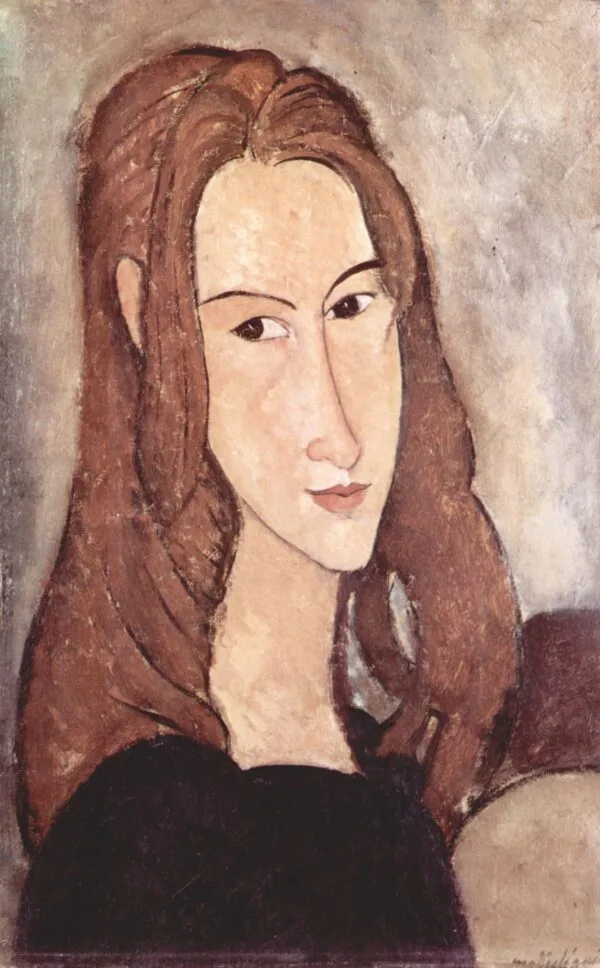
Portrait of Jeanne Hébuterne III is an oil on canvas by Amedeo Modigliani; the German confiscation inventory dates it to 1918 and gives the measurements 46 × 29 cm, while the catalogues of Pfannstiel and Patani give 55 × 38 cm. The original is in private hands today. Our canvas painting is a hand-painted copy of that work: an academy-trained painter makes it in oil on cotton canvas, in eight sizes from 38 × 55 cm to 120 × 170 cm or in the size you specify, and before dispatch we photograph it and send you the photograph for approval.
| Title: | Portrait of Jeanne Hébuterne III |
| Other titles: | Jeanne Hébuterne frontal · Head of Jeanne Hébuterne · Portrait of a lady |
| Painter: | Amedeo Modigliani (1884–1920) |
| Year: | 1918 (per the confiscation inventory; the catalogue marks it with a question mark) |
| Original size (height × width): | 46 × 29 cm (Ceroni, Parisot and the confiscation inventory); Pfannstiel and Patani: 55 × 38 cm |
| Original technique: | Oil on canvas, signed upper right |
| Painting style: | Modern art, École de Paris |
| Where it is: | Private collection – catalogue entry; formerly Nationalgalerie Berlin (inv. A II 799) |
| Our reproduction: | hand-painted oil on canvas, eight sizes from 38 × 55 cm to 120 × 170 cm, custom size on request |
Portrait of Jeanne Hébuterne III – Amedeo Modigliani
What is on the canvas?
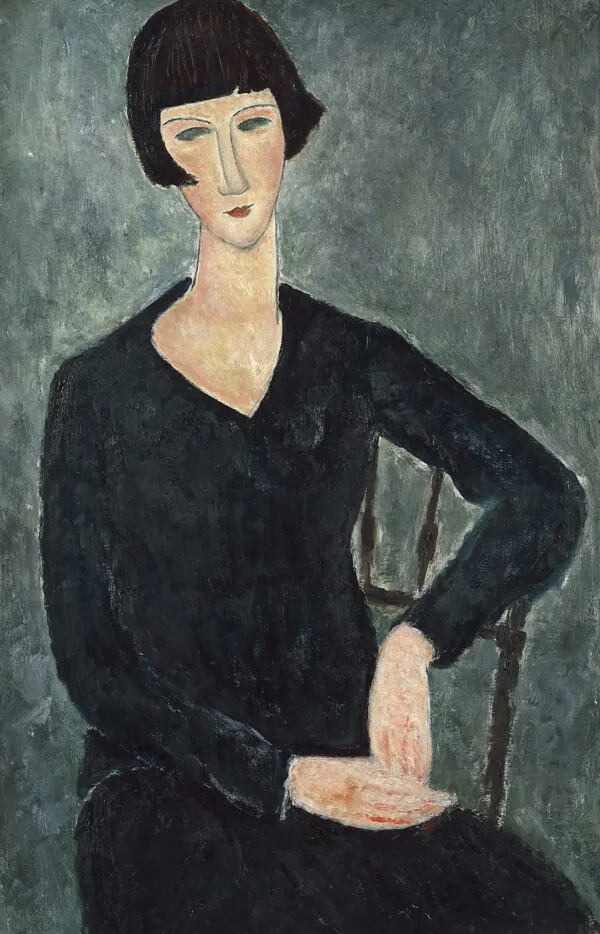
Head, neck and shoulders, square to the viewer. The hair is parted in the middle and falls in two long brown masses either side of the face. The face is narrowed to an oval mask, the nose long and straight, the mouth small and red, the eyes dark almond shapes set wide apart. The neck is markedly slender and elongated. The ground is grey-blue; a darker band closes it at the left, and a light brown stripe runs down at the right. That is exactly how the work is described in the 1939 auction catalogue: a slender girl’s head on a slender neck, brown parted hair, a grey-blue ground, a light brown stripe at the right. The signature is at the upper right. It is a post-impressionist painting in the sense in which post-impressionism meant building the face out of planes rather than describing light. In Paris Modigliani belonged to that circle of immigrant painters we now call the École de Paris.
Where is the original today?
In private hands, so there is no accession number of the present owner and we quote none. The route of this canvas is unusually well documented and unusually dark. From the hands of Léopold Zborowski, the painter’s dealer, it passed to the Netter collection, then to the Bernheim-Jeune gallery and in 1930 to Riccardo Gualino’s collection in Turin; in that same year it was shown at the Venice Biennale. Later it entered the Nationalgalerie in Berlin, at the Kronprinzenpalais, under accession number A II 799 — and it was there that the thing happened which makes this canvas historically interesting today.
What happened to this work in 1937?
On 30 October 1937 it was confiscated. The German inventory of confiscated works, maintained today by the Freie Universität Berlin, records it under number 15680, as oil on canvas, signed upper right, measuring 46 × 29 cm, with the museum of origin given as the Nationalgalerie Berlin (Kronprinzenpalais) and the inventory of origin as A II 799. The entry lists the title as a portrait of a lady. Modigliani was Jewish and a foreigner, and his art was at that time officially declared undesirable; thousands of works were removed from German museums in those years. This canvas was one of them. The confiscation record is publicly accessible and also gives the state of research.
The Lucerne auction of 30 June 1939
The confiscated works were not destroyed — they were sold for foreign currency. This canvas came up on 30 June 1939 at the Galerie Fischer in Lucerne as lot 98, in a sale titled “Paintings and sculptures by modern masters from German museums”. In the catalogue it stood as a portrait of a lady, measuring 47 × 30 cm, with the Nationalgalerie Berlin named as the consignor. That auction is today one of the best-known episodes in the history of the art trade: a museum selling works the state had taken out of its own collections. The work then disappeared into private hands, where it remains. Anyone who buys a reproduction of this portrait hangs on the wall a subject that survived exactly that.
Which measurement is right?
Frankly: the sources differ here more than for any other work on this page. The confiscation inventory gives 46 × 29 cm, and so do Ceroni and Parisot; the 1939 auction catalogue gives 47 × 30 cm; the catalogue entry itself gives 44.8 × 27.5 cm; Pfannstiel and Patani give 55 × 38 cm. The first three are close together and the last one stands out. We therefore print 46 × 29 cm in the table as the better-supported measurement, with Pfannstiel and Patani’s beside it. Our sizes derive from the older figure of 38 × 55 cm, and for that reason we advertise none of them as one-to-one with the original: for this work such a claim would be unfounded, because there is no single firm measurement to follow.
How is our hand-painted version made?
The work is made by an academy-trained painter in oil on cotton canvas, stretched over a wooden frame. It is not a print: every stroke is laid by hand, and your canvas always differs a little from our reference. With this subject everything depends on the face, because there is almost nothing else in the scene. The painter begins with the grey-blue ground and the dark band at the left, because those two settle how light the face will look; only then comes the oval mask, and it has to sit in few strokes — corrected, the face loses its calm. The hair goes over the edge of the face last. When the paint is dry we photograph the work and send the photograph for approval.
Which size for which wall?
The original is small, so every size we offer enlarges it. The smallest, 38 × 55 cm, comes closest to the original impression and belongs in a hallway, on a narrow wall or between two doors. The medium ones, 50 × 70, 60 × 90 and 70 × 100 cm, work above a sideboard or beside a bed. The large ones, 80 × 120, 90 × 130, 100 × 150 and 120 × 170 cm, want a free wall and at least three metres of distance; at those sizes the head is larger than life and the work takes over the room. The format is upright and narrow, so it works where the wall is taller than wide. This is one of the quietest portraits in the group: nothing happens, nothing tries to force attention, and so it also works where you meet the picture only in passing.
Custom size, stretcher and frame
If your wall asks for a size that is not on the list, we will make it. Give us the height and width in centimetres; we check whether the proportion carries the original’s crop and tell you what changes at the edges — here it shows first at the right, where the light brown stripe runs, and at the left, where the darker band closes the ground; both hold the head in the centre and cannot be cut away without cost. You can choose whether it arrives stretched on a wooden frame, ready to hang, or rolled in a tube, which is cheaper to ship. You pick the frame in our 3D application, which shows it realistically on the work, and on request we set the work into a photograph of your wall. If you are looking for a work we do not carry, see our made-to-order paintings.
Delivery and guarantee
We deliver to your address, the canvas held clear of the outer wall of the packaging. Lead time depends on size and the workshop’s load: we estimate it when you order and tell you if it changes. We guarantee workmanship and materials: if the work arrives damaged or does not match the photograph you approved, we repaint it at our own cost. Because you see it in a photograph before it ships, most questions are settled before it leaves.
Frequently asked questions
Where is the original?
In a private collection. That is also how the German confiscation inventory records it.
Why are there two measurements in the table?
Because the sources differ. The confiscation inventory, Ceroni and Parisot give 46 × 29 cm, Pfannstiel and Patani 55 × 38 cm, and the 1939 auction catalogue gives 47 × 30 cm.
Does any of your sizes match the original?
No, and we do not claim so. Since there is no single firm measurement of the original, we advertise no size as one-to-one.
Why was the work confiscated?
Because in 1937 it was classified in Germany as undesirable art. It was removed from the Nationalgalerie in Berlin on 30 October 1937.
What happened after the confiscation?
In 1939 it was auctioned in Lucerne as lot 98 and passed into private hands.
Which size should I choose?
For a narrow hallway wall 38 × 55 cm, above a sideboard 60 × 90 cm, for a large wall 100 × 150 cm.
How high should it hang?
With its centre about 145 cm above the floor. With a narrow upright format it pays to hang it a little lower than feels right.
Which other portraits of Jeanne Hébuterne do you have?
See Portrait of Jeanne Hébuterne I, Portrait of Jeanne Hébuterne IV, Portrait of Jeanne Hébuterne V and Portrait of Jeanne Hébuterne VI, and among the other sitters Portrait of Lunia Czechowska. The full choice is in the Amedeo Modigliani gallery, and we have written a longer article about the painter.
How closely does it follow the original’s proportions?
The original measures 29 × 46 cm. The closest of our sizes is 60 x 90 cm, which departs from the original’s proportions by 5.75%. The catalogues do not agree on the size and give 29 × 46 cm; 38 × 55 cm; the comparison above starts from the first of them.
- Subject: head, neck and shoulders square to the viewer, brown parted hair, a grey-blue ground and a light brown stripe at the right
- Original: 46 × 29 cm per the confiscation inventory (Pfannstiel and Patani 55 × 38 cm), oil on canvas, 1918, private collection
- Our version: hand-painted oil on canvas, eight sizes from 38 × 55 to 120 × 170 cm; none advertised as one-to-one
- Worth knowing: the work was confiscated from the Nationalgalerie in Berlin on 30 October 1937 and auctioned in Lucerne in 1939
The eyes on this canvas do have pupils. Of the 76 Modigliani works on this shelf 17 are like that, and 53 have no pupils – work by work.