



Description
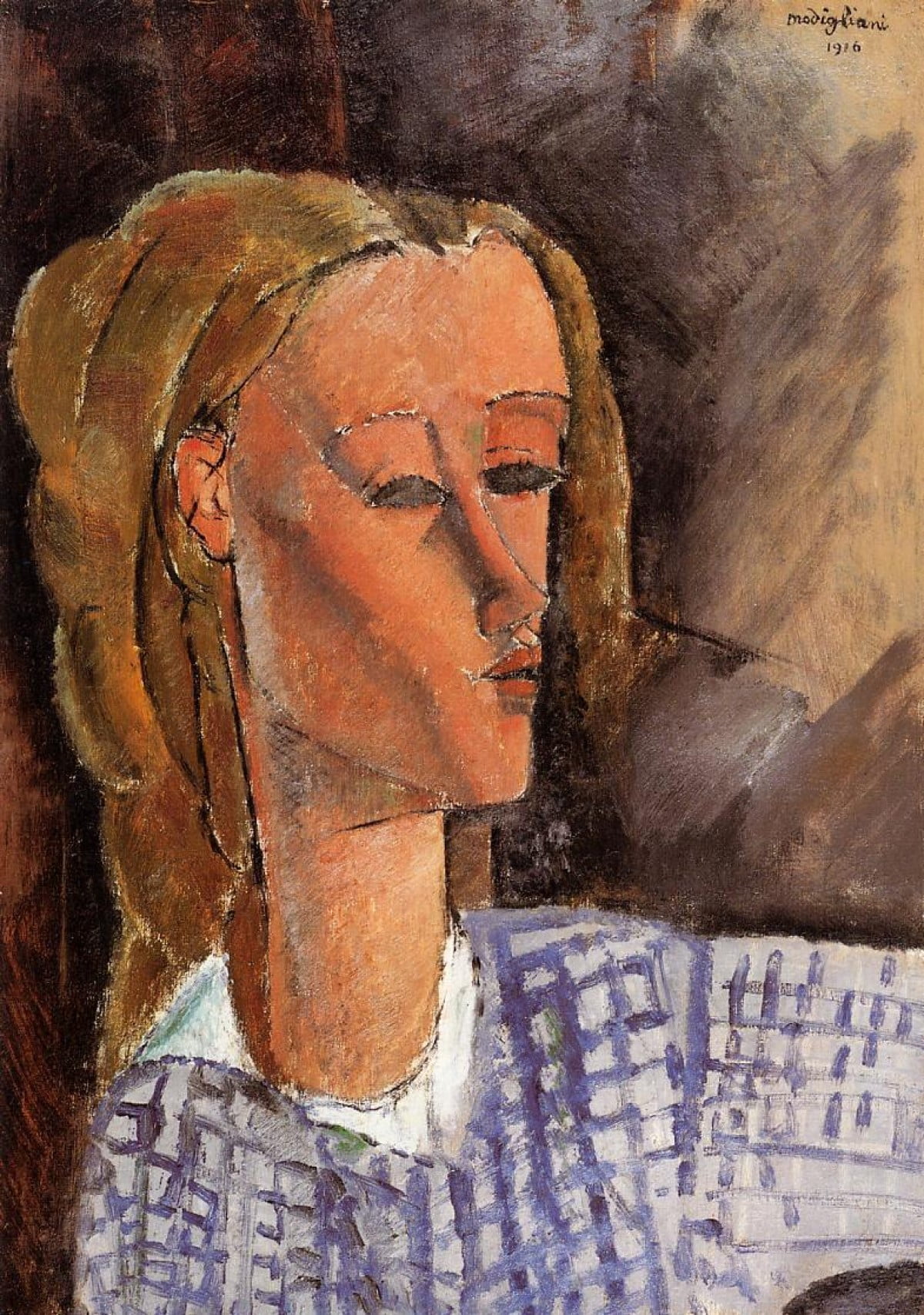
Portrait of Beatrice Hastings is an oil on canvas painted by Amedeo Modigliani in 1916; the catalogue gives the measurements 63 × 46 cm, and the work is signed upper right and dated there with the year 1916. The original is in private hands. Our canvas painting is a hand-painted copy of that work: an academy-trained painter makes it in oil on cotton canvas, in eight sizes from 40 × 60 cm to 120 × 170 cm or in the size you specify, and before dispatch we photograph it and send you the photograph for approval.
| Title: | Portrait of Beatrice Hastings |
| Other titles: | Beatrice Hastings in checkered shirt · La robe à carreaux |
| Painter: | Amedeo Modigliani (1884–1920) |
| Year: | 1916, dated on the canvas |
| Original size (height × width): | 63 × 46 cm (Pfannstiel 64 × 46, Ceroni and Parisot 65 × 46) |
| Original technique: | Oil on canvas, signed and dated upper right |
| Painting style: | Modern art, École de Paris |
| Where it is: | Private collection – catalogue entry; last at Christie’s New York, 14 May 2015 |
| Our reproduction: | hand-painted oil on canvas, eight sizes from 40 × 60 cm to 120 × 170 cm, custom size on request |
Portrait of Beatrice Hastings – Amedeo Modigliani
Who was Beatrice Hastings?
An English writer, journalist, poet and art critic who was the painter’s companion in Paris’s Montparnasse. She was not merely a model: she was an established journalist who wrote for the London weekly The New Age under a pen name, and one of the few of Modigliani’s sitters who left her own written account of those Paris years. This work is therefore not the portrait of a nameless beauty but of a writer who was the painter’s intellectual equal — and it shows in the pose: the chin slightly raised, the shoulders level, the look not inviting but held back. She was with him for about two years, and in that time he painted her several times.
What is on the canvas?
Modigliani painted her to the waist, turned slightly to the right, with the long, markedly stretched neck and the oval face that became his signature. Her hair is worn loose and falls freely beside the face in warm, reddish-gold tones. She wears a blouse with a blue-violet checked pattern and a white collar, which in the lower half of the canvas works almost as a rhythmic ornament in its own right — and it is from that blouse that the work also carries the catalogue titles Beatrice Hastings in checkered shirt and La robe à carreaux, the checked dress. The ground is dark reddish brown and without narrative: nothing draws the eye away from the head and shoulders. The eyes are painted without pupils, as in most of his portraits, so the look is at once absent and very present. At the upper right stand the painter’s signature and the year 1916.
Why did we not give the measurements before?
Because we could not verify them. The size field on this page was deliberately left empty, with a note that we would rather print nothing than an unverified figure. Now there is a source: the catalogue entry gives 63 × 46 cm, Pfannstiel 64 × 46, Ceroni and Parisot 65 × 46, Wayne 64.8 × 46. All four agree on the width and differ by at most two centimetres in height, so we now print the measurement — the catalogue’s figure in the table and the others beside it. It is a post-impressionist painting in the sense in which post-impressionism meant building the face out of planes rather than describing light. In Paris Modigliani belonged to that circle of immigrant painters we now call the École de Paris.
Where is the original today?
In private hands, so there is no accession number and we quote none. The recorded route is long and well documented: in 1918 the work was with the Paris dealer Paul Guillaume, until 1945 with a Mr Schubert in Grasse, in 1958 with the Galerie David Garnier in Paris and then with the Galerie Rosengart in Lucerne, where it stayed until at least 1981. Then came a private collection in Switzerland, Hester Diamond in New York in 1983, and the collection of John C. Whitehead in New York. From that collection it was sold on 14 May 2015 at Christie’s in New York, as lot 26 of sale 3736; the estimate was seven to ten million dollars and it made 16,069,000 dollars.
Are there other portraits of Beatrice Hastings?
Yes, several. Modigliani painted her more than once in those two years, and some of those portraits are in public collections today. One is in the Solomon R. Guggenheim Museum in New York under accession number 41.534 and is dated 1914, two years before ours. So if you find a portrait of Beatrice Hastings anywhere with a museum accession number, it is most likely not this canvas: ours is the one with the checked blouse, dated 1916, and it is in private hands.
How is our hand-painted version made?
The work is made by an academy-trained painter in oil on cotton canvas, stretched over a wooden frame. It is not a print: every stroke is laid by hand, and your canvas always differs a little from our reference. With this subject the blouse is the hard part. The checked pattern has to be painted so that a rhythm remains and no grid appears: if the lines are even and sharp the work stiffens, if they are too soft the pattern is lost. The painter therefore lays in the dark reddish ground and the face first, and the checks only at the end, once it is clear how much attention they may take. When the paint is dry we photograph the work and send the photograph for approval.
Which size for which wall?
The original is small, so every size we offer enlarges it; closest to the original’s proportion is 50 × 70 cm, but we advertise none of them as one-to-one, because the sources differ by two centimetres in height. The smallest, 40 × 60 cm, belongs in a hallway or on a narrow wall. The medium ones, 60 × 90, 70 × 100 and 80 × 120 cm, work above a sideboard or in a living room. The large ones, 90 × 130, 100 × 150 and 120 × 170 cm, want a free wall and at least three metres of distance; at those sizes the head is larger than life. A portrait of this kind works well in a living room or an office, on a quiet single-colour wall where the warm reddish ground has room enough.
Custom size, stretcher and frame
If your wall asks for a size that is not on the list, we will make it. Give us the height and width in centimetres; we check whether the proportion carries the original’s crop and tell you what changes at the edges — here it shows first at the bottom, where the checked blouse spreads across the full width of the canvas and carries the lower half of the scene. You can choose whether it arrives stretched on a wooden frame, ready to hang, or rolled in a tube, which is cheaper to ship. You pick the frame in our 3D application, which shows it realistically on the work, and on request we set the work into a photograph of your wall. If you are looking for a work we do not carry, see our made-to-order paintings.
Delivery and guarantee
We deliver to your address, the canvas held clear of the outer wall of the packaging. Lead time depends on size and the workshop’s load: we estimate it when you order and tell you if it changes. We guarantee workmanship and materials: if the work arrives damaged or does not match the photograph you approved, we repaint it at our own cost. Because you see it in a photograph before it ships, most questions are settled before it leaves.
Frequently asked questions
Where is the original?
In a private collection. It was last sold at Christie’s in New York on 14 May 2015.
What did the work make at auction?
16,069,000 dollars, against an estimate of seven to ten million.
Why are there several measurements in the table?
Because the sources differ by two centimetres in height: 63, 64, 64.8 or 65 centimetres, while the width is 46 cm everywhere.
Is this the same portrait as the Guggenheim’s?
No. The Guggenheim’s is dated 1914; ours is from 1916 and has the checked blouse.
Which size should I choose?
Closest to the original is 50 × 70 cm. For a large wall 100 × 150 cm, for a hallway 40 × 60 cm.
Is the original still for sale?
We do not know. Since the 2015 auction it has been in private hands and we put no value on it.
How high should it hang?
With its centre about 145 cm above the floor. With an upright format it pays to hang it a little lower than feels right.
Which other portraits from Modigliani’s circle do you have?
See Portrait of Lunia Czechowska, Portrait of Chaïm Soutine, Portrait of a Polish Woman and Jacques and Berthe Lipchitz. The full choice is in the Amedeo Modigliani gallery, and we have written a longer article about the painter.
How closely does it follow the original’s proportions?
The original measures 46 × 63 cm. The closest of our sizes is 50 x 70 cm, which departs from the original’s proportions by 2.17%. The catalogues do not agree on the size and give 46 × 63 cm; 46 × 64 cm; 46 × 65 cm; the comparison above starts from the first of them.
- Subject: Beatrice Hastings to the waist, loose reddish-gold hair, a blouse with a blue-violet checked pattern
- Original: 63 × 46 cm, oil on canvas, signed and dated 1916, private collection
- Our version: hand-painted oil on canvas, eight sizes from 40 × 60 to 120 × 170 cm; none advertised as one-to-one
- Worth knowing: on 14 May 2015 the work made 16,069,000 dollars at Christie’s in New York
The eyes on this canvas are painted without pupils. We counted all 76 Modigliani works on this shelf: 53 are like that, 17 are not – work by work.