







































Description
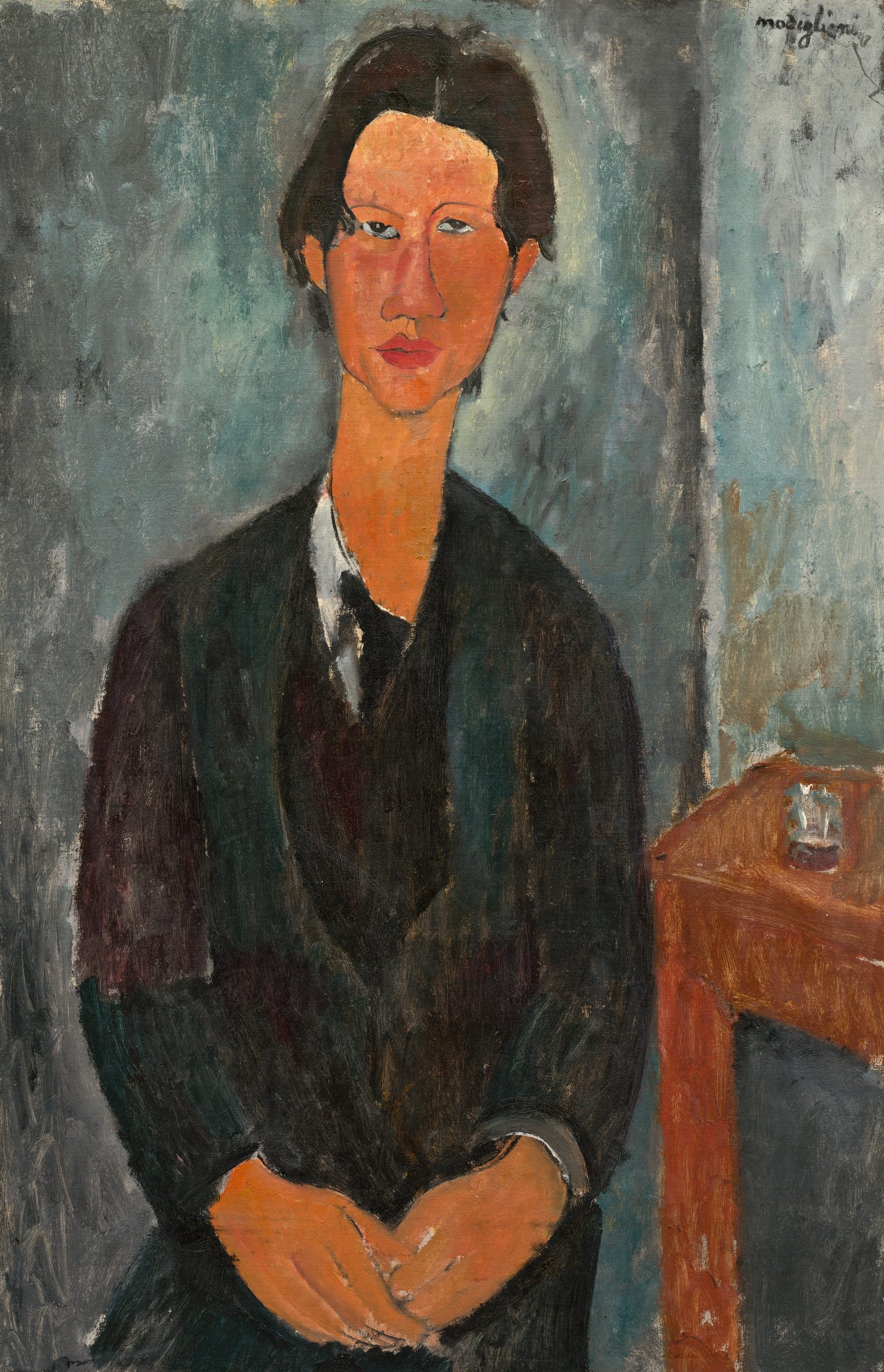
Portrait of Chaïm Soutine is an oil on canvas by Amedeo Modigliani; the original measures 91.7 × 59.7 cm, is signed upper right and hangs in the National Gallery of Art in Washington under accession number 1963.10.47. Our canvas painting is a hand-painted copy of that work: an academy-trained painter makes it in oil on cotton canvas, in eight sizes from 40 × 60 cm to 120 × 180 cm or in the size you specify, and before dispatch we photograph it and send you the photograph for approval.
| Title: | Portrait of Chaïm Soutine |
| Other titles: | Chaim Soutine (at the museum) · Soutine Seated · Soutine at a Table |
| Painter: | Amedeo Modigliani (1884–1920) |
| Year: | 1918 as the museum dates it; the catalogue literature gives 1917 |
| Original size (height × width): | 91.7 × 59.7 cm, portrait format |
| Original technique: | Oil on canvas, signed upper right |
| Painting style: | Modern art, École de Paris |
| Where it is: | National Gallery of Art, Washington, acc. 1963.10.47, Chester Dale Collection – museum record |
| Our reproduction: | hand-painted oil on canvas, eight sizes from 40 × 60 cm to 120 × 180 cm; one of them, 60 × 92 cm, is the original’s measurement to within three millimetres |
Portrait of Chaïm Soutine – Amedeo Modigliani
What is on the canvas?
The canvas stands upright and the sitter is shown to about mid-thigh. Soutine faces us squarely. The hair is dark and heavy, parted in the middle and falling over the ears; the face is long and strongly orange-red against everything around it, with a long straight nose and a small dark red mouth. The eyes are narrow and pale blue-grey, the irises visible, and one sits a little higher than the other — the museum’s own note makes a point of it. He wears a dark jacket over a dark V-neck, with a white shirt collar and a black tie. The hands are clasped in his lap at the bottom of the canvas, and a light cuff shows at one wrist. At his left stands a warm orange-brown wooden table, its corner and one leg in view, carrying a single small glass vessel — the only object in the work. The ground is blue-grey and green-grey, brushed restlessly and divided by a vertical seam, with a warmer ochre patch beyond the table. It is a post-impressionist painting in the sense in which post-impressionism meant building a person out of contour and colour rather than out of the light in a room. In Paris Modigliani belonged to that circle of immigrant painters we now call the École de Paris.
Where is the original today?
In the National Gallery of Art in Washington, accession number 1963.10.47, in the Chester Dale Collection, and normally on view. The museum’s record gives oil on canvas and 91.7 × 59.7 cm, or 36 1/8 × 23 1/2 inches. At the museum the work is called simply Chaim Soutine; the catalogue literature also lists it as Soutine Seated and Soutine at a Table. We carry the fuller form because on a shelf of thirty-odd portraits a bare surname does not say what the picture is.
Which year was it painted?
Three years are in print and we will not pretend otherwise. The National Gallery dates the canvas 1918. The catalogue literature on Modigliani places it in 1917, and some scholars have argued for 1916. Nothing in the picture settles it: Soutine sat for Modigliani repeatedly across those years, in the same dark jacket, in rooms that were rarely described. We give the museum’s date in the table because the museum holds the object, and we give the other two here because a reader who checks a second source should not think we got it wrong. A fuller record, with the alternative dating and the ownership history, is in the catalogue entry.
A friend, not a commission
Chaïm Soutine reached Paris in 1913 from what is now Belarus, and lived very poorly there among other immigrant artists — Chagall, Lipchitz, Kisling. He and Modigliani were close, and Modigliani painted him several times, not to order but because he wanted to. The difference shows. A commissioned portrait settles a face and flatters it; this one leaves it as it was, heavy, unequal, and alive, with the hands doing what hands actually do when nobody has told them where to go. Modigliani died in January 1920, within two years of this canvas. Soutine outlived him by more than twenty years and became, in that time, one of the most violent colourists in Europe.
From Zborowski to Chester Dale
The recorded owners begin with Léopold Zborowski in Paris, the dealer who supported both men. The canvas then passed through the Netter collection, sold in 1928, and through the dealers Étienne Bignou and Alex Reid & Lefèvre in 1929, in which year it entered the collection of the American financier Chester Dale. It stayed with Dale for thirty-four years and came to the National Gallery with his bequest in 1963, part of the gift that gave Washington one of the largest holdings of French modernism in the United States. It has been shown in London and New York in 1929, in Brussels in 1933, in New York and Cleveland in 1951, and in Washington in 1965, in 1983 and again between 2010 and 2012.
How is our hand-painted version made?
The work is made by an academy-trained painter in oil on cotton canvas over a wooden frame. It is not a print: every stroke is laid by hand, and your canvas always differs a little from any other. The hard part here is the head. That orange-red is not a skin colour anywhere else in painting, and it only works because the blue-grey around it is cool and slightly dirty; mix the ground too clean or too bright and the face turns into a mask. The painter therefore lays the ground first and brings the head up against it. The second difficulty is the hands: they are small, badly lit and easy to tidy, and tidying them removes the whole point of the picture.
Which size for which wall?
The original is 91.7 cm high and 59.7 cm wide. Our 60 × 92 cm is the same canvas to within three millimetres in each direction, so if you want it at the size Modigliani painted it, that is the rung. The smaller sizes, 40 × 60 and 50 × 80 cm, suit a hall, a stairwell or a narrow strip of wall between doors. Above a sideboard or a desk, 70 × 110 or 80 × 120 cm reads well. The large sizes, 90 × 140, 100 × 150 and 120 × 180 cm, want a free wall and about three metres of distance; at that scale the head is larger than life and the picture stops being a portrait on a wall and becomes company in the room. The colouring is cool with one hot centre, so it sits well on a white or pale grey wall and fights a warm one.
Custom size, stretcher and frame
If your wall asks for a size that is not listed, we will make it. Give us the width and height in centimetres; we check whether the proportion carries the composition and tell you what changes at the edges. Here it shows first at the right, where the table stands, and at the bottom, where the clasped hands sit close to the edge; a wider format opens empty ground beside the figure, and a squarer one crops the table away and takes the only object with it. It arrives either stretched on a wooden frame, ready to hang, or rolled in a tube, which is cheaper to ship. You pick the frame in our 3D application, which shows it realistically on the work, and on request we set it into a photograph of your wall. If you are looking for a work we do not carry, see our made-to-order paintings.
Delivery and guarantee
We deliver to your address, the canvas clear of the outer wall of the packaging. Lead time depends on size and the workshop load: we estimate it when you order and tell you if it changes. We guarantee workmanship and materials: if the work arrives damaged or does not match the photograph you approved, we repaint it at our cost. Because you see it photographed before it ships, most questions are settled before it leaves.
Frequently asked questions
Where is the original?
In the National Gallery of Art in Washington.
What is the accession number?
1963.10.47, in the Chester Dale Collection.
What is the work called at the museum?
Simply Chaim Soutine. It is also listed as Soutine Seated and Soutine at a Table.
When was it painted?
The museum dates it 1918; the catalogue literature says 1917 and some scholars 1916.
Do you have the original’s size?
Effectively yes. The original is 91.7 × 59.7 cm and our 60 × 92 cm rung differs by three millimetres in each direction.
Which size should I choose?
For a living room wall, 80 × 120 cm. For a hall or a narrow wall, 50 × 80 cm.
How high should it hang?
With its centre about 145 cm above the floor. A tall format wants a little more wall above than below.
Which other Modigliani portraits of artists do you have?
See Jacques and Berthe Lipchitz, Portrait of Juan Gris, Portrait of Max Jacob, Portrait of Moïse Kisling and Jean Cocteau. The full choice is in the Amedeo Modigliani gallery, and we have written a longer article about the painter.
How closely does it follow the original’s proportions?
The original measures 59.7 × 91.7 cm, and that is exactly the size we list: 60 x 92 cm. The proportions are the original’s, with no deviation.
- Subject: the painter Chaïm Soutine seated facing the viewer, hands clasped in his lap, a wooden table with one small glass vessel at his left
- Original: 91.7 × 59.7 cm, oil on canvas, National Gallery of Art, Washington (acc. 1963.10.47, Chester Dale Collection)
- Our version: hand-painted oil on canvas, eight sizes from 40 × 60 to 120 × 180 cm, one of them the original’s measurement to within three millimetres
- Worth knowing: the sitter was a friend, not a client, and three different years are in print for the canvas — 1916, 1917 and the museum’s 1918
The eyes on this canvas do have pupils. Of the 76 Modigliani works on this shelf 17 are like that, and 53 have no pupils – work by work.