


Description
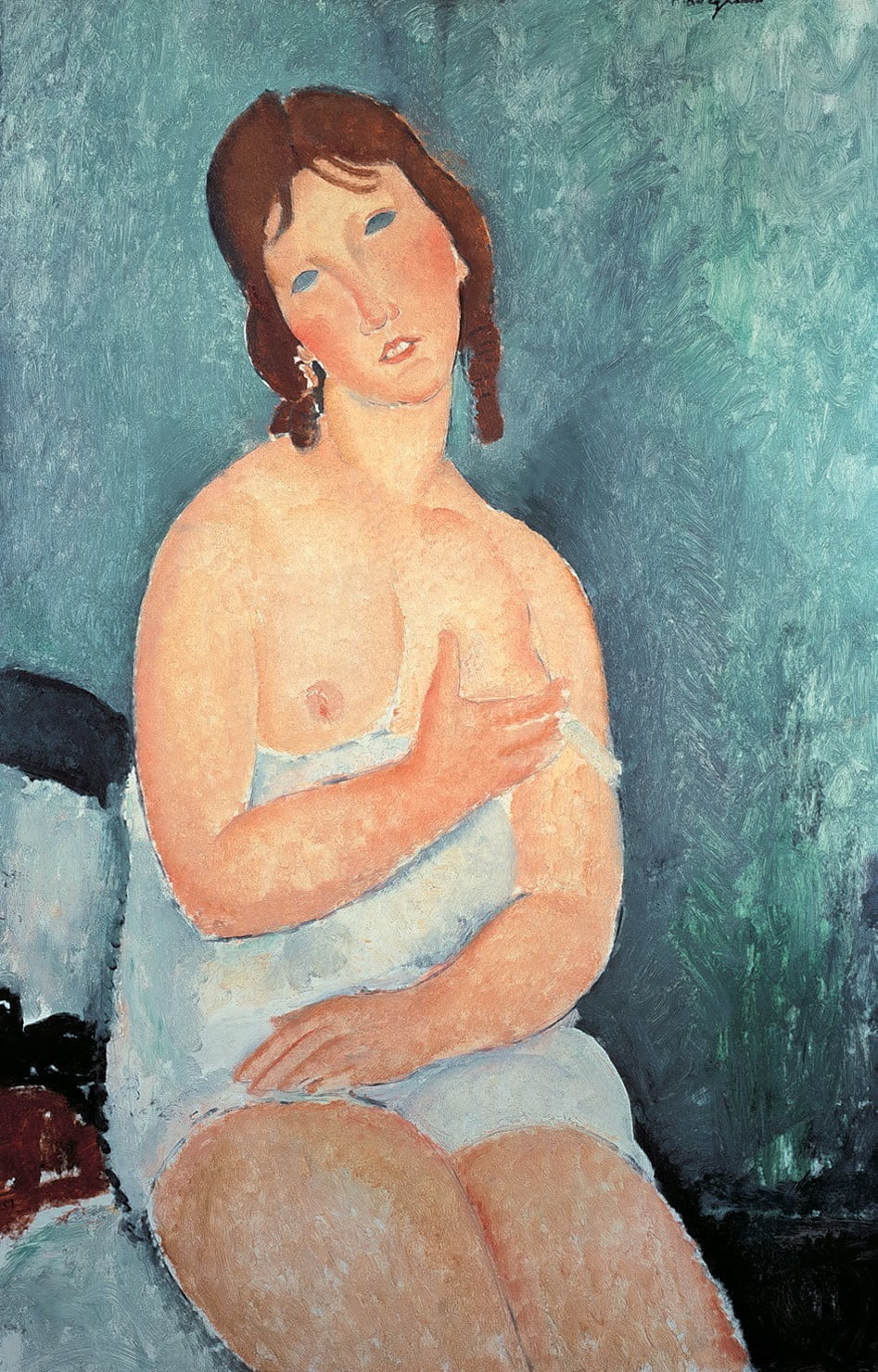
Red-haired Young Woman in a Shirt is an oil on canvas painted by Amedeo Modigliani in 1918; the original is 100 cm tall and 65.3 cm wide and hangs in Vienna at the Albertina, in the Batliner Collection, under accession number GE85DL. Our canvas painting is a hand-painted copy of that work: an academy-trained painter makes it in oil on cotton canvas, in eight sizes from 40 × 60 cm to 120 × 180 cm or in the size you specify, and before dispatch we photograph it and send you the photograph for approval.
| Title: | Red-haired Young Woman in a Shirt |
| Other titles: | Weiblicher Halbakt · Young Woman in a Shirt · La petite laitière |
| Painter: | Amedeo Modigliani (1884–1920) |
| Year: | 1918 |
| Original size (height × width): | 100 × 65.3 cm (per the museum’s record; canvas depth 2 cm) |
| Original technique: | Oil on canvas, signed upper right |
| Painting style: | Modern art, École de Paris |
| Where it is: | Albertina, Vienna – Batliner Collection, museum record (acc. GE85DL) |
| Our reproduction: | hand-painted oil on canvas, eight sizes from 40 × 60 cm to 120 × 180 cm, custom size on request |
Red-haired Young Woman in a Shirt – Amedeo Modigliani
What is on the canvas?
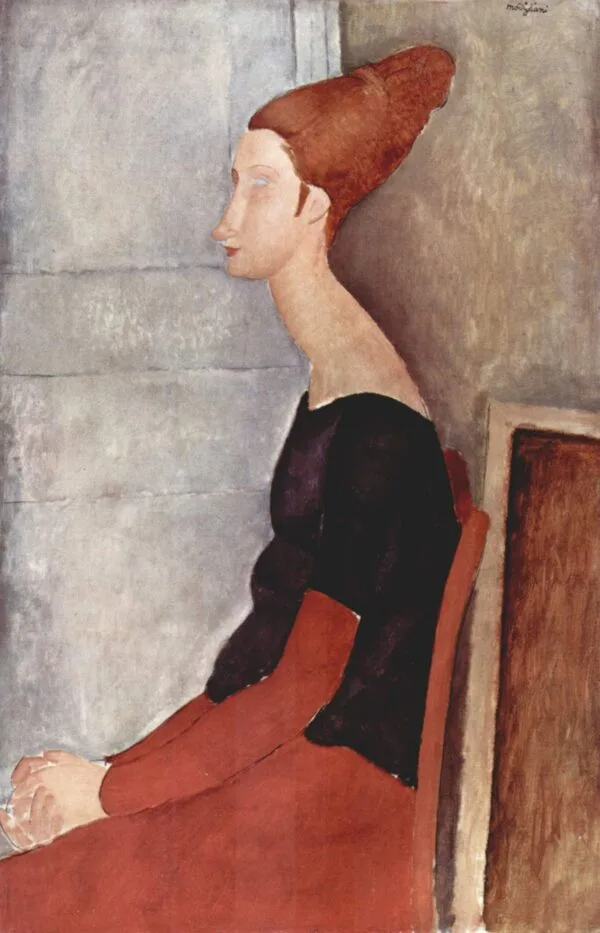
A woman sits square to us, leaning a little, her head slightly lowered. The hair is chestnut red, parted in the middle and rolled into two short coils beside the ears — a hairstyle Modigliani repeats in several portraits of that year. The face is pale and pink, with blue-grey eyes without pupils and a small, slightly open mouth. The white shirt has slipped to the waist, leaving the upper body and one breast bare; the right arm lies across the body holding the fabric, the left rests in her lap. The bare knees show at the bottom. The body is painted softly, without hard outlines, in pale peach and cream tones that barely separate from the white shirt. The ground is blue-green and densely painted in short strokes; a dark plane stands at the left edge, and a red form appears at the lower left. It is that cool blue-green wall which gives the body its warmth. The painter’s signature is at the upper right.
Where is the original today?
In the Albertina in Vienna, as part of the Batliner Collection, under accession number GE85DL; the museum records the work under the German title Weiblicher Halbakt, female half-nude. The recorded route is long: from the hands of Léopold Zborowski, the painter’s dealer, the canvas went to the Bing gallery in Paris, then to Dr Sabouraud’s collection in Paris and to René Gaffé’s in Brussels, where it was from about 1927 to 1933. Then came Paul Rosenberg & Co. in New York until 1954, the Friedland collection in Merion, and the Batliner collection in Vaduz, from which the work reached Vienna. The fuller list is in the catalogue entry.
Which measurement is right?
A fair question, because the sources differ: the catalogue entry gives 102 × 63 cm and attributes that figure to the Albertina, while Ceroni, Patani, Parisot and Restellini give 100 × 65 cm. We checked with the owner: the museum’s record gives 100 × 65.3 × 2 cm — a hundred centimetres of height, a little over sixty-five of width and two centimetres of depth; with its frame the work measures 118.5 × 83 cm. The figure the catalogue attributes to the museum therefore does not match the museum’s own record, and we follow the museum, because that is where the object itself was measured. We also give the measurements in words, because the order of two numbers is easily misread.
Why was Modigliani painting local people in 1918?
Because he was not in Paris then. The war and his poor health had taken him to the south of France, and instead of the poets and dealers of Montparnasse he painted mostly whoever was to hand: young girls, servants, farm boys. This canvas belongs to the same group of works as The Little Peasant. Both show the same decision: no name, no profession, no story — the title gives only a hair colour and a piece of clothing. It is a post-impressionist painting in the sense in which post-impressionism meant building the body out of planes rather than describing light. In Paris Modigliani belonged to that circle of immigrant painters we now call the École de Paris.
What is technically unusual about this work?
How little black there is in it. The contour of the body is drawn with a warm brown and a greyish blue, never with a line that would cut the figure away from the ground; so body and ground touch rather than exclude one another. The second thing is the relation of two whites: the white shirt and the pale skin are so close in lightness that only the cooler tone of the cloth separates them. Anyone reproducing this work has to get both whites at once — too white a shirt and the body goes grey, too warm and the shirt disappears. And third: the blue-green ground is not a plane but a dense mesh of short strokes, which cannot be smoothed out without loss.
How is our hand-painted version made?
The work is made by an academy-trained painter in oil on cotton canvas, stretched over a wooden frame. It is not a print: every stroke is laid by hand, and your canvas always differs a little from our reference. The painter begins with the blue-green ground, because that settles how warm the skin will look, and builds it in short strokes over several passes. Only then comes the body, from light towards darker, with no outline. The shirt goes on last, once it is clear how much light the body has already taken. When the paint is dry we photograph the work and send the photograph for approval.
Which size for which wall?
For most homes the right choice is 65 × 100 cm — that size is practically the original’s, which is 65.3 cm wide, so you receive the original proportions. The smallest, 40 × 60 and 50 × 80 cm, belong in a hallway or on a narrow wall between two doors. The medium ones, 70 × 110 and 80 × 120 cm, work above a sideboard or a sofa. The large ones, 90 × 140, 100 × 150 and 120 × 180 cm, want a free wall and at least three metres of distance; at those sizes the figure is larger than life. The format is upright and works where the wall is taller than wide. The cool blue-green ground sits well with light furniture and white walls, so the work does well in a bedroom or a quiet corner of a living room.
Custom size, stretcher and frame
If your wall asks for a size that is not on the list, we will make it. Give us the height and width in centimetres; we check whether the proportion carries the original’s crop and tell you what changes at the edges — here it shows first at the bottom, where the knees are, and at the left, where the dark plane and the red form stand; both hold the figure in its space. You can choose whether it arrives stretched on a wooden frame, ready to hang, or rolled in a tube, which is cheaper to ship. You pick the frame in our 3D application, which shows it realistically on the work, and on request we set the work into a photograph of your wall. If you are looking for a work we do not carry, see our made-to-order paintings.
Delivery and guarantee
We deliver to your address, the canvas held clear of the outer wall of the packaging. Lead time depends on size and the workshop’s load: we estimate it when you order and tell you if it changes. We guarantee workmanship and materials: if the work arrives damaged or does not match the photograph you approved, we repaint it at our own cost. Because you see it in a photograph before it ships, most questions are settled before it leaves.
Frequently asked questions
Where is the original?
In the Albertina in Vienna, in the Batliner Collection, accession number GE85DL.
What is the work called at the museum?
The museum records it under the German title Weiblicher Halbakt, female half-nude.
Why are the measurements written out in words?
Because the order of two numbers is easily misread. The canvas is 100 cm tall and 65.3 cm wide.
Why does 102 × 63 cm appear elsewhere?
That figure stands in a catalogue which attributes it to the museum; the museum’s own record gives 100 × 65.3 cm, and we follow that.
Which size should I choose?
If you cannot decide, take 65 × 100 cm, the size of the original. For a narrow hallway wall 40 × 60 cm, for a large wall 120 × 180 cm.
Is the original for sale?
No. It belongs to a public museum collection, it is not on the market, and so we put no value on it.
How high should it hang?
With its centre about 145 cm above the floor. With an upright format it pays to hang it a little lower than feels right.
Which other works from this period do you have?
See Seated Woman in a Blue Dress, Portrait of Jeanne Hébuterne I, Red Nude and Nude Sitting on a Divan. The full choice is in the Amedeo Modigliani gallery, and we have written a longer article about the painter.
How closely does it follow the original’s proportions?
The original measures 65.3 × 100 cm, and that is exactly the size we list: 65 x 100 cm. The proportions are the original’s, with no deviation.
- Subject: a seated young woman with chestnut-red hair, the white shirt slipped to the waist, one arm across the body, against a blue-green wall
- Original: 100 × 65.3 cm, oil on canvas, 1918, Albertina, Vienna, Batliner Collection (acc. GE85DL)
- Our version: hand-painted oil on canvas, eight sizes from 40 × 60 to 120 × 180 cm; the 65 × 100 cm size is practically the original’s
- Worth knowing: there is almost no black in the whole work — the contour is drawn with warm brown and greyish blue
The eyes on this canvas are painted without pupils. We counted all 76 Modigliani works on this shelf: 53 are like that, 17 are not – work by work.