







































Description
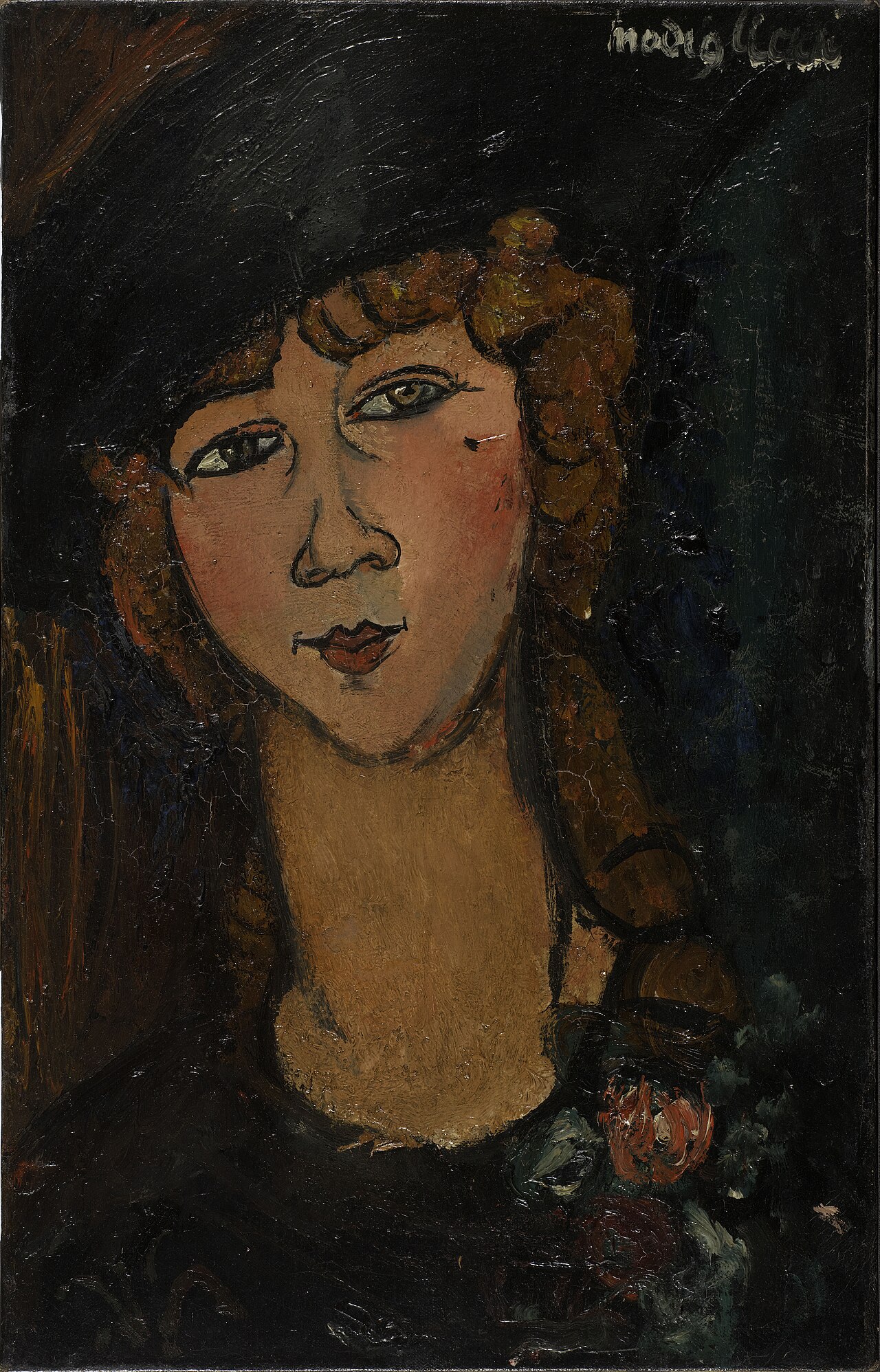
Lolotte is a small canvas of June 1917, owned by the French state and hung at the Musée d’art et d’histoire du Judaïsme in Paris. A woman in a wide black hat is seen close to, her hair in heavy red-brown curls, a spray of flowers at her shoulder. With us it is made as a hand-painted copy, oil on canvas, to order, in eight sizes or in a size you give us; before dispatch we send you a photograph of the finished canvas.
| Title: | Lolotte |
| Other titles: | Lolotte is the only title the museum gives; the catalogues also list it as a woman in a hat |
| Painter: | Amedeo Modigliani (1884–1920) |
| Year of creation: | June 1917 — the Centre Pompidou’s dating; the museum page shows only 1917 |
| Original size (width × height): | 35.5 × 55 cm, the canvas; the museum measures the framed object, 49.3 × 69 × 7.5 cm |
| Original technique: | oil on canvas |
| Painting style: | expressionism, École de Paris |
| Located: | Musée d’art et d’histoire du Judaïsme, Paris (deposit D.98.09.012.MNAM from the Musée national d’art moderne, Centre Pompidou, inv. JP 558 P) |
| Our reproduction: | hand-painted copy, oil on canvas, eight sizes or a custom size |
Lolotte – Amedeo Modigliani
What is on the canvas?
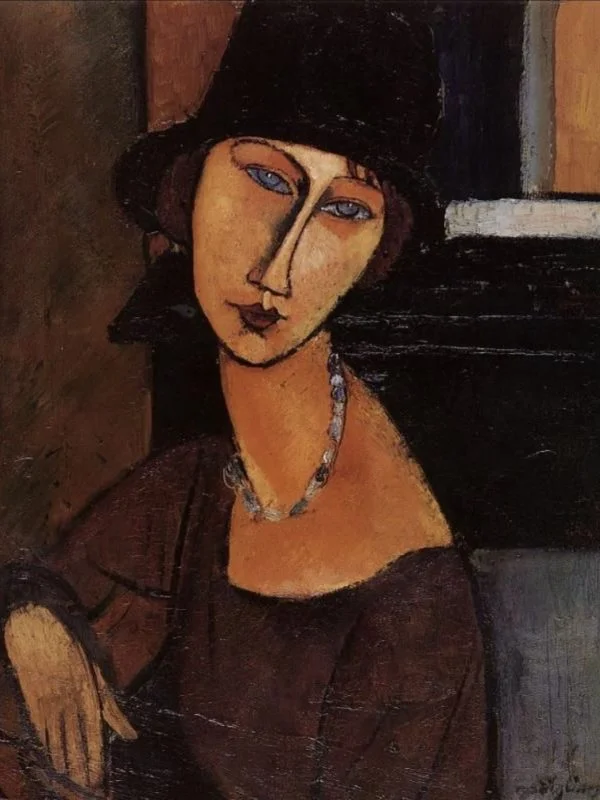
The head and shoulders fill the picture, seen close to and frontally, the head tipped a little to her right. A wide black hat sits low and takes up the top third, its brim sweeping out to the left. Red-brown hair escapes beneath it in thick curls at both sides and falls past the shoulder on the right. The face is broad and rounded rather than the long mask of the later portraits, in pink and ochre with strong pink on the cheeks. The eyes are outlined in hard black and are not a matching pair — the left is narrower — and they carry irises and pupils. The nose is drawn with a firm dark contour, the mouth small and dark red. A long ochre neck opens into a broad V, and at the lower right a spray of red and blue-green flowers sits at the shoulder. The ground is nearly black, with brown and blue-green passages and a warmer brown strip down the left edge. The signature stands at the upper right in white; the catalogue file records it there in that colour, and adds that the name LOLOTTE is inscribed on the back. The whole surface carries heavy craquelure.
Why do two records give two different sizes?
Because they are not measuring the same object. The museum’s record gives three figures — 69 cm high, 49.3 cm wide, 7.5 cm deep — and a depth of seven and a half centimetres is not a stretched canvas; that is the framed picture, measured as it hangs. Wikidata and a published catalogue file both give 55 × 35.5 cm, and that is the painting. The photograph settles it: the published image is 960 by 1497 pixels, a shape of 0.641, which sits within 0.65 per cent of the canvas figures and about eleven per cent away from the framed ones. So we print 35.5 × 55 cm and say why, because a buyer ordering a reproduction wants the size of the painting, not the size of somebody’s frame. This is the sort of thing that makes a record look contradictory when it is only being precise about something else.
The record of the original, and who owns it
The original is oil on canvas. The ownership is layered and worth stating plainly: the picture is the property of the French state, it belongs to the Musée national d’art moderne at the Centre Pompidou under the number JP 558 P, and it is on deposit at the Musée d’art et d’histoire du Judaïsme, where it carries the deposit number D.98.09.012.MNAM. That is why two inventory numbers appear for one painting. On the date, the museum page prints 1917 alone; the catalogue file notes that the Centre Pompidou dates it to June 1917, and Wikidata carries the same month. We print the month and name whose it is. Painted within a year of it, and on this shelf, are The Painter Krémègne and Woman with Earrings. The whole selection is in the Amedeo Modigliani gallery, and we have written a longer article about the painter.
Where has the picture been?
The first name in the chain is one this shelf already knows: Léopold Zborowski, the Paris dealer who kept Modigliani working and who is himself painted in Portrait of Léopold Zborowski. Zborowski was the dealer of the École de Paris circle, and much of what survives of those painters passed through his hands first. After him the catalogue file lists Bernheim-Jeune in Paris, marking the year 1924 with a question mark of its own, and then the purchase that the museum’s record confirms in its own words: bought by the national museums for the Jeu de Paume in 1932. In 1998 it went on deposit to the Musée d’art et d’histoire du Judaïsme, where it hangs. The file calls its own research unfinished, so we do not call the chain complete — but the 1932 purchase is stated by the institution itself, and that is the firmest link in it.
How is our hand-painted version made?
A painter paints it, with a brush, in oil on canvas, to your order. Every canvas painting takes some weeks, and each copy comes out slightly its own; that is the consequence of a person working rather than a machine. This is a dark picture with one lit face in it, and the difficulty is the drawing rather than the colour: the eyes are outlined in hard black, deliberately unlike each other, and the temptation to even them up has to be resisted, because the tilt of the head depends on their being different. The hat must stay a flat black shape with a clean edge — it is a third of the surface and it holds the composition. The curls are painted as separate ochre coils, not as a mass, and the flowers at the shoulder are the only cool notes in the picture. Before dispatch you receive a photograph of the finished canvas and approve it. It is never a print.
Which size for which wall?
For this motif we suggest 70 × 110 cm. On proportions there is a clear winner for once, and we measured it: 90 × 140 cm sits 0.4 per cent from the canvas’s shape, while the next nearest, 70 × 110 cm, is 1.4 per cent off — three times further. The original is small, only 35.5 cm across, and the head is already close to the picture edge; enlarged, it becomes a face that meets you at eye level from across a room, which is why 90 × 140 cm holds a main wall so well. The dark ground means it does not need a bright room, but it does need light falling on it rather than beside it. A post-impressionist painting in a size that is not on the list is no trouble: we make it to order.
Frequently asked questions
Where is the original?
At the Musée d’art et d’histoire du Judaïsme in Paris, on deposit from the Musée national d’art moderne at the Centre Pompidou, which holds it under the number JP 558 P.
How large is the original?
The canvas is 35.5 × 55 cm. The museum’s record gives 49.3 × 69 × 7.5 cm, which is the framed picture measured as it hangs.
Why does the year say June 1917?
Because the Centre Pompidou dates it to that month. The museum page shows only the year, and we give the month with the source named.
How closely does it follow the original’s proportions?
The original measures 35.5 × 55 cm. The closest of our sizes is 90 x 140 cm, which departs from the original’s proportions by 0.4%.
- Subject: a woman in a wide black hat, close to and frontal, red-brown curls, a spray of flowers at the shoulder, a nearly black ground
- Original: 35.5 × 55 cm, oil on canvas, June 1917, Centre Pompidou inv. JP 558 P, hung at the Musée d’art et d’histoire du Judaïsme
- Ours: hand-painted oil on canvas, eight sizes or a custom size, with a photograph to approve before dispatch
- Worth knowing: the museum’s three measurements are of the framed object; the canvas is smaller, and the published photograph agrees with the canvas to within 0.65 per cent
The eyes on this canvas do have pupils. Of the 76 Modigliani works on this shelf 17 are like that, and 53 have no pupils – work by work.