







































Description
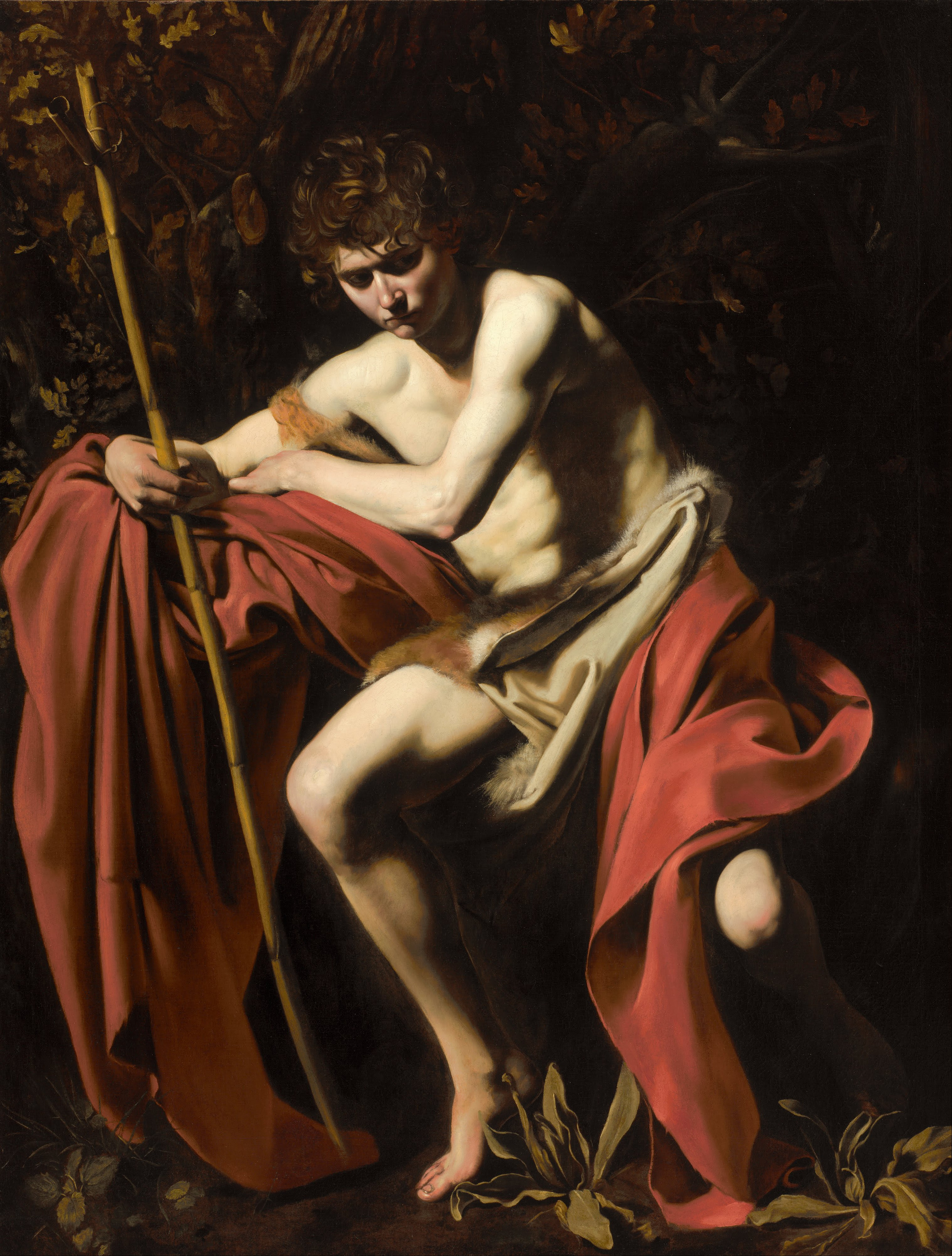
Saint John the Baptist in the Wilderness is a Caravaggio of 1604–1605: the young John, nearly nude, sits leaning forward in a dark wood, wrapped in a large red cloak and a pale, fur-edged cloth, while a thin reed staff topped by a cross rests against his shoulder. The original, oil on canvas, is 173 cm high and 132 cm wide and belongs to the Nelson-Atkins Museum of Art in Kansas City. When you order, our painter paints it by hand in oils on canvas, in one of 8 portrait sizes between 40 x 50 and 147 x 193 cm or made to measure, and before dispatch you receive a photograph of the finished painting.
| Title: | Saint John the Baptist in the Wilderness |
| Other titles: | San Giovanni Battista nel deserto · Johannes der Täufer in der Wüste |
| Painter: | Michelangelo Merisi da Caravaggio (1571–1610) |
| Year painted: | 1604–1605 |
| Original size: | 172.7 cm x 132.1 cm (height x width) |
| Original technique: | Oil on canvas |
| Painting style: | Baroque, tenebrism |
| Located at: | Nelson-Atkins Museum of Art, Kansas City, USA |
| Our reproduction: | Hand-painted oil on canvas, 8 sizes or made to measure |
Saint John the Baptist in the Wilderness – Caravaggio
What does Saint John the Baptist in the Wilderness show?
The tall canvas holds a single figure: the young John sits in a dark wood and leans forward, towards us. Apart from the wide red cloak and a pale cloth with a fur edge, wound round his hips, he is nude.
His right arm curls around a thin reed staff that rests against his shoulder and ends at the top in a simple cross. He bows his head of dark curls, his gaze slides down and to one side, and his eyes sink into shadow.
Light from the upper left catches his shoulder, chest, arm and bent knee, and the other knee gleams at lower right. The red cloak spreads in broad folds and burns in the gloom like a flame, while dry brown leaves hang in the murk behind him and broad-leaved plants grow by his bare foot.
Who was John the Baptist, and how can the scene be read?
The Gospels tell that John, a cousin of Jesus, was called to prepare the way for the Messiah. He lived in the wilderness of Judea in a garment of camel hair, ate locusts and wild honey, baptised Jesus in the Jordan and was later put to death by Herod Antipas.
Painters usually gave him a bowl, a reed cross, a camel skin and a lamb. The young Caravaggio instead painted him as a boy or youth alone in the wilderness, following the Gospel of Luke: the child grew, became strong in spirit and was in the deserts until the day he appeared before Israel.
In this painting almost every sign that would name the saint is missing. Peter Robb, a biographer of Caravaggio, notes there is no halo, no sheep and no leather girdle, only the thin reed cross, recalling the words in which Christ compared John to a reed shaken by the wind.
Why is this painting so admired?
Because Caravaggio’s tenebrist light appears here at its purest: sharp shifts between light and dark make the young man seem to lean out of the shadow into the viewer’s own space.
His mood is even more striking, and almost everyone who has written about the painting notes the brooding melancholy of this John. According to Wikipedia, part of that gravity comes from its purpose, as the centrepiece of a meeting room for a brotherhood that nursed the sick and dying and buried plague victims.
From Giotto to Bellini, painters had shown John as a story anyone could follow; Caravaggio made him a solitary seated figure with no action, shut inside a private world, which was entirely new for its time. All of Caravaggio’s Baptists are covered in the English-language Wikipedia article.
Where is the original, and who commissioned it?
The original hangs in the Nelson-Atkins Museum of Art in Kansas City, USA, under accession number 52-25, and measures 173 cm high by 132 cm wide.
It was commissioned in 1604 by the papal banker and collector Ottavio Costa as the altarpiece of a small oratory at Conscente, a village near Albenga on the Italian Riviera that belonged to his family.
Costa liked it so much that he sent a copy to the oratory and kept the original. It is not the same work as Saint John the Baptist in the Galleria Borghese in Rome, a later canvas in which a ram stands beside the youth.
Saint John the Baptist in the Wilderness or another Caravaggio?
This canvas painting is for anyone who loves silence, deep shadow and a single strong colour; the red cloak flares against the dark ground like a flame, even on a calm, plain wall.
A similar stillness fills Saint Francis in Meditation, where the kneeling saint gazes at a skull in his hands, and Saint Jerome Writing, where the bald Jerome in a red mantle reads beside a skull.
For a quiet inner turning, see Penitent Magdalene, a young woman sitting with bowed head in an empty room. From early works to late ones, the famous Caravaggio paintings we offer are gathered on the Caravaggio page.
How does our painter paint it?
We start only after you order, in oils on canvas and in several layers, beginning with a dark brown ground from which the wood later grows and a brush sketch of the figure, the staff and the cloak.
Then the body is built from shadow towards light, with the most paint on the shoulder, chest and knee. The red cloak grows from deep crimson in the folds to an almost orange red at the edges, and the fur is shaped with short, soft strokes.
This Caravaggio reproduction shows real brush marks when light falls across it from the side. On so dark a canvas that matters: as an oil painting reproduction it keeps depth in the shadows, where branches and leaves still stand apart.
Which size suits which wall?
In short: 40 x 50 or 45 x 60 cm beside a door or a bookcase, 58 x 75 or 73 x 94 cm above a chest of drawers or in a hallway, 80 x 108 or 100 x 135 cm above a sofa or a bed, and 113 x 155 or 147 x 193 cm for a high wall or a stairwell.
We paint it in 8 portrait sizes (width x height): 40 x 50, 45 x 60, 58 x 75, 73 x 94, 80 x 108, 100 x 135, 113 x 155 and 147 x 193 cm. The closest to the original is 113 x 155 cm, 19 cm narrower and 18 cm shorter; 147 x 193 cm is 15 cm wider and 20 cm taller.
Because the canvas is tall and dark, John comes into his own in the larger sizes, when the red cloak fills the wall. As a painting for the living room it is most convincing at 100 x 135 or 113 x 155 cm.
Can I order another size or a frame?
Yes. If none of the sizes fits, we adapt the composition so that the reed cross stays whole from top to ground and the red cloak keeps its edges. Tell us the size you need, and we will reply with a price and a lead time.
We send the painting rolled, on a stretcher bar or in a frame; our workshop in Slovenia does the stretching and framing. You pick the moulding in our 3D app, which exists only for choosing a frame; seeing the painting on your own wall is a separate service.
A sturdy dark wood moulding or a patinated gold frame suits the shadowy wood and the red cloak.
When does the painting arrive, and how is it delivered?
The painter starts as soon as you confirm your order, and within 15 to 45 working days the painting is ready to ship. First we send you a photograph of it; if you want a change, we make it before packing. Within Slovenia and the wider EU no customs duty applies, and our returns policy protects every order.
It makes a fine gift for someone called John or for a christening; if the size is a puzzle, a wall art voucher leaves the choice to them.
Frequently asked questions
Which museum holds the original?
The Nelson-Atkins Museum of Art in Kansas City, under accession number 52-25.
What does John hold at his shoulder?
A thin reed staff with a cross, his one identifying sign.
Is it a print?
No, you receive a hand-painted copy, built up stroke by stroke in oils on canvas by our painter.
How big is the original?
It is 173 cm high and 132 cm wide; our nearest size, 113 x 155 cm, is a little smaller.
Why does John look so thoughtful?
Many read his melancholy as the weight of his mission.
Does it suit a bedroom?
Yes, if you like calm, dark tones; it also suits a hallway or a home office.
Is there a size beyond the list?
There is: send us the width and height for a price and a completion date.
How long does it take?
From 15 to 45 working days; the photograph of your finished John reaches you before dispatch.
- Subject: the young Baptist in a red cloak and a pale fur-edged cloth, leaning forward in a dark wood with a reed cross.
- Original: 1604–1605, oil on canvas, 173 x 132 cm, Nelson-Atkins Museum of Art, Kansas City.
- Ours: hand-painted to order in oils on canvas, 8 portrait sizes from 40 x 50 to 147 x 193 cm or made to measure.
- Worth knowing: the patron, Ottavio Costa, kept the original for himself and sent a copy to the oratory.