












Description
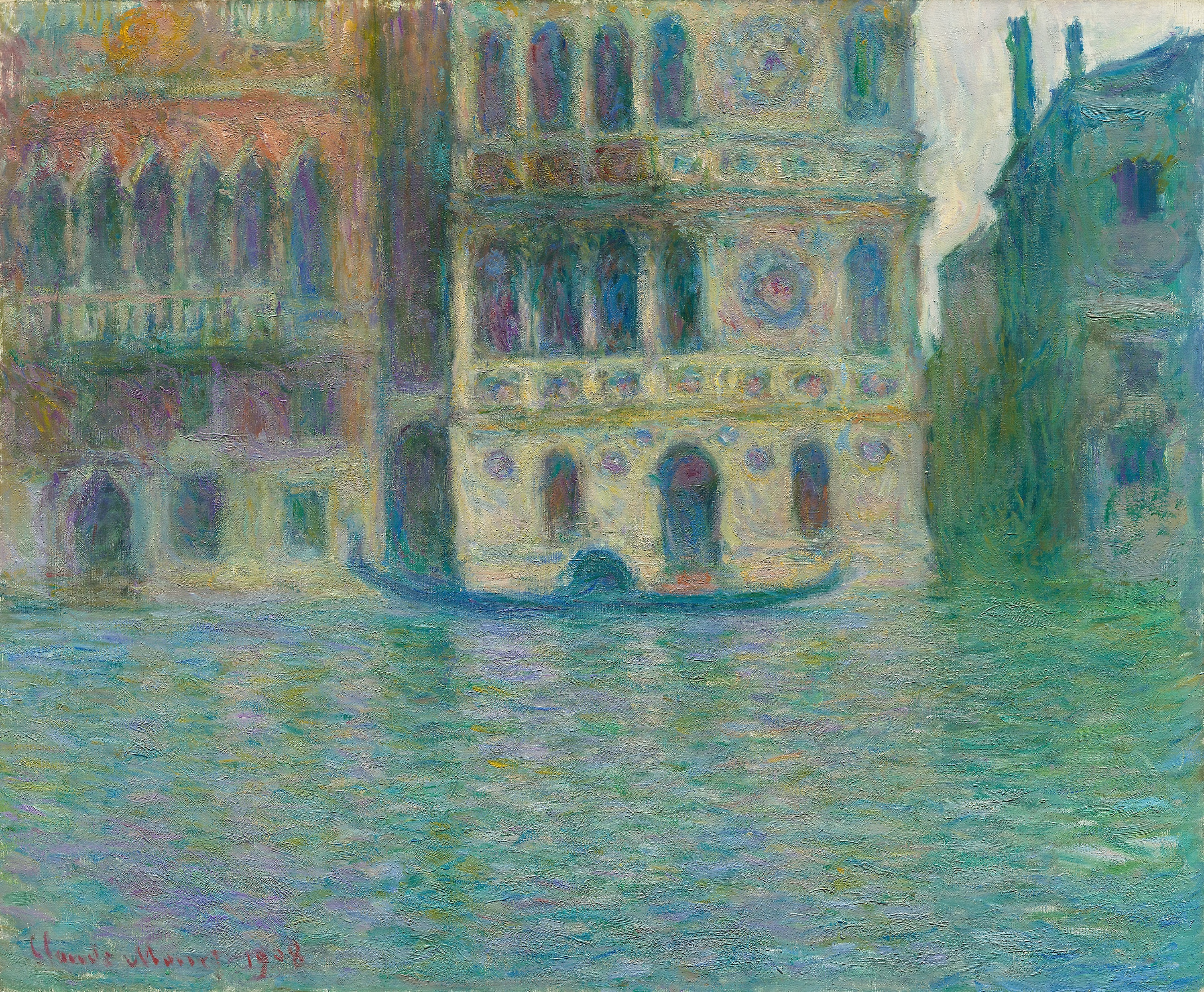
Venice, Palazzo Dario is a hand-painted reproduction of Monet’s canvas in the Art Institute of Chicago: the front of the Palazzo Dario in Venice, with its round marble medallions and arched windows, rises above the water, a gondola is moored before its central door, a pink neighbouring palace stands to the left and a green house in shadow to the right. The original measures 81.8 x 66.2 cm, is oil on canvas and carries accession number 1933.446. The museum dates it 1908, and the signature at the lower left reads »Claude Monet 1908«. We paint it in eight sizes or to your own, with a photograph of the finished work sent for approval before dispatch.
| Title: | Venice, Palazzo Dario |
| Other titles: | Le Palais Dario (the Bernheim-Jeune exhibition, 1912); in the Wildenstein catalogue the work is number 1757 |
| Painter: | Claude Monet (1840–1926) |
| Year: | 1908 per the museum record; the signature at the lower left reads »Claude Monet 1908«, so the two years agree |
| Original size: | 81.8 cm x 66.2 cm |
| Original technique: | Oil on canvas |
| Style: | Impressionism |
| Held at: | Art Institute of Chicago (inv. 1933.446) |
| Our reproduction: | Hand-painted oil on canvas, eight sizes or made to measure |
Venice, Palazzo Dario – Claude Monet
What is on the canvas?
The upper half of the canvas is filled by the front of the Palazzo Dario, seen from the water almost head-on. It is pale cream, shot through with lilac, blue and pink strokes: arched windows run across three storeys, two large round medallions sit to the right, and a band of small rosettes crosses the middle. Three arches open at water level; before the central and largest one a dark blue gondola is moored.
From the left a pink neighbouring palace with pointed Gothic arches and a balcony pushes into the canvas, to the right stands a green-blue house in shadow with two chimneys, and between it and the front runs a narrow strip of pale sky. The lower half is water, in short horizontal strokes of green, turquoise and lilac.
How did the canvas come about?
The museum record says the painter was long reluctant to visit or paint Venice, because the art market was already crowded with images of the city. When he was finally persuaded to travel there in 1908, its colours and atmosphere inspired him, though he still worried about producing nothing but trite »souvenir« pictures.
The canvas was first shown in May and June 1912 at the Galerie Bernheim-Jeune in Paris, in the exhibition Claude Monet: »Venise«, as number 19 and under the title Le Palais Dario; the catalogue carried a preface by Octave Mirbeau.
What does the museum record say about the work?
The work is held by the Art Institute of Chicago, accession 1933.446, which gives the size height first, 66.2 x 81.8 cm, and 79.7 x 94 cm with the frame. The credit line reads Mr. and Mrs. Lewis Larned Coburn Memorial Collection, the canvas hangs in Gallery 243, and in the Wildenstein catalogue it is number 1757.
The signature at the lower left, in red on the water, reads »Claude Monet 1908«, and the museum gives it in the same words. Wikidata gives the same year and the same measurements to the decimal, so here the sources do not diverge.
Whose hands has the canvas passed through?
The museum publishes the full chain of owners with prices, so we give it as it gives it. On 10 April 1912 the painter sold the canvas in half-shares to the Galerie Bernheim-Jeune and to Durand-Ruel in Paris for 10,000 francs. In October that year Durand-Ruel sold it to its New York house, and on 26 December 1912 Arthur B. Emmons of Newport bought it for 7,500 dollars.
On 27 May 1913 Emmons sold it back to Durand-Ruel in New York for 37,600 francs and bought it again the same day for 6,500 dollars. At his sale at the American Art Association in New York on 14 January 1920 it was lot 42, bought in half-shares by Durand-Ruel and Knoedler for 5,800 dollars. On 8 February 1923 Annie Swan Coburn of Chicago bought it for 9,735 dollars plus tax; she died in 1932 and bequeathed it to the museum, where it has been since 1933.
Is this the only canvas of the Palazzo Dario?
No. Wikidata lists four canvases of the Palazzo Dario from 1908 under Wildenstein numbers 1757 to 1760; one of them, NMW A 2481, is in the National Museum Wales in Cardiff. The title Le Palais Dario, under which our canvas was shown in 1912, is one Wikidata also gives in French to others.
From the same year, and once in the same private collection, comes another Venetian front, Palazzo da Mula, Venice at the National Gallery of Art in Washington, 1963.10.182, 80.5 x 61.4 cm, signed at the lower left in cobalt blue »Claude Monet 1908«. Arthur B. Emmons owned both canvases and sold both at the same sale in New York on 14 January 1920: ours as lot 42, the Washington canvas as number 39.
Why does this work matter?
Because of how the stone is painted. The museum writes that the painter rendered the solid marble buildings the same way as the water, subtly dissolving the forms as if they were floating in the Venetian haze.
He had painted London over the water before: Waterloo Bridge, Gray Day is from 1903, London, the Houses of Parliament in the Fog from 1904, and from London we also sell Charing Cross Bridge, London. A front that fills almost the whole canvas he had already painted in Rouen, as Rouen Cathedral, the Portal and Saint-Romain Tower shows; and two years before Venice came Water Lilies, held by the same museum. An impressionist painting of this kind is not a souvenir of Venice, which, by the museum record, was what the painter feared.
How is our hand-painted version made?
Every order is painted individually by an artist, in oil on cotton or linen. That is how every canvas painting leaves us, with no print and no machine step. This oil painting reproduction is demanding in its pale tones: the front must stay cream and at the same time full of small touches of colour, or it turns into a flat white wall.
The second test is the water. The strokes must stay short and separate, so that the gondola and its reflection do not melt into one surface. A Monet reproduction of this kind depends on the line between stone and water staying soft. Work of this kind will not take a high gloss, so ours is matt. A hand-painted copy is not a facsimile; two canvases of the same size always differ in the brushwork.
Which size for which wall?
There are eight sizes, from 45 x 38 to 150 x 120 cm. By size the closest is 80 x 60 cm, 1.8 cm narrower and 6.2 cm lower, but at 1.3333 it is noticeably wider in proportion than the original’s 1.2356. By proportion the closest are 50 x 40 and 150 x 120 cm, both at 1.2500.
If you want the original’s shape on a large wall, take 150 x 120; for a smaller room there is 50 x 40. The cool greens and blues sit well in a quiet room, which makes this a good painting for the bedroom. All sizes are listed with the product in our Claude Monet gallery.
Custom size, stretcher bar and frame
For a size not on the list, made to measure is the only route; send us the width and height and we keep the proportion of the original. The canvas is stretched on a wooden bar. A frame is not included; the museum’s own measures 94 x 79.7 cm and is 6.1 cm deep.
Delivery and guarantee
Making it takes two to three weeks, a few days more at the largest sizes. It arrives stretched on its bar in a rigid box, or rolled in a tube, with tracking. If it arrives damaged or differs noticeably from the approved photograph, we replace it or refund. Small differences in the brushwork are expected in handwork; damage is not.
Frequently asked questions
Where is the original?
In Chicago, at the Art Institute of Chicago, accession number 1933.446, on view in Gallery 243.
What year is it from?
From 1908; that is how the museum dates it and how it is signed at the lower left.
What does it show?
The front of the Palazzo Dario in Venice above the water, with a gondola before the door, a pink neighbouring palace on the left and a green house on the right.
Is Le Palais Dario the same work?
It is; it was shown under that title in 1912. Because Wikidata gives the same French title to other canvases too, go by accession number 1933.446.
Is this a print?
No. Ours is made by hand, in oil on canvas; we sell no printed work.
Which size should I choose?
50 x 40 or 150 x 120 cm if the shape of the original matters to you, and 80 x 60 cm if its size does.
Can I have a size that is not listed?
Yes. A piece to your own measurement keeps the proportion of the original at any width.
How does the work reach me?
Stretched on its bar in a rigid box, or rolled in a tube, with tracking.
What is this work about, in one sentence?
About a marble front painted as softly as the water beneath it.
Is the original for sale and what is it worth?
Not for sale: it is in a museum collection. We give no valuation; the prices from 1912 to 1923 are the museum’s record of past sales.
Is it suitable as a gift?
It is, and if you are unsure of the size there is a voucher with which the recipient chooses.
- Subject. The front of the Palazzo Dario in Venice above the water, with a gondola moored before the central door.
- Original. Oil on canvas, 81.8 x 66.2 cm, 1908; signed at the lower left »Claude Monet 1908«; Art Institute of Chicago, inv. 1933.446.
- Ours. Eight sizes; 80 x 60 cm is closest by size, 50 x 40 and 150 x 120 cm by proportion.
- Worth knowing. The same collector, Arthur B. Emmons, sold another Venetian canvas of 1908 at the same sale in 1920; it is now in Washington.