

Description
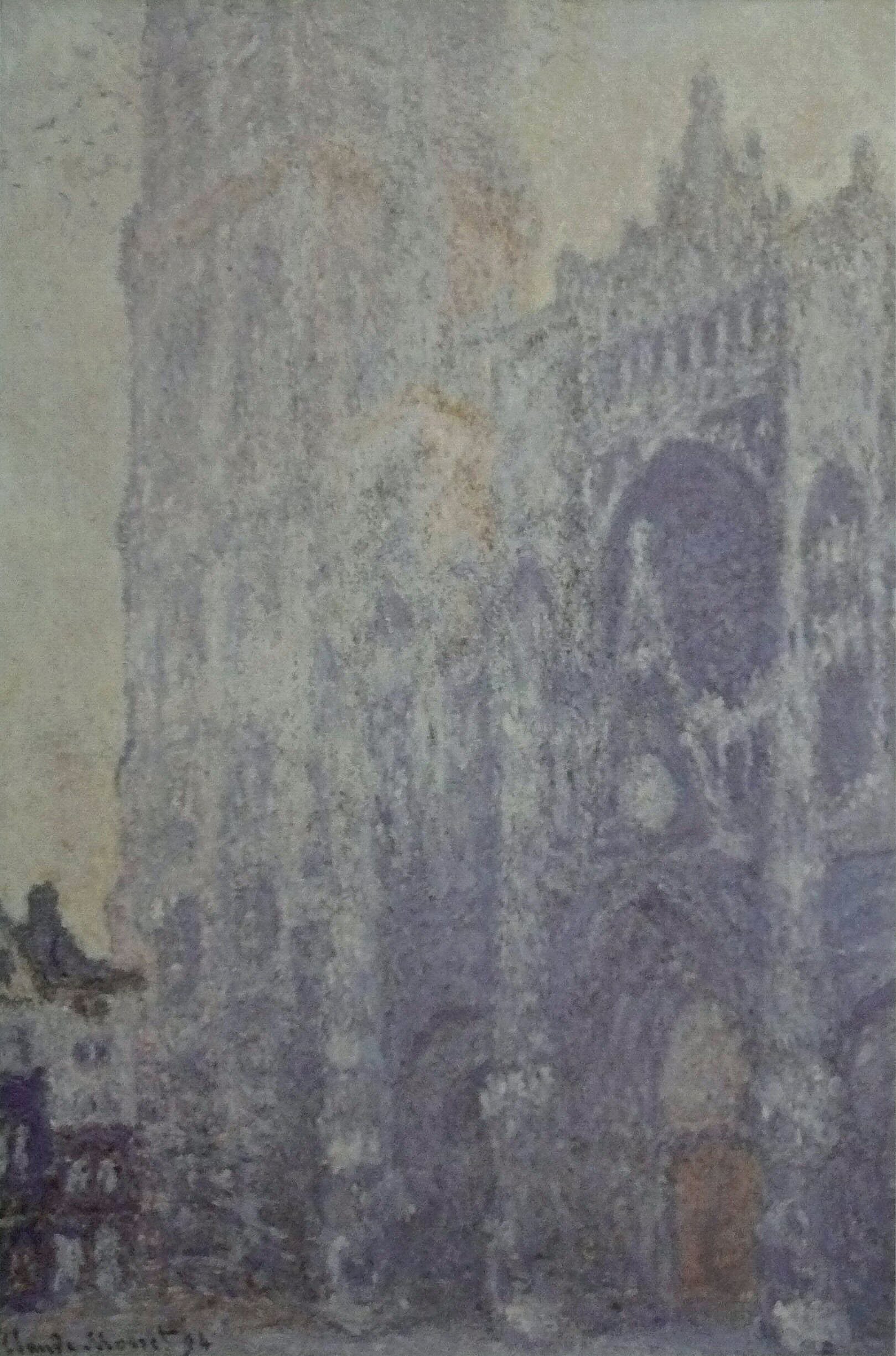
Rouen Cathedral, the Portal and Saint-Romain Tower is a hand-painted reproduction of Monet’s canvas in the Musée d’Orsay in Paris: the tower fills the left half and runs off the top edge, the portal stands to its right with a great pointed arch, a pale rose window and a steep gable, and a low house with a reddish awning is wedged in at the lower left. The original is oil on canvas, 73.2 x 106.5 cm, accession number RF 2001. The museum dates it 1893; the signature at the lower left reads “Claude Monet 94”. We paint it in eight sizes or to your own measurement, with a photograph of the finished work for approval before shipping.
| Title: | Rouen Cathedral, the Portal and Saint-Romain Tower |
| Other titles: | La Cathédrale de Rouen. Le Portail et la Tour Saint-Romain, effet du matin ; Harmonie blanche (the name in the museum record, with both of its parts); in the Wildenstein catalogue the work is number 1346 |
| Painter: | Claude Monet (1840–1926) |
| Year painted: | 1893 according to the museum record, without reservation; the signature on the canvas reads “Claude Monet 94”, so the two years diverge |
| Original size: | 73.2 cm x 106.5 cm |
| Original technique: | Oil on canvas |
| Painting style: | Impressionism |
| Located at: | Musée d’Orsay, Paris (inv. RF 2001) |
| Our reproduction: | Hand-painted oil on canvas, eight sizes or made to measure |
Rouen Cathedral, the Portal and Saint-Romain Tower – Claude Monet
What is on the canvas?
The left half belongs to the Saint-Romain tower, the cathedral’s northern bell tower. It grows out of the lower edge and runs off the upper one, its top never shown: a tall upright wall of lilac, blue-grey and cream, with pink patches where the morning light reaches.
The portal stands to the right. Its pointed arch is the darkest place on the canvas, with the pale rose window above it and, higher still, a steep gable of pinnacles and stone lacework of tiny dots. The right edge cuts the façade off, so the second bell tower is missing, and the sky is only a narrow cream band at the upper left.
On the canvas it is the other way round: the tower holds the whole left half, and it is the portal that does not fit, the right edge taking its ending away. We checked that on our own photograph of the original and on the museum’s plate.
What did the painter write on the canvas?
At the lower left, over the dark stone at the foot of the tower, the signature stands in thin dark strokes. The name reads easily, Claude Monet, and behind it two figures we can read as well: 9 and 4.
The record says nothing about inscriptions here, so we are not correcting the museum, only saying what we saw.
Why does the museum say 1893 while the canvas carries 94?
Because these are two sources and they diverge. The museum dates the work to 1893, flatly and without a range; the canvas says 94.
The divergence is not peculiar to this canvas. The Musée d’Orsay holds five Rouen cathedrals by Monet and dates none to 1894: two carry 1892, three 1893.
Why they diverge we do not claim, because the record does not say. The year in the table is the museum’s, the year on the canvas is the painter’s.
What does the museum record say about the size?
The work is held by the Musée d’Orsay in Paris, accession number RF 2001. It publishes the measurements height first, 106.5 x 73.2 cm; our table puts the width first, so you read 73.2 x 106.5 cm here. Framed it measures 83.8 x 117 cm, reordered the same way.
The gap is half a centimetre in height and two tenths in width; the source, not the size of the gap, is what counts.
Where the museum record and a data collection disagree, the museum governs: it holds the work and measured it. In everything else the collection agrees, on 1893 and on Wildenstein 1346.
What tells this canvas apart from its twin?
The hour. The Musée d’Orsay holds two canvases with this framing, the portal and the Saint-Romain tower, both from 1893. Ours carries the museum’s addition effet du matin ; Harmonie blanche, morning effect and white harmony; the second canvas in the same museum, RF 2002, carries plein soleil ; Harmonie bleue et or, full sunlight and a harmony of blue and gold. We sell that one as Rouen Cathedral, Portal and Tower Saint-Romain in Full Sunlight.
By measurement they are almost impossible to tell apart: ours is 73.2 x 106.5 cm, the sunlit one 73.5 x 107 cm. Look at the light rather than the figures: here the stone is pale and cool, there the blue gives way to gold.
We could check only the museum’s five, and among those it is true: two carry the tower in the title, three only the portal. The series is larger than those five and we have not counted the rest, so the claim about the whole series is withdrawn.
How did they come to Paris?
The five did not arrive by the same route, and the record says so for each. Four of them, ours included, came with a single bequest: legs comte Isaac de Camondo, 1911, the bequest of Count Isaac de Camondo.
The fifth the museum bought from the painter himself in 1907, four years before that bequest and fifteen years after it was painted. It is the portal from the front, Harmonie brune in the record. So the Rouen cathedrals hang together in Paris although they did not arrive together.
Which other Rouen cathedrals do we sell?
In our Claude Monet gallery the Rouen façade returns six times, each in a different light. Beside the sunlit twin are two canvases from the same Paris collection, Rouen Cathedral, Morning Sun under RF 2000 and Rouen Cathedral, Grey Weather under RF 1999, neither with the tower in its title.
The sixth is not from Paris. Rouen Cathedral, Portal belongs to the National Gallery of Art in Washington, accession number 1963.10.49, and shows the same façade closer up.
How is our hand-painted version made?
Every order is painted individually, in oil on cotton or linen. That is how every canvas painting is made here, with no print and no machine step. This one is demanding in the stone, which is nowhere grey: lilac, blue, ochre and cream, breaking into dots at close range.
The second test is thickness. Monet built the stone so densely that it stands above the weave and the surface itself catches the light; smooth it down and the façade stiffens into a drawing. An impressionist painting of this kind takes no high gloss, so our oil painting reproduction stays matt.
Which size for which wall?
There are eight sizes, from 38 x 55 to 120 x 170 cm, and two answers. By size the closest is 70 x 100 cm, 3.2 cm narrower and 6.5 cm shorter than the canvas in Paris. By proportion the closest is 38 x 55 cm, at 1.4474 against the original’s 1.4549, while 70 x 100 cm sits at 1.4286.
The answers diverge more here than for most subjects: the closest proportion belongs to the smallest size on the list. That is a fact about the ladder, not a recommendation: 70 x 100 cm for a medium room, 80 x 120 cm for a stairwell, 38 x 55 cm where price or a narrow alcove decides. As a painting for the living room it works, staying in pale tones and never pulling the eye.
How high to hang the painting: centre about 150 cm above the floor, so the tall canvas clears the furniture.
Made to measure, stretcher and frame
For a size not on the list, painting it to your own measurement is the only way; send us width and height in centimetres. The canvas arrives stretched or rolled in a tube. A frame is not included; a narrow light moulding suits this subject, a wide dark one pushes the stone into shadow.
Delivery and guarantee
The work takes two to three weeks, longer at the largest sizes, because the oil has to dry between layers. Stretched canvases travel in a rigid box, rolled ones in a tube. If the work arrives damaged or differs from the photograph you approved, we replace it or refund the price. A hand-painted copy is not a factory product and small differences in brushwork are expected; damage is not.
If the painting is a gift and you are unsure of the size, there is a gift voucher: the recipient chooses the size and the subject.
Frequently asked questions
Where is the original?
In Paris, in the Musée d’Orsay, accession number RF 2001.
What does Harmonie blanche mean?
White harmony, part of the museum’s title, naming the light the canvas was painted in.
Why did Monet paint Rouen Cathedral so many times?
He was not after the building but the light on it. In 1892 and 1893 he painted the west façade about thirty times, at different hours and in different weather, working on several canvases at once and switching as the light changed. He finished them in his studio in 1894.
How many times did Monet paint Rouen Cathedral?
More than thirty times, in 1892 and 1893; 28 of the canvases show the west façade. He finished them in his studio in 1894 and chose twenty for the show at Durand-Ruel in Paris in May 1895.
- Subject. The Saint-Romain tower across the left half, the portal to its right, a low house with a reddish awning at the lower left.
- Original. Oil on canvas, 73.2 x 106.5 cm, 1893; Musée d’Orsay, Paris, inv. RF 2001.
- Our version. Eight sizes; 70 x 100 cm is closest by size, 38 x 55 cm by proportion.
- Worth knowing. The museum dates the work to 1893, while the signature on the canvas reads “Claude Monet 94”.