







Description
| Title: | Field of Tulips in Holland |
| Other titles: | Champs de tulipes en Hollande · Tulpenfeld in Holland |
| Painter: | Claude Monet (1840–1926) |
| Year painted: | 1886 |
| Original size: | 81.5 cm x 65.5 cm |
| Original technique: | Oil on canvas |
| Painting style: | Impressionism |
| Located at: | Musée d’Orsay, Paris (inv. RF 1944 19) |
| Our reproduction: | Hand-painted oil on canvas, eight sizes or made to measure |
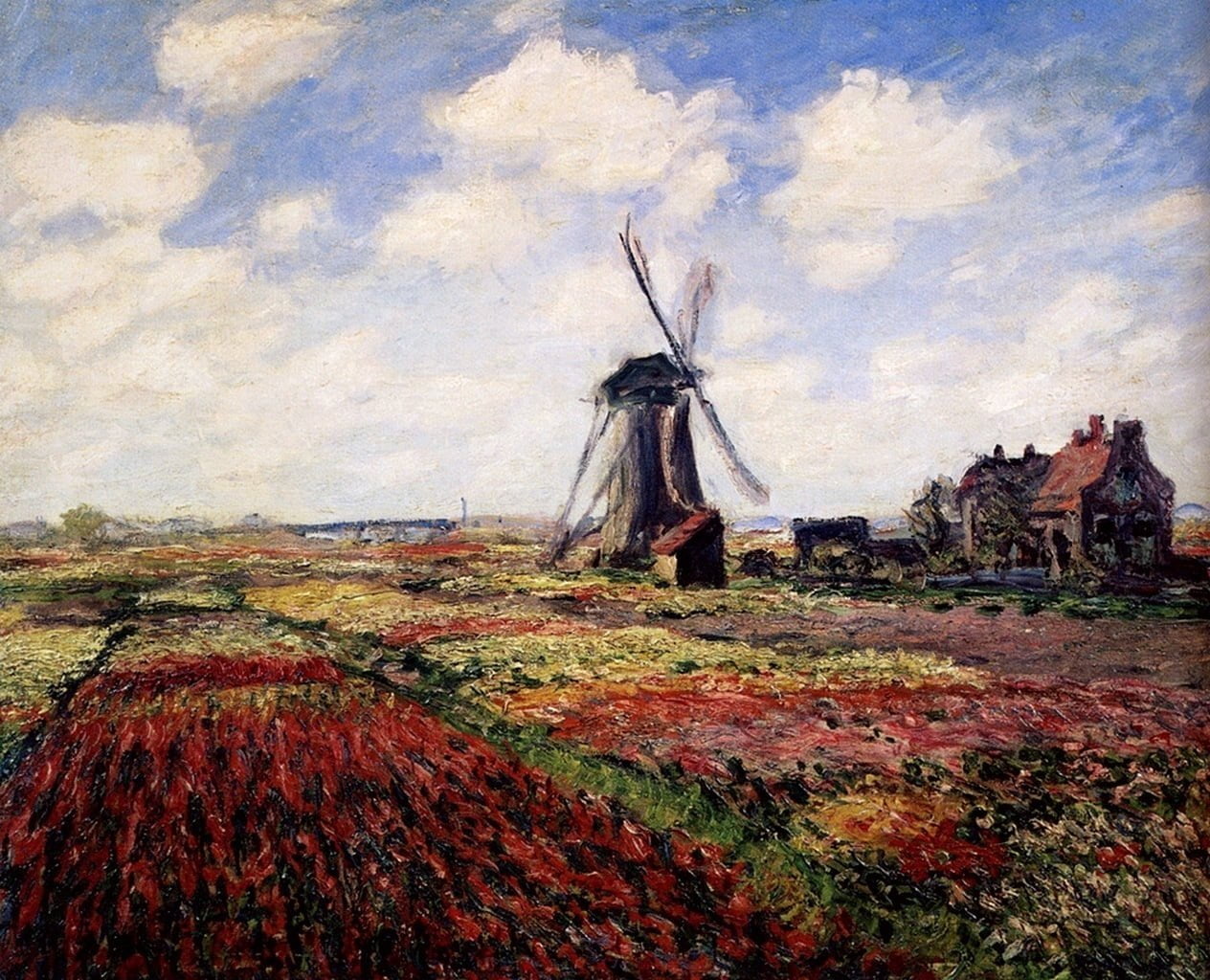
Field of Tulips in Holland is Monet’s canvas of 1886: bands of red, yellow and pink tulips run across the lower half, a windmill stands at the centre, and above them the sky takes up almost half the surface. The original hangs in the Musée d’Orsay in Paris. We make it as a hand-painted copy in oil on canvas, in eight sizes or to your own measurement, with a photograph of the finished work sent for approval before dispatch.
Field of Tulips in Holland – Claude Monet
What is shown?
The flat land near Leiden in spring, when the beds are in flower. In the foreground a dark red bed runs diagonally in from the left edge, and behind it come bands of yellow, pink and pale green, separated by narrow strips of grass. At the centre stands a wooden windmill with four sails; to its right a low farm with reddish roofs and a few dark shapes beside it. The horizon lies low and is almost straight. This canvas painting is therefore not a scene with a story but a map of coloured bands under a large sky.
What is on the canvas?
The canvas is divided horizontally, roughly in half: earth below, sky above. The earth is not painted as a meadow but as a run of separate bands, each in its own colour and each with a different stroke — the dark red in front in short vertical touches, the yellow behind it in longer horizontal ones, the green between them almost smooth. The mill and the farm are the only verticals and stand just above the horizon, which gives the whole plain its scale. The sky is pale: blue only along the top edge, and cream cumulus everywhere else, laid on thickly. An impressionist painting is ordered here by bands rather than by depth — there is barely any perspective, and the bands simply narrow towards the horizon.
Why does this work matter?
Because here Monet painted something he did not have in France: a field already divided into areas of colour by itself. The Dutch beds were almost a ready-made subject for him — human work that had sorted the colour into bands before the painter arrived. An oil painting reproduction of it is therefore flatter and more ordered than most of his landscapes, and that is exactly why it looks so surprisingly modern.
When was Monet in Holland?
Twice. First in the early 1870s, when he spent some months at Zaandam; then in the spring of 1886, for a week or two, exactly while the tulips were in flower near Leiden. Several canvases come from that second trip; among the known ones are the Tulip Fields near The Hague in the Van Gogh Museum and the Tulip Fields at Sassenheim in the Clark Art Institute. The Monet reproduction you order here is of the one in the Musée d’Orsay.
Which tulip field is this?
The question matters, because two canvases from the same year are dangerously alike in their numbers. Ours measures 81.5 x 65.5 cm and lies horizontally; the Tulip Fields near The Hague in the Van Gogh Museum measure 81.5 x 66 cm and stand upright — the same two figures, the other way round. Ours is the one with the mill at the centre and the low plain. If you are looking for Monet’s other plains and gardens: the Dutch subject of the earlier years is — Zaandam; the poppy field near Giverny is — Poppy Field (Giverny); the meadow beside the house is — Meadow at Giverny; and the dense flower bed in a private garden is — Corner of the Garden at Montgeron.
How is our hand-painted version made?
This subject is painted from the top down: the sky first, which takes half the canvas and has to stay light, then the horizon and the mill, and only last the bands of tulips. Each band has its own stroke, and that is where the work lies: if they all go on the same way, the field sticks together into one red area and the work loses the depth it otherwise carries. So the painter does not mix the colours on the canvas but lays them side by side. Before dispatch we send you a photograph of the finished work.
Which size for which wall?
Short answer: 90 x 70 cm for a living room, 60 x 50 cm for a smaller wall, 120 x 100 or 150 x 120 cm for a large one. The sizes include 81 x 66 cm, which is closest to the original. A painting for living room walls should take up roughly two thirds of the width of the sofa or sideboard. The small sizes, 40 x 30 and 50 x 40 cm, are meant for a hallway or a shelf. As impressionist wall art this subject is pale and horizontal, so it works well above low furniture and on wide walls where the bands can stretch.
How high to hang the painting: put the centre of the canvas about 150 cm above the floor. Because the subject is horizontal, do not squeeze it between tall shelves — it needs width.
Made to measure, stretcher and frame
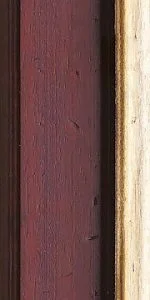
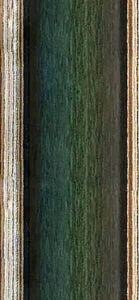
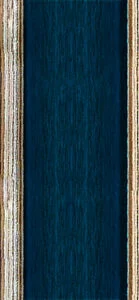
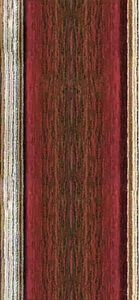
If none of the listed sizes suits, we paint to measure — send the width and the height and we will quote a price and a lead time. The original measures 81.5 x 65.5 cm, a ratio of about 1.24 : 1. The canvas is stretched over a wooden stretcher and the edges are painted, so it does not look unfinished without a frame. A pale natural or white moulding suits this subject and carries the sky on; a dark one closes the field off.
Delivery and guarantee
We ship to the United Kingdom, Ireland and across the EU, wrapped in protective film and packed in a rigid box. Before dispatch we send a photograph of the finished work; if something on it is wrong, it is corrected before the piece leaves the workshop. Lead time depends on the size and on how full the workshop is. Other subjects by Monet are in the Claude Monet gallery, and we write about painting and about choosing a subject on the blog.
If the painting is a gift and you are unsure of the size, there is a wall art voucher: the recipient chooses the size and the subject.
Frequently asked questions
Where is the original?
In the Musée d’Orsay in Paris, under inventory number RF 1944 19. The museum received it from the bequest of Winnaretta Singer (Princesse Edmond de Polignac).
What year is it from?
From 1886. The museum also records the size as 65.5 cm high and 81.5 cm wide, and the technique as oil on canvas.
Why does the sky get so much room?
Because the land is flat and nothing lifts the eye. In Holland the sky is the only thing happening above the horizon, and Monet gave it half the canvas because that is genuinely how much room it takes.
How many tulip paintings did Monet make in Holland?
Five. Invited by a French diplomat, Monet spent about ten days among the bulb fields near The Hague in spring 1886 and painted five canvases of tulip fields and windmills, this one among them.
- Painted by hand. Oil on canvas, no print and no machine application.
- Eight sizes or made to measure. From 40 x 30 to 150 x 120 cm, including 81 x 66 cm, the closest to the original.
- A photograph before dispatch. You see the finished work before it leaves the workshop.
- Figures from the museum. Year, size and inventory number are given as the Musée d’Orsay records them.