
Description
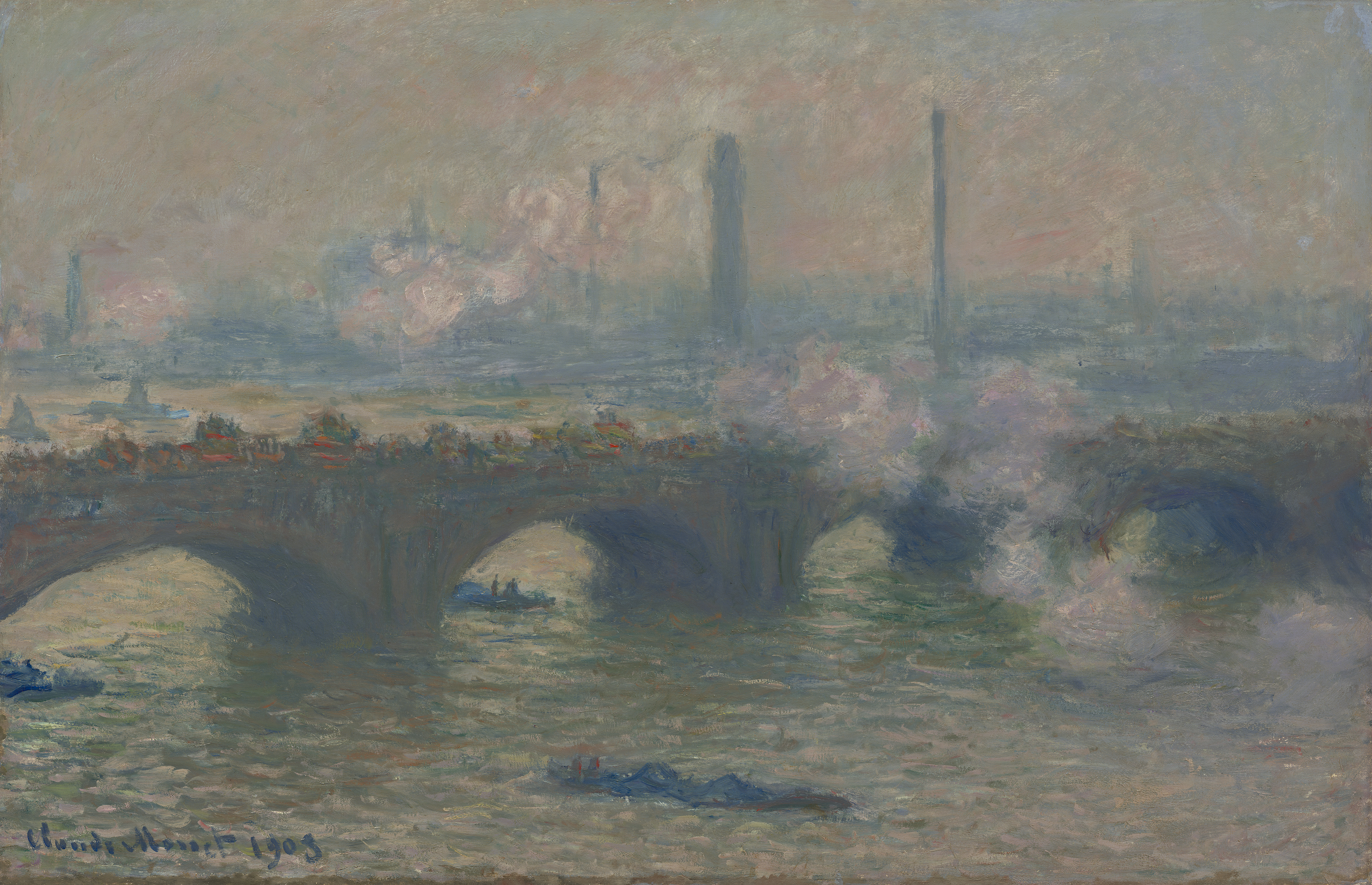
Waterloo Bridge, Gray Day is a hand-painted reproduction of Monet’s canvas in the National Gallery of Art in Washington: the bridge lies across the full width as a dark horizontal mass with four visible arches, factory chimneys rise behind it in the mist, and three long narrow boats lie on the green-grey water below. The original is oil on canvas, 100 x 65.1 cm, accession number 1963.10.183. The museum dates it 1903; the signature at the lower left reads “Claude Monet 1903”. We paint it in eight sizes or to your own measurement, with a photograph of the finished work for approval before shipping.
| Title: | Waterloo Bridge, Gray Day |
| Other titles: | Waterloo Bridge, Gray Day is the name in the museum record; in the Wildenstein catalogue the work is number 1569 |
| Painter: | Claude Monet (1840–1926) |
| Year painted: | 1903 according to the museum record, without reservation; the signature on the canvas reads “Claude Monet 1903”, the same year and written out in full |
| Original size: | 100 cm x 65.1 cm |
| Original technique: | Oil on canvas |
| Painting style: | Impressionism |
| Located at: | National Gallery of Art, Washington (inv. 1963.10.183) |
| Our reproduction: | Hand-painted oil on canvas, eight sizes or made to measure |
Waterloo Bridge, Gray Day – Claude Monet
What is on the canvas?
The bridge lies across the full width, just above the middle, a dark mass whose arch faces are ash brown and whose undersides are cobalt blue. Four arches are visible whole and a fifth is cut off by the left edge. Under them the water is a pale yellow, lighter than elsewhere, and along the top runs a band of small orange and blue-green strokes: the traffic.
Behind the bridge stand factory chimneys, two prominent and several fainter, their pink and white smoke drifting left, while over the right half of the bridge a pale pink cloud of smoke or steam rolls across the water. The far bank is a pale band dissolving into mist. Three long narrow boats lie below: one under a left arch with a small figure on deck, one low and blue at the bottom edge, one hard against the left edge.
On the canvas it is the other way round: the bridge is the darkest and most solid thing on it, the chimneys are tall and smoking, and what disappears into the mist is the far bank. We checked that on our own master and on the museum’s own description.
What did the painter write on the canvas?
At the lower left, across the green-grey strokes of the water, the signature stands in dark blue. It reads easily: Claude Monet 1903, the year complete, all four figures.
The museum records the same, writing in its inscriptions field “lower left: Claude Monet 1903”.
Why do the two years agree here?
Because the sources agree, and in our collection that is the exception. The museum dates the work 1903, without reservation and without a range, so the year goes into the data behind the page too. The canvas carries the same year and writes it out in full.
What does the museum record say about the size?
The work is held by the National Gallery of Art in Washington under the accession number 1963.10.183. It publishes the measurements height first, 65.1 x 100 cm, and beside them in inches, 25 5/8 by 39 3/8. Framed it gives 120 x 84.4 cm (width first).
The 100 x 65 cm size on our list sits close to the original: the width matches exactly and the height is one millimetre short. By proportion the same size is nearest, 0.6500 against 0.6510, though none matches to three decimals.
Gray Day is not Gray Weather
A canvas with almost the same title hangs in Chicago, and it is not this one. Waterloo Bridge, Gray Weather is 1984.1173 at the Art Institute of Chicago, dated 1900, 92.6 x 65.4 cm, signed at the lower left with the name alone, no year. Ours is in Washington, from 1903, 100 x 65.1 cm, with the year written out. That canvas we do not sell.
We do sell three other London canvases. Waterloo Bridge, Sunlight Effect is the same bridge from the same year, 1933.1163, 101 x 65.7 cm, signed 1903 at the lower right. Charing Cross Bridge, London is 1933.1150 and 1901, and London, the Houses of Parliament in the Fog is in Paris. All three Chicago canvases, the near-namesake included, hang in Gallery 243 by the museum’s record — the same room as Stacks of Wheat (Sunset, Snow Effect).
What does the museum describe, and what does it never name?
The record carries a Visual Description, an account of the canvas, down to the ash-brown arch faces, the shell-pink smoke and the icy sky. That is where our count of the arches and the boats was corrected.
What the record never does is place the scene. The museum says what is painted, not where or why.
Neither claim is in the museum record. So we do not name the room and we do not repeat the quotation: what we cannot attribute to a source does not stand here.
A chain that does not begin with the painter
The museum publishes the chain of owners, but it does not begin where such chains usually do. The first station is the private collection of Paul Durand-Ruel in Paris, and how the canvas came into it the record does not say. In 1904 Durand-Ruel sold it to Franklin F. Nicola of Pittsburgh; on 7 January 1933 Chester Dale of New York bought it; and in 1963 it came to the museum with his bequest.
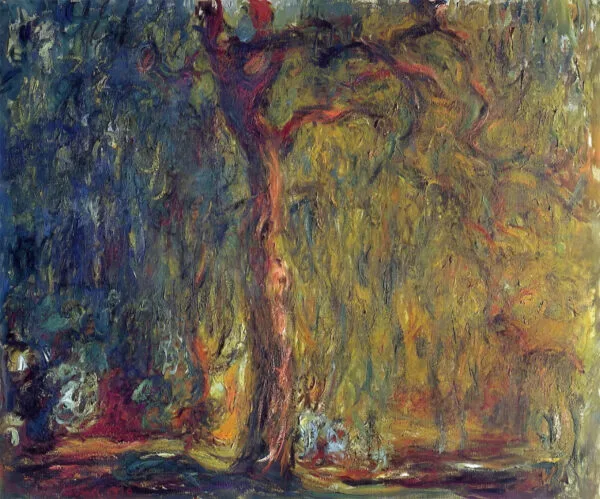
The museum attributes the date of Dale’s purchase to copies of his papers in its own curatorial records — it says where it knows that from. That is why the gap at the start shows: where there is a source the museum names it, and where there is none it does not guess. Today the work hangs, by the museum’s record, in Gallery 80 of the West Building, the same room as The Willows, which we also sell.
How is our hand-painted version made?
Every order is painted individually, in oil on cotton or linen. That is how every canvas painting is made here, with no print and no machine step. This one is demanding in the mist, which is not one colour: pale pink, cream and greenish strokes that have to run together without an edge, or the haze breaks into patches.
The second test is the bridge: paint it too dark and it cuts the canvas in two, too light and it loses the weight that is the only solid thing in the scene. An impressionist painting of this kind takes no high gloss, so our oil painting reproduction stays matt.
Which size for which wall?
There are eight sizes, from 70 x 45 to 200 x 130 cm, and the two answers agree. By size and by proportion the nearest is 100 x 65 cm, where the width matches exactly and the height is out by a millimetre. All the sizes are listed with the product in our Claude Monet gallery.
For a large wall 150 x 100 cm keeps the shape, and in a narrower space 92 x 60 cm is enough. As a painting for the office it works in daylight, because it is made of soft tones with no strong contrast in it.
How high to hang the painting: the centre about 145 cm above the floor, so the bridge sits near eye level.
Made to measure, stretcher and frame
For a size not on the list, painting it to your own measurement is the only way; send us width and height in centimetres. The canvas arrives stretched or rolled in a tube. No frame is included; a thin dark moulding gives the mist an edge.
Delivery and guarantee
The work takes two to three weeks, longer at the largest sizes, because the oil has to dry between layers. If the work arrives damaged or differs from the photograph you approved, we replace it or refund the price. A hand-painted copy is not a factory product and small differences in brushwork are expected; damage is not.
If the painting is a gift and you are unsure of the size, there is a gift voucher: the recipient chooses the size and the subject.
Frequently asked questions
Where is the original?
In Washington, in the National Gallery of Art, accession number 1963.10.183, on view in Gallery 80.
Is the original for sale and what is it worth?
It is not for sale, being in a museum collection. We give no value; the museum records no price in the chain.
Where did Monet paint the bridge from?
From his fifth-floor room at the Savoy Hotel on the Thames. From the window he had Waterloo Bridge to his left and Charing Cross Bridge to his right, and he finished the canvases later in his studio at Giverny.
How many paintings of Waterloo Bridge did Monet make?
Forty-one, between 1900 and 1904. Together with Charing Cross Bridge and the Houses of Parliament they belong to nearly a hundred views of the Thames from his London stays.
- Subject. The bridge across the full width with four arches, chimneys with pink smoke behind it, three boats below.
- Original. Oil on canvas, 100 x 65.1 cm, 1903; National Gallery of Art, Washington, inv. 1963.10.183.
- Our version. Eight sizes; at 100 x 65 cm the width matches exactly.
- Worth knowing. The museum and the canvas give the same year, 1903.