


Description
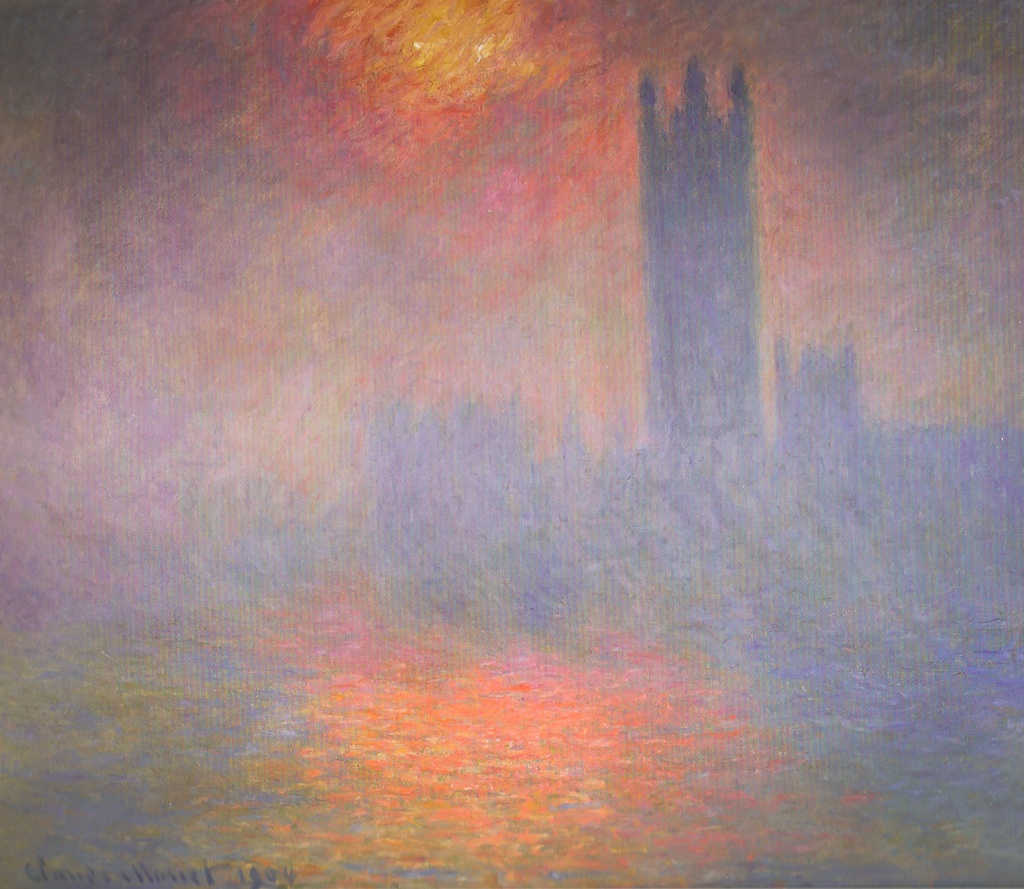
London, the Houses of Parliament in the Fog is a hand-painted reproduction of Monet’s canvas in the Musée d’Orsay in Paris: right of centre a dark tower rises out of the fog and ends in three spires, to its left the low body of the Parliament dissolves into the fog, and at the upper left the sun breaks through as a pale disc inside an orange and red flare that spills across the Thames below as a broad band of reflections. The original measures 92.5 x 81.5 cm and is oil on canvas, accession number RF 2007. The museum dates it to 1904, and the signature at the lower left reads “Claude Monet 1904”. We paint it in eight sizes or to your own measurement, with a photograph of the finished work sent for approval before dispatch.
| Title: | London, the Houses of Parliament in the Fog |
| Other titles: | Londres, le Parlement. Trouée de soleil dans le brouillard (the name in the museum record, with its note about the sun breaking through the fog); in the Wildenstein catalogue the work is number 1610 |
| Painter: | Claude Monet (1840–1926) |
| Year painted: | 1904 according to the museum record, with no reservation; the signature on the canvas reads “Claude Monet 1904”, the same year and written out in full |
| Original size: | 92.5 cm x 81.5 cm |
| Original technique: | Oil on canvas |
| Painting style: | Impressionism |
| Located at: | Musée d’Orsay, Paris (inv. RF 2007) |
| Our reproduction: | Hand-painted oil on canvas, eight sizes or made to measure |
London, the Houses of Parliament in the Fog – Claude Monet
What is on the canvas?
Right of centre stands a tower, the darkest thing on the canvas, built from blue and grey-lilac strokes and ending at the top in three spires: the left one lower, the middle one tallest and broadest, the right one lower again. The fog shows through the two gaps between them, and to the right a lower, narrower block can just be made out. To its left the low building runs on and dissolves into the fog, and the lower third is the Thames, green-grey and violet under the band of reflections.
Above and left of the tower is the sun: a pale disc inside a flare of orange, red and yellow strokes spreading upward and to both sides. This is what the museum’s own title calls trouée de soleil, the sun breaking through.
On the canvas that band is broad: it takes up most of the lower third and reaches from the left edge to under the tower. Checked against our own photograph of the original and the museum’s plate, which shows the same.
What did the painter write on the canvas?
At the lower left, over the water and the reflections, the signature stands in dark blue and grey. It reads Claude Monet 1904, the year in full, all four digits.
The museum record says nothing about inscriptions; it carries no field for them. So we are not correcting the museum, only saying what we saw: our own photograph of the original and the plate the museum publishes in its manifest carry the same.
Why do the two years agree?
Because the sources agree. The museum dates the work to 1904, with no reservation and no range, and the canvas carries the same year in full.
What does the museum record say about the size?
The work is held by the Musée d’Orsay in Paris under accession number RF 2007. With the frame it gives 112.5 x 101.5 cm, reordered the same way.
This Parliament is not the Washington one
Monet painted the same building more than once, and the canvases sit so close in size that numbers cannot separate them. In Washington hangs The Houses of Parliament, Sunset, 1963.10.48, and that canvas is not this one. It measures 92.5 x 81.3 cm, exactly our width and two millimetres less in height. It is dated 1903 and signed at the lower right, “Claude Monet 1903”.
Three things that are not measurements separate them: the year, the signature’s corner, and the light. Ours is from Paris and from 1904, signed lower left, and in it the sun breaks through the fog; the Washington one is from 1903, signed lower right, and in it the sun is setting. We do not sell it.
We do sell three other London ones. Waterloo Bridge, Gray Day of 1903 hangs in Washington, Waterloo Bridge, Sunlight Effect of the same year in Chicago, and Charing Cross Bridge, London carries the year 1901. All three show the Thames, and all three carry a bridge, which this one does not.
What does the museum record not say?
It says what is painted, when, and how it came to the museum. It does not say where the painter looked from, at what hour, or what he thought of the London fog – no building, no hour, no quotation.
Neither claim is in the museum record, so we do not name the room and assert nothing about the hour: what we cannot attribute to a source does not stand here.
How did the canvas reach Paris?
By a single bequest: for this work the museum gives legs comte Isaac de Camondo, 1911, the bequest of Count Isaac de Camondo, seven years after the canvas was painted. It publishes no chain of owners: it says who it came from, not by what road it had come to him.
That same bequest stands against two of the Rouen cathedrals we sell. Rouen Cathedral, the Portal and Saint-Romain Tower under RF 2001 and Rouen Cathedral, Portal and Tower Saint-Romain in Full Sunlight under RF 2002 came in by the same road and in the same year as this London. Three very different motifs, one record of acquisition. Another of Monet’s late views across water at the end of the day, the Venetian church on its island against a burning sky, is San Giorgio Maggiore at Dusk.
How is our hand-painted version made?
Every order is painted individually by an artist, in oil on cotton or linen. That is how every canvas painting of ours is made, with no print and no machine step. An oil painting reproduction of this motif is demanding where it is most beautiful: the fog is not one colour but lilac, pale blue and salmon pink at once, and those strokes must run together without an edge, or the veil breaks up into patches.
The second test is the sun. Paint the flare too strongly and it becomes a blot and the fog loses depth; too weakly, and the scene is left without the thing that gave it its title. An impressionist painting does not take a high gloss, so every Monet reproduction leaves our studio matt.
Which size for which wall?
Eight sizes are available, from 50 x 40 to 150 x 140 cm, and there are two answers, because the canvas is nearly square. By size the nearest is 90 x 80 cm, 2.5 cm narrower and 1.5 cm shorter than the canvas in Paris. By the ratio of the sides the nearest is 80 x 70 cm, at 0.8750 against the original’s 0.8811; 90 x 80 cm has 0.8889.
Nobody sees the difference between the two on a wall, so the real reason to choose is the room. For a large wall 130 x 120 cm keeps the shape; in a narrower room 70 x 60 cm is enough. As a painting for the office the motif works well, because it holds no strong contrast except the sun, and the sun is high, above eye level. Every size is listed with the item in our Claude Monet gallery.
How high to hang the painting: the centre about 145 cm above the floor, so the reflections on the water sit a little below eye level.
Made to measure, stretcher and frame
If you want a size that is not on the list, made to measure is the only route; write to us with the width and height in centimetres. The canvas can arrive stretched on a wooden stretcher or rolled in a tube. A frame is not included; a narrow dark moulding suits this motif and gives the fog an edge.
Delivery and guarantee
Making takes two to three weeks, a few days longer at the largest sizes, because the oil must dry between layers. If the work arrives damaged or differs noticeably from the approved photograph, we replace it or refund the price. A hand-painted copy is not a factory article and small differences in the brushwork are to be expected; damage is not.
If the painting is a gift and you are unsure of the size, there is a voucher: the recipient chooses the size and the subject.
Frequently asked questions
Where is the original?
In Paris, in the Musée d’Orsay, under RF 2007.
Is the original for sale and what is it worth?
It is not for sale, because it belongs to a museum collection. We give no value; the museum writes no price.
Why did Monet paint the Houses of Parliament?
For the London fog he loved above all: on his winter stays of 1899 to 1901 he painted the building against the sun in the fog, so that it dissolves into the air.
How many paintings of the Houses of Parliament did Monet make?
Nineteen, from a terrace of St Thomas’ Hospital across the Thames, between 1899 and 1901; he finished them at Giverny.
- Subject. A dark tower with three spires right of centre, a building dissolving into fog to its left, the sun at the upper left, and a broad band of reflections on the Thames below.
- Original. Oil on canvas, 92.5 x 81.5 cm, 1904; Musée d’Orsay, Paris, inv. RF 2007.
- Ours. Eight sizes; 90 x 80 cm is nearest by size, 80 x 70 cm by ratio.
- Worth knowing. Museum and canvas give the same year, 1904, written out in full.