



Description
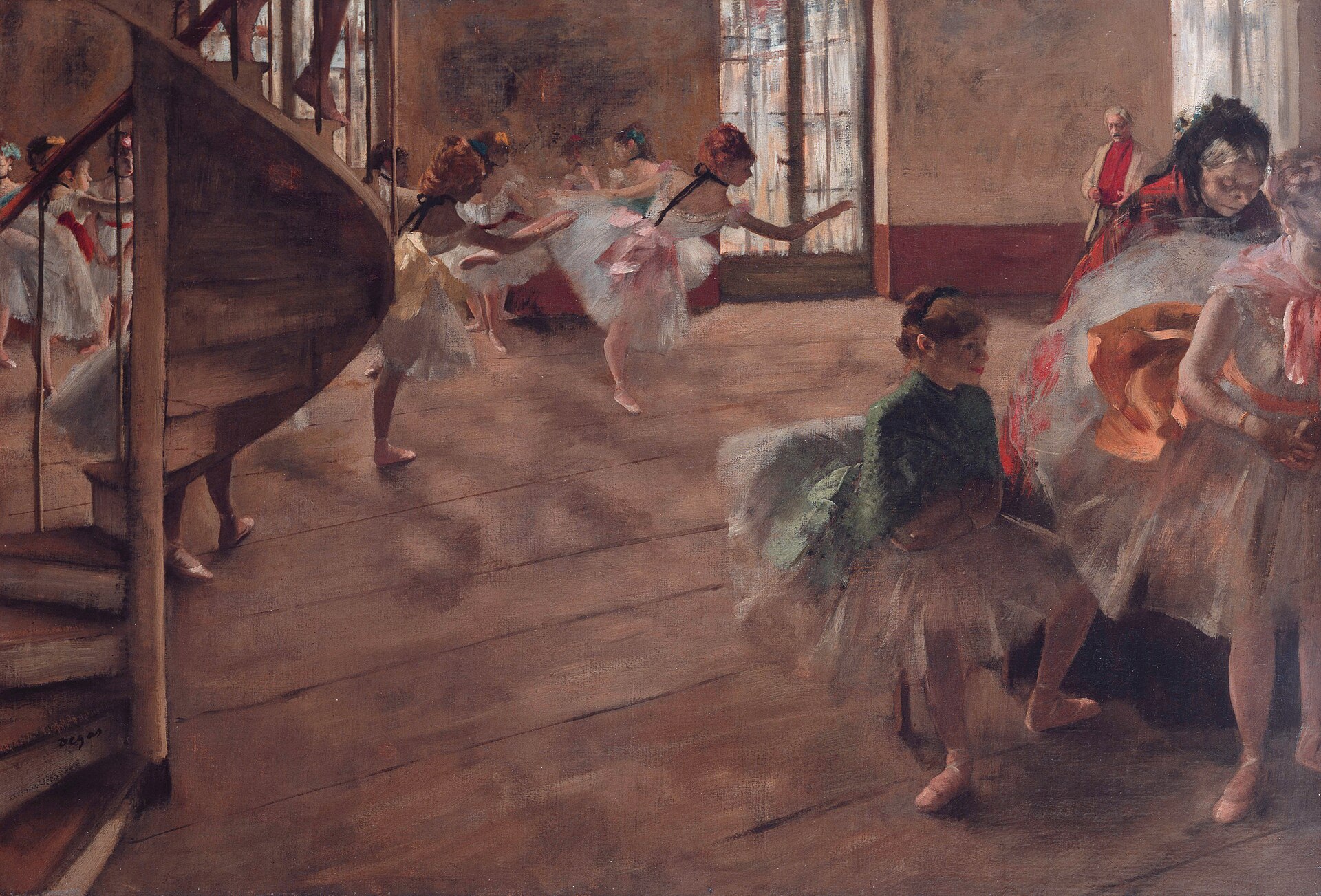
The Rehearsal shows a practice room at the Paris Opéra whose middle is empty, with everything that happens pushed to the edges. On the left a spiral staircase cuts into the scene; dancers come down it and we see them only as far as the knees. Left of centre two work at an arabesque with the leg and arm stretched out, and behind them, by the tall windows, stands a group in pale skirts. On the right a dancer sits in a green jacket with her back to us, another stands beside her, and behind them are an older woman in a red shawl and a bearded old man. The lower half of the canvas is bare wooden floor. The original is an oil work on canvas and is held by the Burrell Collection in Glasgow under inventory number 35.246. Ours is made by hand in eight sizes from 80 x 60 to 180 x 130 cm, or to your own measurement, and you receive a photograph of the finished work for approval before it ships.
| Title: | The Rehearsal |
| Other titles: | La répétition, The Dancing Class |
| Painter: | Edgar Degas (1834–1917) |
| Year: | circa 1874 |
| Size of the original: | 58.4 cm x 83.8 cm |
| Technique of the original: | oil, canvas |
| Style: | impressionism |
| Where it hangs: | Burrell Collection, Glasgow (inv. 35.246) |
| Our version: | hand-painted in oil on linen, 8 sizes from 80 x 60 cm to 180 x 130 cm, custom size on request |
The Rehearsal – Edgar Degas
Who is in the scene?
Some fifteen dancers, an older woman and an old man; none of them is named. On the staircase at the left, at least three pairs of legs in pink shoes come down, but the bodies are cut off by the top edge. Left of centre two dancers are working, one in pale yellow and one in white with a pink sash, and a third is red-haired with a black ribbon at her throat. By the windows at the back stands a group in pale skirts. On the right a dancer sits in a dark green jacket, her back to us and her head turned, while another stands beside her adjusting her sash. Behind them a woman in a red shawl, and at the top right corner a bearded man in a red and cream coat.
What is on the canvas?
The scene lies wide, and the room falls into three unequal parts. On the left stands the spiral staircase: the large brown curved surface of its underside cuts into the scene and hides whatever is behind it. Top right are tall windows with a pale light and a brown wall with a reddish band along the bottom. The right third is filled with figures pressed close together. And between all of it the middle stays empty: bare wooden floor, warm brown boards running diagonally, taking up nearly the whole lower half. Lower left, the signature. The colours are earthy, with only a few pink sashes, one green jacket and one orange patch at the right.
Why does this scene matter?
Because the middle is empty. Everything that happens Degas pushed to the edges: the staircase cuts the left side, the group crowds the right, the dancers on the steps are cut off at the knees. The middle — the place the eye goes first — is bare floor. The second reason is that cut itself: we do not see the dancers on the staircase as people but as legs in shoes, as though caught on their way in. So the scene reads as the view of somebody who happened to step into the room, not as a group arranged for us.
What does the scene mean?
Rehearsal as long, untidy work. Impressionism in Degas meant a cut as the eye takes it from one particular place, and that place here is by the door, where the staircase hides half the scene. An impressionist painting of this kind therefore shows not the performance but the waiting, the adjusting of a sash and the repeating. As wall art it is unusually calm despite the many figures, because so much of the surface is empty floor; it is one of the few subjects that will carry a large painting in a big room without tiring the eye.
The subject among Degas’s works
Practice rooms form a whole family of works in Degas. Dance Rehearsal in the Foyer shows the same kind of room emptier and in colder colour, The Ballet Class puts the working class of dancers in the foreground, and Ballet Rehearsal on Stage moves the rehearsal onto the stage. The work is recorded in the Degas catalogue raisonné as MS 214, and a related work of the same subject is held by the National Gallery in London.
How is our hand-painted version made?
With a brush and oil paint, not a printer. The original is oil on canvas, so the same technique as ours. On this subject the floor is the hard part, because it takes more room than anything else and has to stay interesting without detail: we paint the boards in long strokes that follow the diagonal, leaving cooler and warmer bands between them so the surface never goes even. The staircase is the second difficulty, since its large brown surface has to read as timber and not as shadow. The figures at the right stand close together and are built from the back forwards so they do not merge. The pink shoes and the green jacket come last. Every reproduction is painted afresh, and no two are quite alike, because a hand does not repeat the same stroke twice; each hand-painted copy is therefore its own. For this work we have no photographs of our finished canvases, so none are shown here and none are described. You receive the photograph of your own canvas before it ships.
Which size for which wall?
If you do not know which: 100 x 70 cm. We make this work in the larger sizes only, because it has many figures and a great deal of floor; below 80 x 60 cm the dancers on the staircase merge into a smudge. The original measures 58.4 x 83.8 cm; our smallest size, 80 x 60 cm, is closest to it in area — almost exactly the same — while in proportion the closest is 100 x 70 cm. The 80 x 60 and 90 x 65 cm belong above a sofa in an ordinary room. The 100 x 70 cm makes the most sense here, joining the right proportion to enough size for the figures on the right to separate. The 110 x 80 and 120 x 90 cm want a broader wall and some distance. The 140 x 100 cm belongs in a room where you can step back at least three metres. The 155 x 109.5 and 180 x 130 cm change a room outright; at those the figures come close to life size. Measure the size you choose on the wall first with a paper cut-out. No size is kept in stock as a finished piece: every copy is painted to order and stays a single piece.
Custom size, stretcher and frame
If none of the eight sizes fits, or if you want the proportion of the original, we paint to your measurement and keep the proportions of the scene as we do, so that the staircase on the left keeps its share and the empty floor in the middle stays as wide as it is in Degas; this is our work painted to order. Every canvas painting ships stretched on a wooden stretcher, ready to hang. For the frame, use our 3D app: it shows every moulding we carry on this subject, so you can compare gold, silver, black, white and natural wood — it is for choosing a frame and nothing else. If you want to see how the work looks on your own wall, we have a separate service for that, placement in the room.
Delivery and guarantee
Every piece is painted to order in our workshop in Slovenia, so allow 15-45 days depending on the size chosen; at the largest sizes the time is usually at the upper end. It travels stretched and protected for transport, framed if you chose a frame, to sixteen countries in the European Union, with no customs. Before it ships you receive a photograph of the finished work for approval, and our returns policy applies to every order. The painter’s full offer is in the Edgar Degas gallery, and his life is described in our article about Edgar Degas.
Frequently asked questions
What is happening in the scene?
A rehearsal in the practice room. Some dancers are working, others are coming down the stairs, others again wait and adjust their clothes.
Why are the dancers on the staircase cut off?
Because the top edge of the scene cuts through them. We see only legs and shoes, not the bodies.
What is the large brown shape on the left?
The underside of the spiral staircase. It takes up nearly a quarter of the canvas and hides whatever is behind it.
Who is the woman in the red shawl?
The record does not name her. She stands at the right among the dancers and is not dressed for practice.
Where is the original?
In the Burrell Collection in Glasgow, under inventory number 35.246.
How big is the original?
58.4 x 83.8 cm. Our 80 x 60 cm is closest to it in area, being almost exactly the same.
Why do you not make this work in smaller sizes?
Because it has many figures. Below 80 x 60 cm the group on the right and the dancers on the staircase merge, and the scene loses its point.
Do your sizes follow the proportion of the original?
One of them very closely: 100 x 70 cm. The rest are a little squarer than the original.
Is this a print?
No. The work is made by hand in oil; the brushstrokes are visible and can be felt.
Can I have a size that is not on the list?
Yes, we paint to measurement and keep the proportions of the scene as we do.
Is it suitable as a gift?
Yes, especially for someone who dances or goes to the ballet. Because every piece is painted to order, allow for the making time; if you would rather leave the choice to the recipient, there is our voucher.
- Subject: a practice room during rehearsal, the spiral staircase at the left, the crowded group at the right and empty floor in the middle
- Original: Edgar Degas, oil painted on canvas, 58.4 x 83.8 cm, Burrell Collection, Glasgow (35.246)
- Ours: painted by hand in oil, eight sizes from 80 x 60 to 180 x 130 cm, stretched and framed on request
- Note: the dancers on the staircase are not seen as people at all, only as legs in pink shoes