







































Description
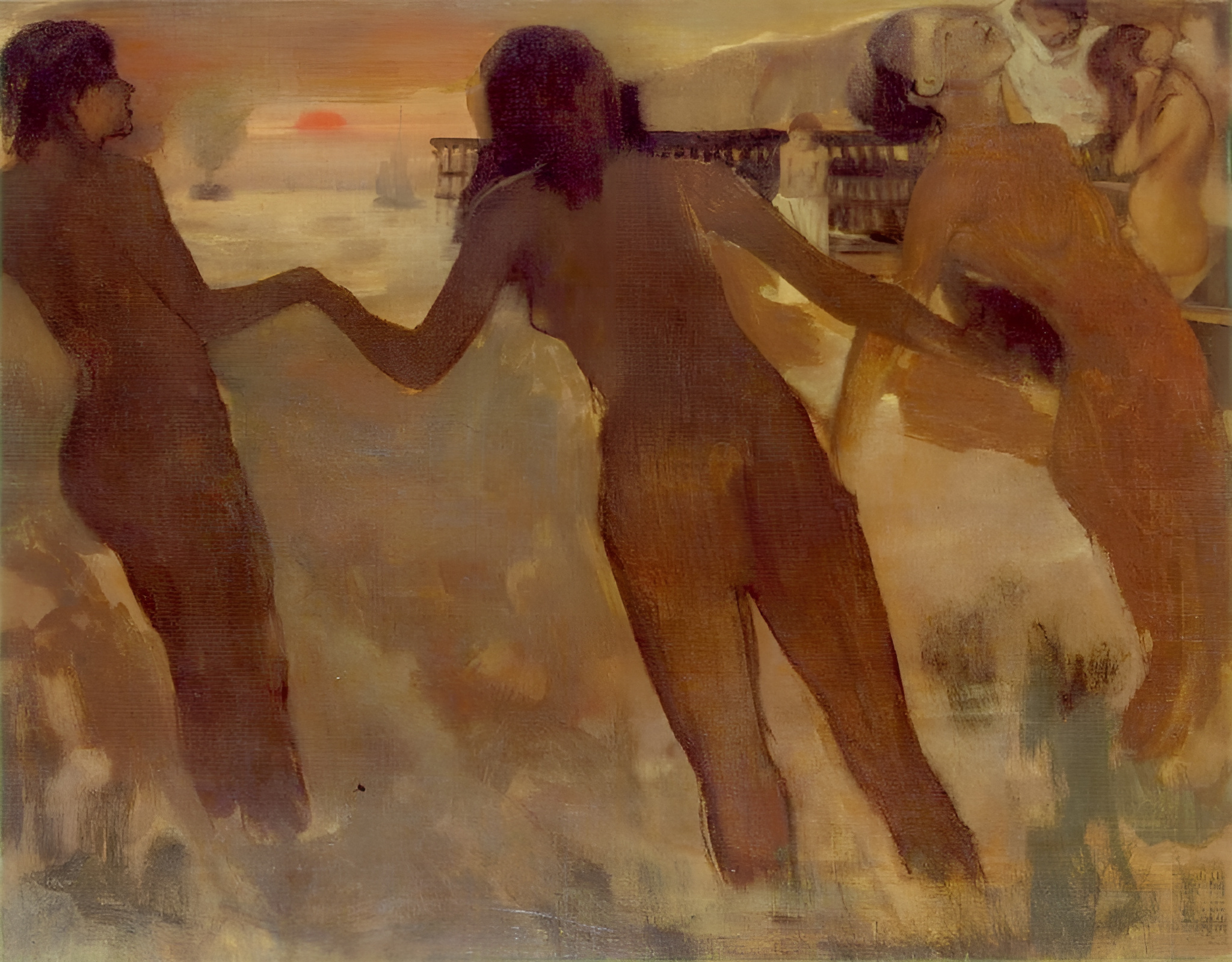
Peasant Girls Bathing in the Sea at Dusk shows three figures holding hands as they walk into shallow water, all of them turned away from us. The one at the left has dark hair and her head in profile, the middle one wears her hair loose down her back and stretches out both arms, and the one at the right is wrapped to the knees in a rust-brown cloth with her head thrown back. Behind at the right a wooden pier with a dark railing runs out over the water, a small figure in white stands beside it, and further right there is a group of smaller figures. At the left, on the sea, a steamer trails smoke, two sailing boats pass, and a small red sun sits just above the horizon. In the lower left corner there is no signature but the red stamp of the studio sale. The original is an oil painting on canvas in a private collection in Great Britain, listed in the Schulman catalogue as MS 1271. Ours is made by hand in eight sizes from 60 x 50 to 150 x 120 cm, or to your own measurement, and you receive a photograph of the finished work for approval before it ships.
| Title: | Peasant Girls Bathing in the Sea at Dusk |
| Other titles: | Petites paysannes se baignant à la mer le soir, Peasant girls bathing in the sea |
| Painter: | Edgar Degas (1834–1917) |
| Year: | about 1875 |
| Size of the original: | 65 cm x 81 cm |
| Technique of the original: | oil on canvas |
| Style: | impressionism |
| Where the original is: | private collection, Great Britain (Schulman catalogue MS 1271, Lemoisne II-377) |
| Our version: | hand-painted in oil on linen, 8 sizes from 60 x 50 cm to 150 x 120 cm, custom size on request |
Peasant Girls Bathing in the Sea at Dusk – Edgar Degas
Who is in the scene?
In the foreground stand three large figures, all turned away from us, holding hands as they walk into shallow water. The one at the left is naked and dark-haired, her head turned in profile to the left, her right arm stretched back. The middle one is the largest: her loose dark hair falls down her back, her left hand holds the first, her right reaches towards the third. The third is wrapped to the knees in a rust-brown cloth and holds her head thrown back. Further back at the right are smaller figures: one in white at the railing of the pier, and beyond her a group with a woman in white and a naked girl raising her hands to her hair. No face is seen close to.
What is on the canvas?
The sea is a cold grey-green with bands of foam, and the sky above the horizon is warm, orange and pink, with a small red sun sitting on the water. At the left a steamer with dark smoke and two tiny sailing boats. At the right a wooden pier with a dark railing pushes into the scene and runs towards the middle. The bodies are dark brown and almost without modelling, and their edges dissolve into the water in places. The paint is thin, the weave of the canvas shows through it, and the lower edge is barely begun. In the lower left corner, a red stamp — not a signature.
Why does this scene matter?
Because of that red stamp. Degas never signed this work and never sold it; it stayed in his studio until his death in 1917, and the stamp was added only at the sale of his estate in 1919. The second reason is the arrangement: the three large bodies are pushed right to the front, dark and almost flat, while the sun, the steamer and the pier — everything an ordinary sea picture would be about — are small and far behind. The event is put at the back and the bodies are the foreground. The third reason is the surface: the canvas shows through the thin colour and the edges of the bodies are lost, as if the scene had not been carried all the way through.
What does the scene mean?
Bathing as an ordinary errand, not as an episode from mythology. Impressionism here is turned inward: no glitter, no white sand, but dusk, cold water and three figures walking into it hand in hand. As an impressionist painting it is unusually dark and quiet for exactly that reason. As wall art it works where you do not want a story but colour and shape, and the large silent areas let it calm a room instead of taking it over. Hung as a large painting the three bodies stand near life size, which is the scale Degas gave them.
The subject among Degas’s works
Degas painted several scenes at the sea and none of them is a postcard. Beach Scene is the best known of them and hangs in London, Landscape by the Sea is a coast without people, and Bather Stretched Out on the Floor shows the same naked body taken as a shape and not as a story. This canvas is described in the Schulman catalogue of Degas’s works as MS 1271. Because it is in private hands you cannot go and see it; the related Beach Scene is held by the National Gallery in London as NG3247, and that one is open to the public.
How is our hand-painted version made?
With a brush and oil paint, not a printer. The original is painted in oil on a canvas support, so ours is oil on canvas in the same technique — rarer in Degas than people expect, since many of the late works are pastels. The hard part here is the relation of the colours: the bodies have to stay dark and still have shape, and the sea has to stay light without turning white. So we begin with the sea and carry it into a cold grey-green, while the bodies are built from several layers of brown, with no black. The sun is small and has to stay small; painted any stronger, the scene tips over into a postcard. The red stamp at the lower left belongs to the surface of the original, so we paint it as it is seen and do not pass it off as a signature. Every reproduction is painted afresh, and no two are quite alike, because a hand does not repeat the same stroke twice; each hand-painted copy is therefore its own. For this work we have no photographs of our finished canvases, so none are shown here and none are described. You receive the photograph of your own canvas before it ships.
Which size for which wall?
If you do not know which: 81 x 65 cm. On this work that size is exactly the original’s — the original measures 65 x 81 cm and our third rung is 81 x 65 cm, the same to the centimetre, only written by width and height. The 60 x 50 and 70 x 60 cm are small, and at those sizes the pier and the boats merge into the background. The 90 x 70 cm is the usual choice above a chest of drawers. The 100 x 80 and 150 x 120 cm carry the original’s proportion exactly, 1.25 against 1.246, only larger. The 110 x 90 and 120 x 100 cm want a broader wall and some distance. Measure the size you choose on the wall first with a paper cut-out. No size is kept in stock as a finished piece: every copy of this canvas painting is made to order and stays a single piece.
Custom size, stretcher and frame
If none of the eight sizes fits, we paint to your measurement and keep the proportions of the scene as we do, so that the three bodies keep their share of the foreground and the pier at the back right is not cropped away; this is our work painted to order. Every piece ships stretched on a wooden stretcher, ready to hang. For the frame, use our 3D app: it shows every moulding we carry on this subject, so you can compare gold, silver, black, white and natural wood — it is for choosing a frame and nothing else. If you want to see how the work looks on your own wall, we have a separate service for that, placement in the room.
Delivery and guarantee
Every piece is painted to order in our workshop in Slovenia, so allow 15-45 days depending on the size chosen; at the largest sizes the time is usually at the upper end. It travels stretched and protected for transport, framed if you chose a frame, to sixteen countries in the European Union, with no customs. Before it ships you receive a photograph of the finished work for approval, and our returns policy applies to every order. The painter’s full offer is in the Edgar Degas gallery, and his life is described in our article about Edgar Degas.
Frequently asked questions
What painting is this?
It is Degas’s oil Peasant Girls Bathing in the Sea at Dusk, about 1875, 65 x 81 cm, listed in the Schulman catalogue of Degas’s works as MS 1271 and in Lemoisne as II-377.
Where is the original?
In a private collection in Great Britain. It is not open to the public, so it cannot be visited.
Why is there no signature in the lower left corner?
Because Degas did not sign it. The red mark there is the stamp of the 1919 sale of his studio, so it was added two years after the painter’s death.
Who owned it before?
The catalogue gives the route: Degas’s studio, the Vente Degas sale of 1919 as lot 32, then Charles Vignier in Paris, Sotheby’s in London on 4 December 1984 as lot 6, and then a private collection.
Has the work ever been exhibited?
Yes. The catalogue lists it in Paris in 1877, at 6 rue Le Peletier, as number 51, and most recently in 2024 at the National Gallery in London, in the exhibition Discover Degas & Miss La La, as number 45.
How big is the original?
65 x 81 cm. Our 81 x 65 cm is the same, only written by width and height.
Why is the year given as an approximation?
Because the catalogue records it that way: circa 1875. Where a record gives an approximation, we keep it.
Is the original oil or pastel?
Oil, painted on canvas. On this work our technique is the same as the original’s.
Is this a print?
No. The work is made by hand in oil; the brushstrokes are visible and can be felt.
Can I have a size that is not on the list?
Yes, we paint to measurement and keep the proportions of the scene as we do.
Is it suitable as a gift?
Yes, for someone who likes quiet, darker subjects. Because every piece is painted to order, allow for the making time; if you would rather leave the choice to the recipient, there is our voucher.
- Subject: three figures hand in hand in shallow water, behind them a pier, a steamer and the red sun on the horizon
- Original: Edgar Degas, oil painting on canvas, 65 x 81 cm, private collection, Great Britain (MS 1271)
- Ours: painted by hand in oil, eight sizes from 60 x 50 to 150 x 120 cm
- Note: our 81 x 65 cm is the original’s size to the centimetre