







































Description
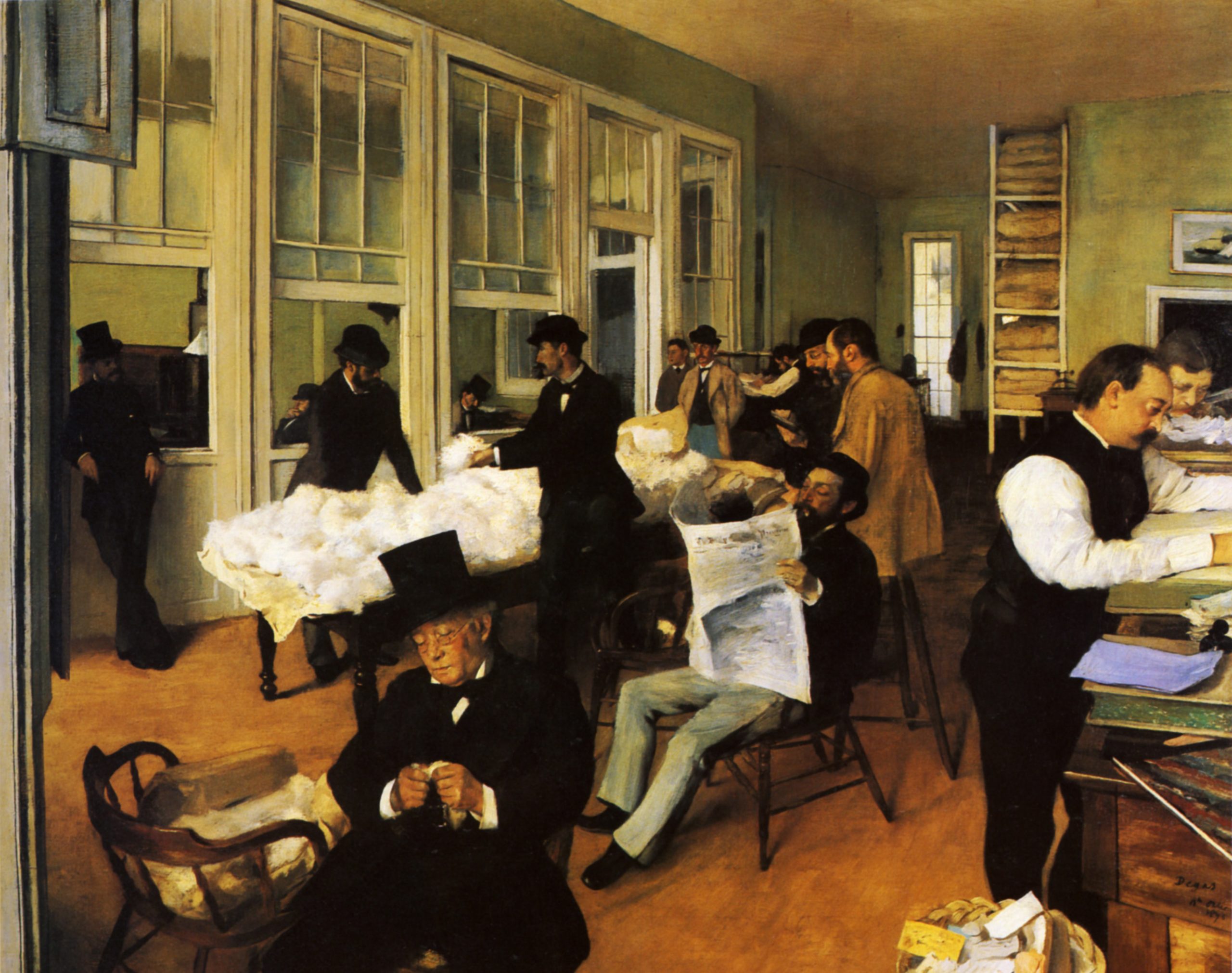
Portrait in a New Orleans Cotton Office shows a long green-walled office with tall glazed partitions, in which more than a dozen men are at work. In the foreground an elderly gentleman in a black top hat sits testing raw cotton between his fingers. Behind him runs a long table heaped with white cotton, with two men in dark suits standing at it. Right of centre one man sits with his legs crossed reading an opened newspaper, and at the right edge a man in a white shirt bends over the ledgers. Not one of them is looking at the painter. The original is an oil work on canvas and is held by the Musée des Beaux-Arts in Pau under inventory number 878.12. Ours is made by hand in seven sizes from 50 x 40 to 150 x 110 cm, or to your own measurement, and you receive a photograph of the finished work for approval before it ships.
| Title: | Portrait in a New Orleans Cotton Office |
| Other titles: | Bureau de marchands de coton à La Nouvelle-Orléans, A Cotton Office in New Orleans |
| Painter: | Edgar Degas (1834–1917) |
| Year: | 1873 |
| Size of the original: | 73 cm x 92 cm |
| Technique of the original: | oil, canvas |
| Style: | impressionism |
| Where it hangs: | Musée des Beaux-Arts, Pau (inv. 878.12) |
| Our version: | hand-painted in oil on linen, 7 sizes from 50 x 40 cm to 150 x 110 cm, custom size on request |
Portrait in a New Orleans Cotton Office – Edgar Degas
Who is in the scene?
More than a dozen men in one office; the record names none of them. In the foreground an elderly gentleman in a black top hat, his spectacles slipped down and his beard white, tests a tuft of raw cotton between his fingers. Behind the long table of white cotton a man in a dark suit and black hat pushes his hands into the heap; to his left a second leans across the table. Right of centre a man sits with his legs crossed reading an opened newspaper, which catches all the light. At the back two men in brownish coats are talking, and at the right edge a man in a white shirt and dark waistcoat bends over open ledgers.
What is on the canvas?
A long room with green walls, tall glazed partitions at the left and a warm ochre wooden floor. The centre is taken by the table with its heap of raw cotton — the whitest thing on the whole surface. At the back right stands a tall rack of pale bundles, a small framed work hangs on the wall, and light falls through a door in the background. At the left, through the glass, another office is visible with a man at its window. The colours are earthy and quiet: green wall, black suits, brown floor, and the white cotton in the middle of it. Lower right stand the signature and the note of place and year.
Why does this scene matter?
Because it is a portrait that behaves like a report. The title promises a portrait; what is on the canvas is a working day — one man testing goods, one reading a paper, one writing in a ledger, two talking. Not one looks at the painter and not one poses. The second reason is the signature: at the lower right Degas wrote the place and the year beside his own name, New Orleans 1873, dating and locating the scene in his own hand. The third is the cotton. Everything these men are doing turns on that white material, and it is the only thing on the canvas that shines.
What does the scene mean?
Work as it looks from the inside. Impressionism in Degas meant a cut from modern life as the eye takes it from one particular place, and that place here is the office door. An impressionist painting of this kind therefore shows no special occasion but an ordinary Wednesday. As wall art it is unusually readable: it holds many small stories and you notice somebody different each time. Take it as a large painting and the scene gets room enough to be searched like a photograph, which is what this subject rewards.
The subject among Degas’s works
Degas painted group portraits in working rooms more than once. Portraits at the Stock Exchange is the same kind of scene, but in Paris and in a crowd, The Collector of Prints sets one man among his own possessions, and Hilaire de Gas is an early family portrait in an entirely different key. The work is recorded in the Degas catalogue raisonné as MS 837; from the same stay comes the smaller version, Cotton Merchants in New Orleans, MS 838.
How is our hand-painted version made?
With a brush and oil paint, not a printer. The original is oil on canvas, so the same technique as ours. On this subject the demanding thing is the number of people. Each figure is built separately and from the back forwards, or they merge in their dark suits into a single mass; air has to stay between them. The cotton is the second difficulty: it must be white without reading as empty, so it is made from several greys and yellowish tones and the brightest tips go on last. The green wall and the ochre floor give the whole its colour and are laid in first. The newspaper is the only genuinely bright surface on the right and is left until the end. Every reproduction is painted afresh, and no two are quite alike, because a hand does not repeat the same stroke twice; each hand-painted copy is therefore its own. For this work we have no photographs of our finished canvases, so none are shown here and none are described. You receive the photograph of your own canvas before it ships.
Which size for which wall?
If you do not know which: 100 x 80 cm. On this work that size is closest to the original in area and in proportion at once: the original measures 73 x 92 cm, in proportion 50 x 40 and 100 x 80 cm are equally close, and in area 100 x 80 cm is the nearest of everything we make. The 50 x 40 cm has the right proportion but is too small for this subject; the figures merge at that size. The 70 x 50 and 80 x 60 cm are the usual choice above a chest of drawers, though only at 80 x 60 cm do the individual faces separate. The 90 x 60 cm is the most elongated and the least like the original. The 100 x 80 cm is the right choice here. The 120 x 90 and 150 x 110 cm give the scene enough room to be searched like a photograph. Measure the size you choose on the wall first with a paper cut-out. No size is kept in stock as a finished piece: every copy is painted to order and stays a single piece.
Custom size, stretcher and frame
If none of the seven sizes fits, or if you want the exact proportion of the original, we paint to your measurement and keep the proportions of the scene as we do, so that the cotton table keeps its width and the depth of the office to the right is not shortened; this is our work painted to order. Every canvas painting ships stretched on a wooden stretcher, ready to hang. For the frame, use our 3D app: it shows every moulding we carry on this subject, so you can compare gold, silver, black, white and natural wood — it is for choosing a frame and nothing else. If you want to see how the work looks on your own wall, we have a separate service for that, placement in the room.
Delivery and guarantee
Every piece is painted to order in our workshop in Slovenia, so allow 15-45 days depending on the size chosen; at the largest sizes the time is usually at the upper end. It travels stretched and protected for transport, framed if you chose a frame, to sixteen countries in the European Union, with no customs. Before it ships you receive a photograph of the finished work for approval, and our returns policy applies to every order. The painter’s full offer is in the Edgar Degas gallery, and his life is described in our article about Edgar Degas.
Frequently asked questions
What painting is this?
It is Degas’s scene in a cotton office in New Orleans, 1873, oil painted on canvas, 73 x 92 cm, held by the Musée des Beaux-Arts in Pau under inventory number 878.12.
What is happening in the scene?
A working day in a cotton merchants’ office: testing goods, reading the paper, writing in ledgers, talking.
How many people are in it?
More than a dozen. Some stand in the foreground and are clearly seen; others are only indicated in the depth of the room.
Who are these people?
The record does not name them. It gives only the place and the year, which the painter wrote beside his signature.
Why is a city name next to the signature?
Because Degas signed and dated it at the lower right, with the note New Orleans and the year 1873.
Where is the original?
In the Musée des Beaux-Arts in Pau, France, under inventory number 878.12.
How big is the original?
73 x 92 cm. Our 100 x 80 cm is the closest to it in area and proportion at once.
Is there a second, similar version?
Yes, a smaller version of the same subject from the same stay, held by the Fogg Art Museum at Harvard University.
Is this a print?
No. The work is made by hand in oil; the brushstrokes are visible and can be felt.
Can I have a size that is not on the list?
Yes, we paint to measurement and keep the proportions of the scene as we do.
Is it suitable as a gift?
Yes, especially for an office or for someone who likes scenes with a great deal of detail. Because every piece is painted to order, allow for the making time; if you would rather leave the choice to the recipient, there is our voucher.
- Subject: a cotton merchants’ office on a working day, more than a dozen men, nobody posing
- Original: Edgar Degas, oil painted on canvas, 73 x 92 cm, Musée des Beaux-Arts, Pau (878.12)
- Ours: painted by hand in oil, seven sizes from 50 x 40 to 150 x 110 cm, stretched and framed on request
- Note: Degas wrote the place and the year beside his signature — New Orleans, 1873