







































Description
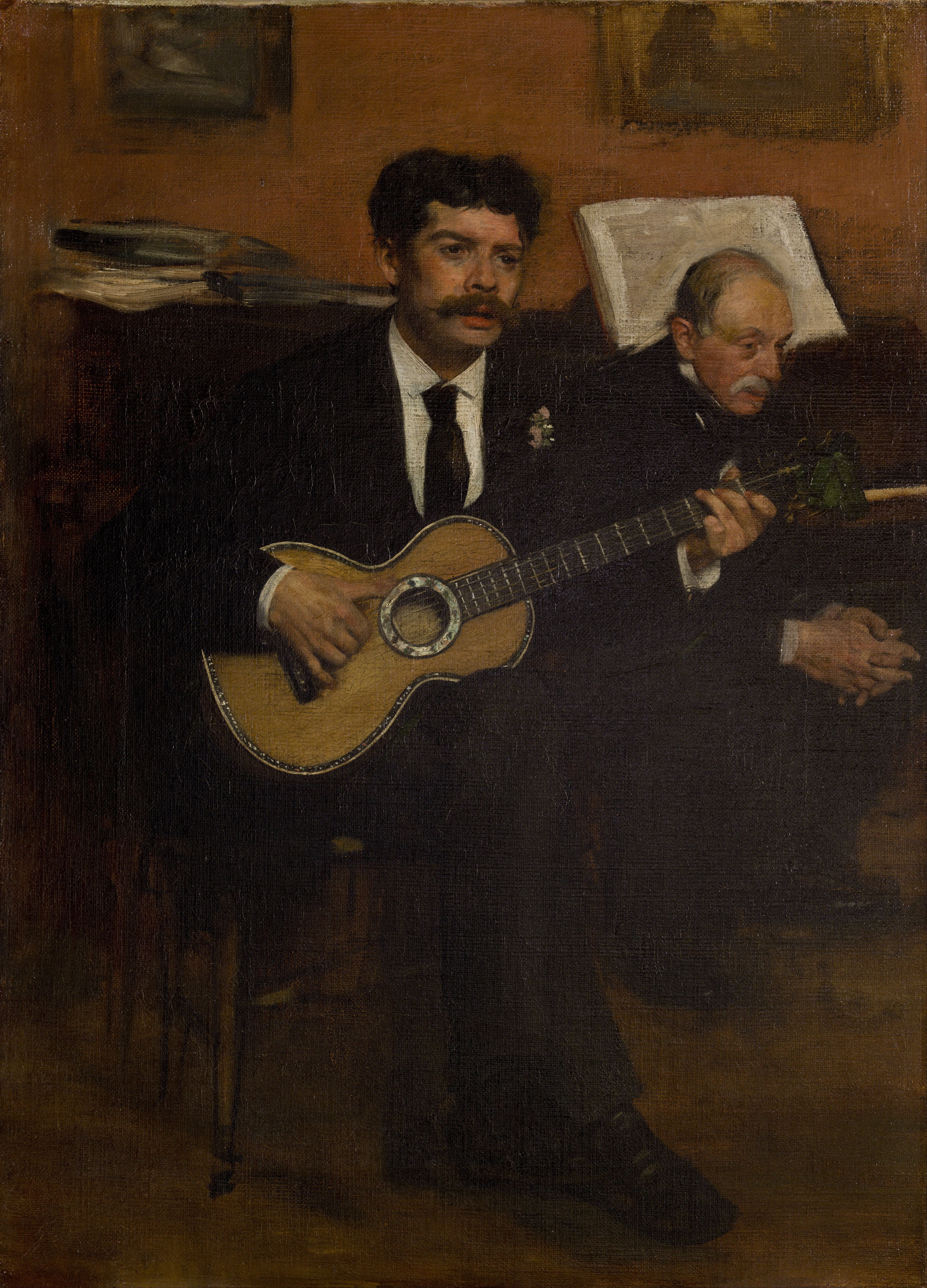
Lorenzo Pagans and Auguste De Gas shows two men in a dark room: in front sits a younger man with a black moustache playing a pale, honey-coloured guitar, and behind him and slightly to the right an older man with a white moustache listens beside the piano with his hands folded. As a canvas painting this is an upright, quiet scene of music at home, in which nobody looks out at us. The original is oil on canvas and is held in the Musée d’Orsay in Paris under the inventory number RF 3736. We make it as a hand-painted work on linen, in sizes from 40 x 60 to 150 x 210 cm or to your own measurements, and you receive a photograph of the finished work for approval before dispatch.
| Title: | Lorenzo Pagans and Auguste De Gas |
| Other titles: | Lorenzo Pagans et Auguste De Gas |
| Painter: | Edgar Degas (1834–1917) |
| Period of execution: | the 1870s |
| Original size: | 54,5 cm x 39,5 cm |
| Original technique: | Oil on canvas |
| Painting style: | Impressionism |
| Located at: | Musée d’Orsay, Paris (inv. no. RF 3736) |
| Our reproduction: | hand-painted oil on linen canvas, 7 sizes from 40 x 60 cm to 150 x 210 cm, custom sizes on request |
Lorenzo Pagans and Auguste De Gas – Edgar Degas
Who is shown?
Two men, both named in the title already, which with Degas is a rarity – he almost never named his models. In front sits Lorenzo Pagans, a Spanish singer who performed with the guitar in the Paris salons; he is turned a little to the right and looks past us. Behind him, at the piano, sits Auguste De Gas – the painter’s father. That is the heart of the scene: the son painted his father listening, not posing. The older man’s hands are folded, his head slightly bowed and his eyes lowered; this is not a pose held for a portrait but the attitude of someone absorbed in the music.
What is on the canvas?
The format is upright and tight. The guitar is the brightest object in the scene: honey-yellow, with a decorated ring around the soundhole, and it fills nearly the whole centre of the lower half. The player’s right hand is over the soundhole, his left reaches up the neck to the right. Pagans’s black suit almost merges with the dark behind him; only the white collar and the face come forward out of it. A small green leaf sits at his lapel. At the upper right, behind the father’s head, an open score glows on a stand, and at the upper left a pile of papers lies on the dark surface of the piano. The wall is a warm reddish brown and carries two framed sheets, one at the upper left and one at the upper right. At the lower left the thin legs of a chair are visible.
Why does this particular scene matter?
Because it is a family portrait by Degas pretending to be a scene. The painter put his father in the second plane, in shadow, with no gaze and no pose – and that is exactly why it reads as truer than any official portrait of those years. The music is a pretext: really this is two people in the same room, each doing something of their own. Degas carried the same idea into the ballet and the orchestra later, where the event is always incidental and people are caught mid-action. Here we see it in its most private form.
What does the scene mean?
Listening. Nothing happens, nobody addresses the viewer, and that is where the warmth of the scene comes from. Impressionism for Degas always meant a cutting out of everyday life rather than an arranged scene; an impressionist painting of this kind is therefore not light and airy, as the name leads you to expect, but dark and inward. As wall art it carries a room through mood rather than through colour, which is why it works where people stay a while.
The motif among Degas’s works
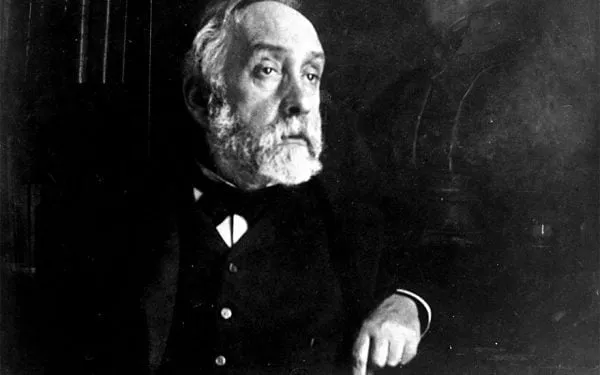
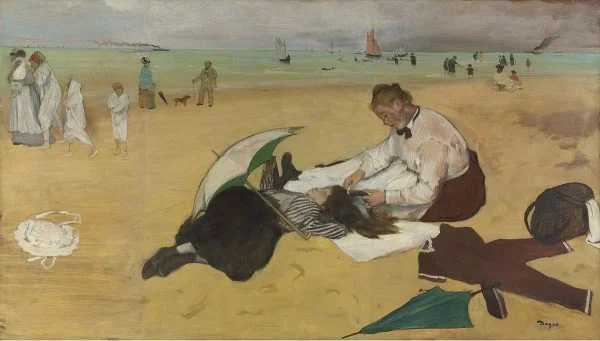
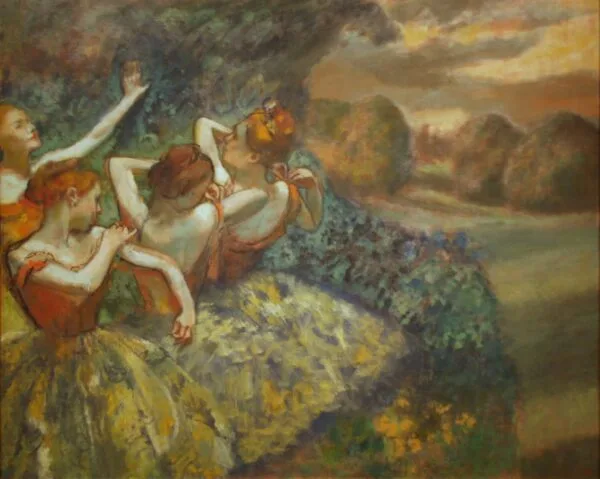
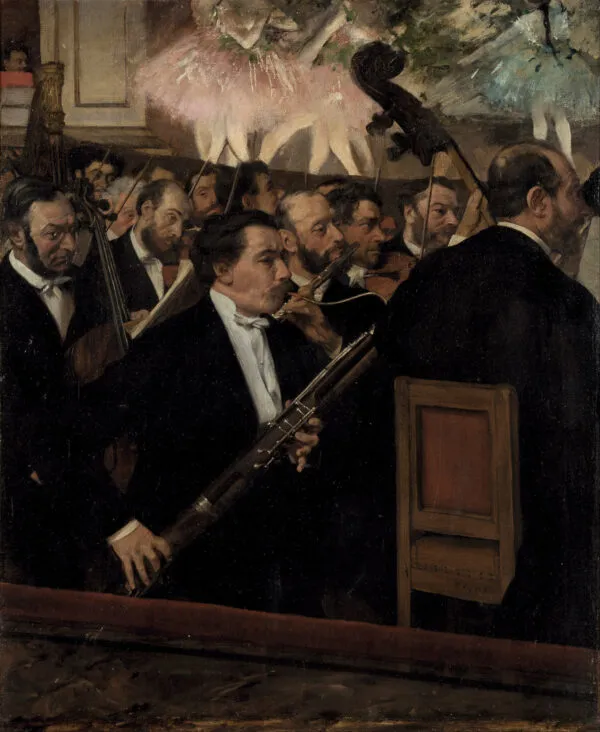
Music returns often in Degas. In The Orchestra at the Opera the same world is seen from the stalls, with the strings in the foreground and the stage above; The Cellist Pilet is the portrait of a single musician with his instrument in his lap, and so the nearest relative of this canvas. The family line continues in Hilaire de Gas, a portrait of the painter’s grandfather. How Degas looked at the musicians in the pit below the stage is shown by Ballet at the Paris Opéra at the Art Institute of Chicago, and how he looked at himself by the Self-Portrait in the same collection.
How is our hand-painted version made?
With a brush and oil colours, not a printer, and here the technique of the original is the same as ours. Every one of our canvases is made layer after layer, and in this scene the dark is the hardest part: a large part of the canvas is nearly black, but it is not empty – the suit, the piano and the wall can still be told apart inside it. If the painter evens the dark out, the scene loses its depth and the guitar floats in a void. The colour is therefore built in thin layers until it takes on warmth. Every reproduction is made afresh and no two copies are ever quite the same, because the hand does not repeat the same stroke twice; every hand-painted copy is therefore its own. For this work we have no photographs of our finished canvases, so we show and describe none here. The photograph of your canvas reaches you before dispatch.
Which size for which wall?
If you do not know which: 60 x 80 cm. The original is small – 54,5 x 39,5 cm – so even our smallest size is a little larger than it; if you want the impression of the original, stay with 40 x 60 or 50 x 70 cm, of which 50 x 70 cm is the closest in proportion. The 60 x 80 and 80 x 110 cm sizes are the most usual choice above a chest of drawers or beside a door; at them the faces and the guitar are large enough to read from a few metres. The 90 x 130 cm size belongs beside a sofa or in a dining room, where the upright format fills a narrow wall well. The 120 x 170 and 150 x 210 cm sizes are genuinely large: at them the figures are close to life size, and a large painting of this kind needs a few metres of distance, or the dark opens out into a flat plane. Measure your chosen size on the wall with a paper cut-out first; with an upright format the mistake is usually made in the height. None of the sizes is held in stock as a finished item: every copy is made to order and stays a single piece.
Custom size, stretcher bar and frame
If none of the seven sizes suits your wall, we paint to your measurements and keep the proportions of the scene, so that the guitar stays in the middle and the father in the background keeps his space; that is our painting made to order. Every copy is delivered stretched on a wooden bar, ready to hang. For the frame, use our 3D application: on this motif it shows every moulding profile we carry, so you can compare gold, silver, black, white and natural wood – it is for choosing a frame and nothing else. If you want to see how the work looks on your own wall, that is our separate room-placement service.
Delivery and guarantee
Every copy is made to order in our studio in Slovenia, so allow 15 to 45 days depending on the size you choose; for the largest sizes the time is usually at the upper end. We send it stretched and protected for transport, framed if you chose a frame, to sixteen countries in the European Union, without customs duties. You receive a photograph of the finished work for approval before dispatch, and our returns policy applies to every order. The whole range is in the Edgar Degas gallery, and the painter’s life is described in our article about Edgar Degas.
Frequently asked questions
Who are the two men?
Lorenzo Pagans, a Spanish singer playing the guitar, and Auguste De Gas, the painter’s father, listening beside the piano.
Why is the father in the background?
Because the scene is not a portrait of the father but a moment of listening. Degas left him in shadow and without a pose, and that is exactly what gives the canvas its intimacy.
What is the singer holding?
A guitar with a pale honey-coloured body and a decorated ring around the soundhole. It is the brightest object in the scene.
What can be seen on the wall?
Two framed sheets, at the upper left and the upper right, and an open score on a stand behind the father’s head.
Why is there no exact year in the table?
Because the record gives it only to the decade. We would rather write the decade than invent a year.
Where is the original located?
In the Musée d’Orsay in Paris, under the inventory number RF 3736.
How large is the original?
54,5 by 39,5 cm, so quite small. All of our sizes are larger than it.
Why is the work so dark?
Because the scene is an interior lit from one side. The dark is not empty – the suit, the piano and the wall can still be told apart inside it.
Is this a print?
No. The work is painted by hand in oil colours; the brushstrokes are visible and can be felt.
Which size should I choose?
Above a chest of drawers usually 60 x 80 cm, for the impression of the original 50 x 70 cm. The size guide is above.
Is it suitable as a gift?
Yes, especially for a musician or for someone who likes quiet, warm scenes. Because every copy is made to order, allow for the making time; if you would rather leave the choice to them, there is our gift voucher.
- Subject: a singer with a guitar in front, the painter’s father at the piano behind him, a dark room with a score and two framed sheets
- Original: Edgar Degas, an oil painting on canvas, 54,5 x 39,5 cm, Musée d’Orsay in Paris (RF 3736)
- Ours: hand-painted in oil, seven sizes from 40 x 60 to 150 x 210 cm, stretched and framed on request
- Worth knowing: the older man is the painter’s father – Degas almost never named his models, and here both are in the title