







































Description
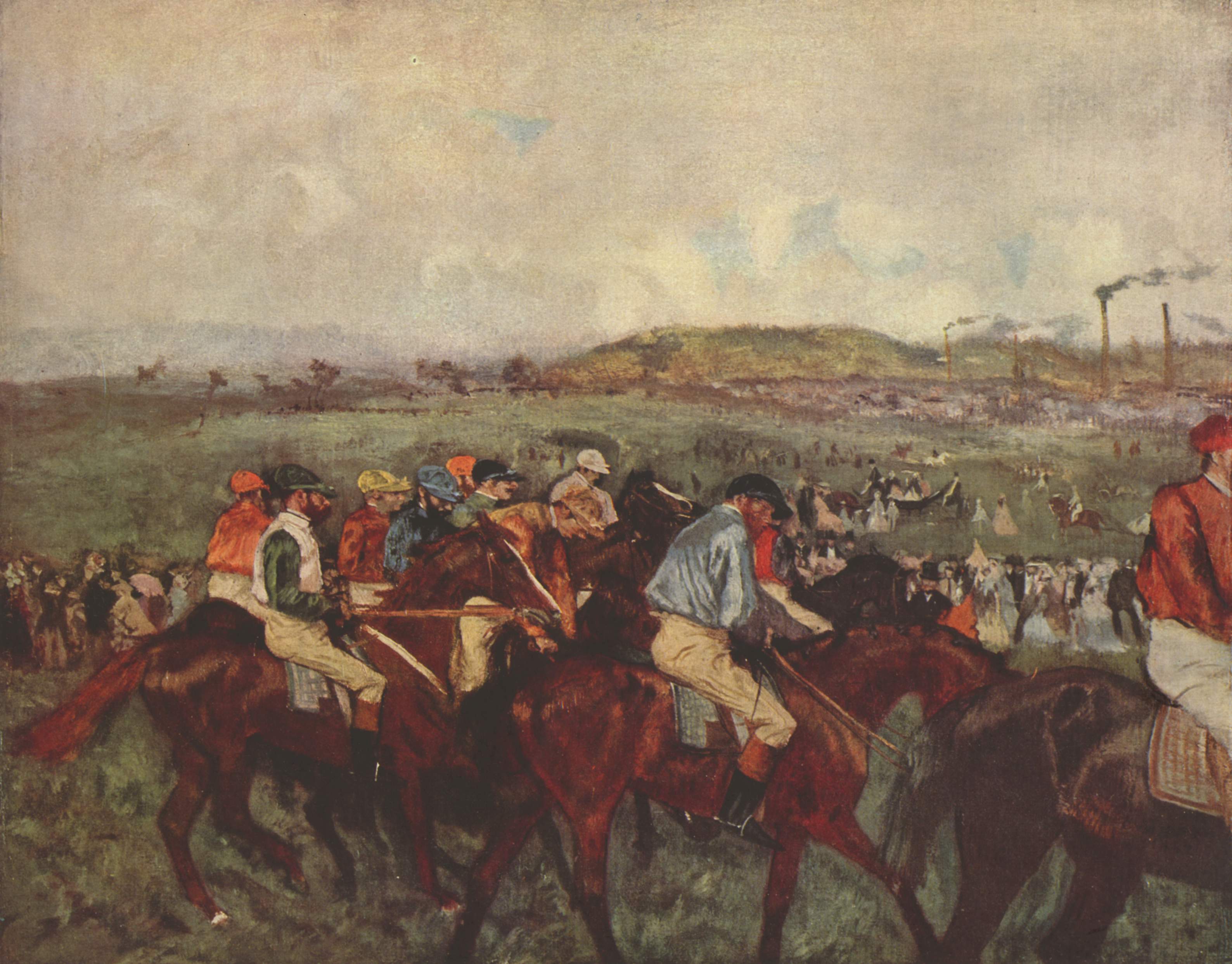
Gentlemen’s Race. Before the Start shows a group of riders on brown horses moving from left to right across the grass of the course before the race begins. The riders wear coloured silks and caps – red, green, yellow, blue-grey – and behind them stretch a low green hill and a crowd of spectators with carriages. At the right, above the horizon, factory chimneys are smoking. As a canvas painting this is a landscape-format scene before the event rather than during it. The original is oil on canvas and is held in the Musée d’Orsay in Paris under the inventory number RF 1982. We make it as a hand-painted work on linen, in sizes from 50 x 40 to 150 x 110 cm or to your own measurements, and you receive a photograph of the finished work for approval before dispatch.
| Title: | Gentlemen’s Race. Before the Start |
| Other titles: | Course de gentlemen. Avant le départ |
| Painter: | Edgar Degas (1834–1917) |
| Year of execution: | 1862 |
| Original size: | 48 cm x 61 cm |
| Original technique: | Oil on canvas |
| Painting style: | Impressionism |
| Located at: | Musée d’Orsay, Paris (inv. no. RF 1982) |
| Our reproduction: | hand-painted oil on linen canvas, 7 sizes from 50 x 40 cm to 150 x 110 cm, custom sizes on request |
Gentlemen’s Race. Before the Start – Edgar Degas
Who is shown?
Eight or nine riders, none of them named. They are not professional jockeys but gentlemen – amateurs who in those years rode their own horses, as the title says. We see them mostly from behind and from the side, moving across the grass. The silks and caps are coloured: red, green, yellow, white and one blue-grey in the centre, which stands out most. At the far right is a rider in a red jacket and red cap, cut by the edge of the canvas. Nobody looks out at us.
What is on the canvas?
The format is landscape and the horizon sits low, so the sky takes nearly half the canvas. In front moves a line of brown and dark brown horses, the riders in pale breeches and black boots. Behind them stretches a wide green plain, a low green hill rises in the middle, and the sky is pale and hazy. At the back right stands a crowd of spectators with carriages and pale dresses, and at the left edge another, smaller group. And at the right above the horizon: several tall factory chimneys with dark plumes of smoke trailing from them.
Why does this particular scene matter?
Because of those chimneys. The race is an old, gentlemanly amusement, but Degas painted a factory behind it – and so said where and when the scene takes place. In 1862 that was not usual: equestrian scenes were then aristocratic and timeless, while here industry slips into the same work. The second thing is the timing: the scene is caught before the start, not during the race. No gallop, no dust, no winner – only waiting and movement over grass. Degas painted the moments just before the event all his life, and here that habit begins.
What does the scene mean?
Expectation. The tension is in the fact that nothing has happened yet. Impressionism for Degas always meant a cutting caught as the eye sees it – including when the cutting takes in something that does not “belong” in the scene, like the chimneys. An impressionist painting of this kind therefore reads as a look from the edge of the course rather than a ceremonial picture of sport. As wall art it carries a room through air and distance; with this motif the sky matters as much as the horses.
The motif among Degas’s works
Horse racing is Degas’s second great subject, right after the ballet. At the Races in the Countryside shows the same world with a family and a carriage instead of a start, Race Horses before the Stands puts the horses in front of the crowd, and Before the Race catches the same moment of waiting from close up. How precisely Degas studied the rider is shown by Jockey at the Art Institute of Chicago, and how he saw a crowd out of doors by Beach Scene at the National Gallery in London.
How is our hand-painted version made?
With a brush and oil colours, not a printer, and here the technique of the original is the same as ours. Every one of our canvases is made layer after layer, and in this scene the line of horses is the hardest part: several animals overlap, and each has to stay separate from its neighbour or the group turns into a brown mass. The other demanding part is the sky, which has to stay hazy rather than empty. The coloured silks are painted last, because they are the only pure colours on the canvas. Every reproduction is made afresh and no two copies are ever quite the same, because the hand does not repeat the same stroke twice; every hand-painted copy is therefore its own. For this work we have no photographs of our finished canvases, so we show and describe none here. The photograph of your canvas reaches you before dispatch.
Which size for which wall?
If you do not know which: 80 x 60 cm. The original measures 48 x 61 cm, and our 70 x 50 cm size comes nearest to it in size; in proportion the nearest are 50 x 40 and 100 x 80 cm, because our sizes run a little wider than the original. The 50 x 40 and 70 x 50 cm sizes are for a smaller room or a hallway, where the individual riders already become hard to tell apart. The 80 x 60 and 90 x 60 cm sizes are the most usual choice above a chest of drawers. The 100 x 80 cm size is for a larger wall, where the sky is given its space. The 120 x 90 cm size belongs above a sofa, and at 150 x 110 cm we are at the sizes where a large painting really breathes and the horses stand close to life size. Measure your chosen size on the wall with a paper cut-out first; with a landscape format the mistake is usually made in the width. None of the sizes is held in stock as a finished item: every copy is made to order and stays a single piece.
Custom size, stretcher bar and frame
If none of the seven sizes suits your wall, or if you want the original’s proportion, we paint to your measurements and keep the proportions of the scene, so that the line of horses stays whole and the chimneys at the right do not fall off the canvas; that is our painting made to order. Every copy is delivered stretched on a wooden bar, ready to hang. For the frame, use our 3D application: on this motif it shows every moulding profile we carry, so you can compare gold, silver, black, white and natural wood – it is for choosing a frame and nothing else. If you want to see how the work looks on your own wall, that is our separate room-placement service.
Delivery and guarantee
Every copy is made to order in our studio in Slovenia, so allow 15 to 45 days depending on the size you choose; for the largest sizes the time is usually at the upper end. We send it stretched and protected for transport, framed if you chose a frame, to sixteen countries in the European Union, without customs duties. You receive a photograph of the finished work for approval before dispatch, and our returns policy applies to every order. The whole range is in the Edgar Degas gallery, and the painter’s life is described in our article about Edgar Degas.
Frequently asked questions
What is happening in the scene?
Nothing yet. The riders are moving over the grass before the start; the race has not begun.
Who are the riders?
Gentlemen amateurs, not professional jockeys – the title says so. None of them is named.
What are the chimneys on the right?
Factory chimneys with smoke. They are the most unusual detail on the canvas and they place the race in its own time and its own country.
What is in the background?
A wide green plain with a low hill in the middle, a crowd of spectators with carriages at the right, and a smaller group of people at the left.
Where is the original located?
In the Musée d’Orsay in Paris, under the inventory number RF 1982.
How large is the original?
48 by 61 cm, so relatively small and wider than it is tall. Our 70 x 50 cm size comes nearest to it in size.
Are our sizes in the same proportion as the original?
Not quite – ours run a little wider. In proportion the nearest are 50 x 40 and 100 x 80 cm; if you want the original’s proportion, we paint it to your measurements.
Is this a print?
No. The work is painted by hand in oil colours; the brushstrokes are visible and can be felt.
Which size should I choose?
Above a chest of drawers usually 80 x 60 cm, for a smaller room 70 x 50 cm. The size guide is above.
Can I have a size that is not listed?
Yes, we paint to measure and keep the proportions of the scene while doing it.
Is it suitable as a gift?
Yes, especially for someone who rides or likes horses and open landscape. Because every copy is made to order, allow for the making time; if you would rather leave the choice to them, there is our gift voucher.
- Subject: eight or nine riders in coloured silks before the start, a green plain, a crowd at the right and factory chimneys above the horizon
- Original: Edgar Degas, an oil painting on canvas, 48 x 61 cm, Musée d’Orsay in Paris (RF 1982)
- Ours: hand-painted in oil, seven sizes from 50 x 40 to 150 x 110 cm, stretched and framed on request
- Worth knowing: factory chimneys smoke behind an old gentlemanly amusement – in 1862 that was not usual in an equestrian scene