


Description
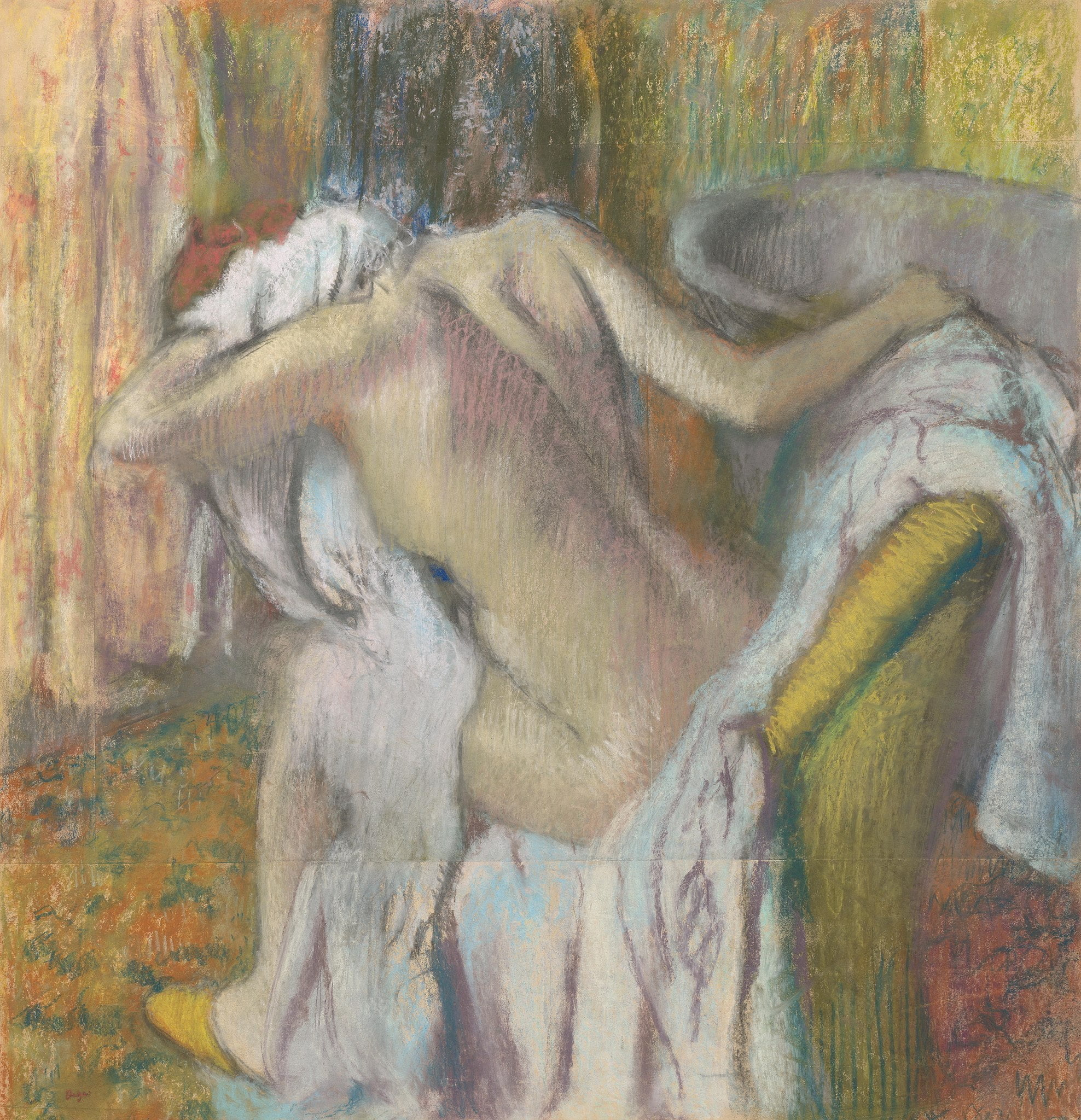
After the Bath, Woman Drying Herself shows a woman seen almost entirely from behind, bent forward, drying her neck and shoulders with a white towel. Her face is not visible; her raised arm hides her head. At the right stands an armchair with a yellow cushion, a large white sheet thrown across it, and at the lower left a patterned carpet spreads in orange and green. The background is not a wall but a curtain of yellow, green and blue strokes. Faint straight seams run across the sheet. The original is a pastel on paper mounted on board and is held by the National Gallery in London under inventory number NG6295. Ours is made by hand in eight sizes from 50 x 55 to 150 x 160 cm, or to your own measurement, and you receive a photograph of the finished work for approval before it ships.
| Title: | After the Bath, Woman Drying Herself |
| Other titles: | Après le bain, femme s’essuyant |
| Painter: | Edgar Degas (1834–1917) |
| Year: | about 1890–1895 |
| Size of the original: | 103.5 cm x 98.5 cm |
| Technique of the original: | pastel on paper, mounted on board |
| Style: | impressionism |
| Where it hangs: | The National Gallery, London (inv. NG6295) |
| Our version: | hand-painted in oil on linen, 8 sizes from 50 x 55 cm to 150 x 160 cm, custom size on request |
After the Bath, Woman Drying Herself – Edgar Degas
Who is in the scene?
One woman; the record does not name her. She sits or kneels at the edge of an armchair and leans forward and to the right. With her right hand she has brought a white towel over her shoulder and is drying her neck; her left arm reaches along the arm of the chair. Her head is almost entirely hidden behind the raised arm and her face cannot be seen. What we see above all is her back: a long curve from nape to hip that takes the middle of the scene and is the brightest surface in it. There is nobody else.
What is on the canvas?
The scene is nearly square and full of cloth. At the right stands an armchair with a yellow cushion and a rounded back; a large white sheet is thrown over it and falls in folds to the lower edge. At the lower left a carpet spreads with a small pattern in orange, green and brown. The background is not a wall but vertical strokes of yellow, green, blue and brown, like a curtain. Faint straight seams, horizontal and vertical, run across the sheet. The colours are warm and dry as pastel is: ochre, pink, olive green, yellow. Lower left, the signature.
Why does this scene matter?
Because Degas treats the body as a landscape. There is no face, no pose and no story; what remains is a back over which the light climbs as it would climb a slope. The woman does not know she is being looked at, and the scene is built so that the same is true of us: we do not enter it, we catch it in passing. The second reason is the construction — three large surfaces, the back, the white sheet and the patterned carpet, each with its own texture. The third is the seams in the sheet, still visible in the original and never covered over.
What does the scene mean?
Privacy without a story. Impressionism in the late Degas is no longer a scene from the city but a study of a body and its colour in a closed room. An impressionist painting of this kind therefore has no event to summarise; it has a gesture and a light. As wall art it is demanding and warm, and the large surfaces let it carry a big format easily. Take it as a large painting and the figure passes life size, which is the point at which the back stops being a body and becomes the landscape Degas painted.
The subject among Degas’s works
The bathers are a large late group in Degas. After the Bath (bending figure) shows the same task from another side, After the Bath (1895) is from the same years and likewise in pastel, and Woman Combing Her Hair is the same kind of scene with a different gesture. The work is held by the National Gallery in London as NG6295; a related late version of the same subject is described in the Degas catalogue raisonné as MS 1090.
How is our hand-painted version made?
With a brush and oil paint, not a printer. Here too the difference has to be said straight out: the original is not an oil painting but a pastel on paper mounted on board, and our version is oil on canvas, recreated from the pastel. Pastel is dry and grainy, so we do not imitate it with smooth colour but with thin passes laid over one another that let the layer below show through. The back is the hard part: it has to stay the brightest surface on the canvas and still have shape, so we build it from cool shadow towards warm light and never outline it. The white sheet is painted with several different whites. The carpet goes on last, so its pattern does not take over the scene. Every reproduction is painted afresh, and no two are quite alike, because a hand does not repeat the same stroke twice; each hand-painted copy is therefore its own. For this work we have no photographs of our finished canvases, so none are shown here and none are described. You receive the photograph of your own canvas before it ships.
Which size for which wall?
If you do not know which: 98 x 104 cm. On this work that size is almost exactly the original’s: the original measures 103.5 x 98.5 cm, an area of 10,195 square centimetres, and ours is 10,192 — a difference of three square centimetres. It is also the closest in proportion. The 50 x 55 and 60 x 65 cm are small, and at those sizes the carpet pattern merges. The 70 x 75 and 90 x 100 cm are the usual choice above a chest of drawers. The 98 x 104 cm is the original’s own size. The 110 x 120 and 120 x 130 cm want a broader wall and some distance. At 150 x 160 cm a canvas painting of this kind is very strong and the figure passes life size. Measure the size you choose on the wall first with a paper cut-out. No size is kept in stock as a finished piece: every copy is painted to order and stays a single piece.
Custom size, stretcher and frame
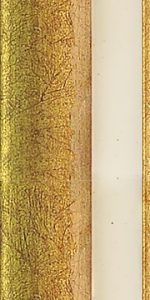
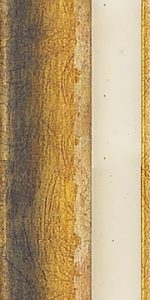
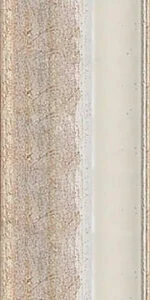
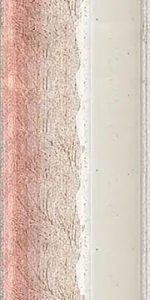
If none of the eight sizes fits, or if you want the exact proportion of the original, we paint to your measurement and keep the proportions of the scene as we do, so that the back keeps its share of the middle and the carpet at the lower left is not squeezed; this is our work painted to order. Every piece ships stretched on a wooden stretcher, ready to hang. For the frame, use our 3D app: it shows every moulding we carry on this subject, so you can compare gold, silver, black, white and natural wood — it is for choosing a frame and nothing else. If you want to see how the work looks on your own wall, we have a separate service for that, placement in the room.
Delivery and guarantee
Every piece is painted to order in our workshop in Slovenia, so allow 15-45 days depending on the size chosen; at the largest sizes the time is usually at the upper end. It travels stretched and protected for transport, framed if you chose a frame, to sixteen countries in the European Union, with no customs. Before it ships you receive a photograph of the finished work for approval, and our returns policy applies to every order. The painter’s full offer is in the Edgar Degas gallery, and his life is described in our article about Edgar Degas.
Frequently asked questions
What painting is this?
It is Degas’s pastel After the Bath, Woman drying herself, about 1890–1895, 103.5 x 98.5 cm, held by the National Gallery in London under inventory number NG6295.
Is the original an oil painting?
No. The original is a pastel on paper mounted on board. Ours is an oil painting on canvas, recreated from the pastel.
Why can we not see her face?
Because her raised arm hides it. Degas painted her almost entirely from behind and did not show the face.
What are the straight lines across the picture?
Faint seams in the sheet. The work was made on paper that was later mounted on board, and the seams were never covered over.
Where is the original?
In the National Gallery in London, in Room 42, under inventory number NG6295; whether it still hangs there can change.
How big is the original?
103.5 x 98.5 cm. Our 98 x 104 cm has almost exactly the same area.
Why is the year given as a range?
Because the museum records it that way: about 1890–5. Where a record gives a range, we keep it.
Do your sizes follow the proportion of the original?
Very closely. The 98 x 104 cm is nearest both in proportion and in area.
Is this a print?
No. The work is made by hand in oil; the brushstrokes are visible and can be felt.
Can I have a size that is not on the list?
Yes, we paint to measurement and keep the proportions of the scene as we do.
Is it suitable as a gift?
Yes, for someone who likes restrained subjects rich in colour. Because every piece is painted to order, allow for the making time; if you would rather leave the choice to the recipient, there is our voucher.
- Subject: a woman seen from behind drying her neck with a white towel, beside an armchair with a yellow cushion
- Original: Edgar Degas, pastel on paper mounted on board, 103.5 x 98.5 cm, The National Gallery, London (NG6295)
- Ours: painted by hand in oil from the pastel, eight sizes from 50 x 55 to 150 x 160 cm
- Note: our 98 x 104 cm is three square centimetres away from the original’s area