


Description
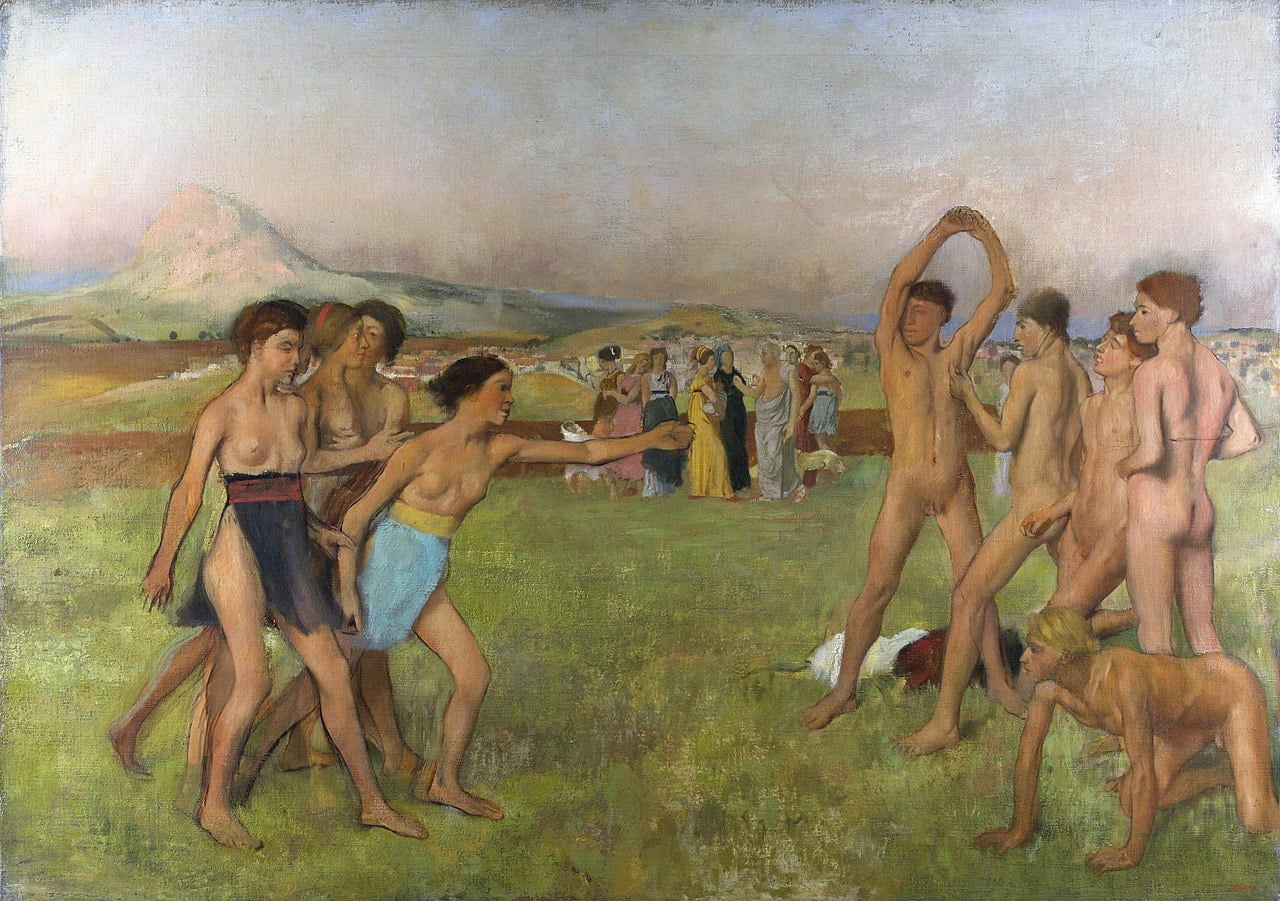
Young Spartans Exercising is an early work by Edgar Degas from around 1860: four girls stand on the left, five nude boys on the right, and between them the plain opens out towards Sparta and Mount Taygetus. As a canvas painting this is a history scene, not the rehearsal room the painter is known for today. The original measures 109.5 x 155 cm and is held by the National Gallery in London under the accession number NG3860. We make it as a hand-painted oil on linen canvas, in eight sizes or to your own measurements, and you receive a photograph of the finished work for approval before dispatch.
| Title: | Young Spartans Exercising |
| Other titles: | Petites filles spartiates provoquant des garçons · Young Spartan Girls Challenging Boys |
| Painter: | Edgar Degas (1834–1917) |
| Year painted: | about 1860, with later revisions around 1879–80 |
| Original size: | 109.5 cm x 155 cm |
| Original technique: | Oil on canvas |
| Painting style: | History painting |
| Located at: | The National Gallery, London (acc. no. NG3860) |
| Our reproduction: | hand-painted oil on linen canvas, 8 sizes from 80 x 60 cm to 180 x 130 cm, custom sizes on request |
Young Spartans Exercising – Edgar Degas
Who is shown?
The scene comes from Plutarch’s Life of Lycurgus. The Roman author describes how Spartan girls were ordered to take physical exercise – running, wrestling, throwing the discus and the javelin – and were allowed to challenge the boys. Four girls stand on the left of the canvas, five nude boys on the right; in the middle distance a group of women, the mothers of these children, surround the elderly Lycurgus, who drew up the laws of Sparta. Beyond them lies the city of Sparta, overlooked on the left by Mount Taygetus, from which unwanted Spartan infants were thrown. All of this is what the entry of the National Gallery in London records for NG3860; there are no names for the individual figures, because there are none in Plutarch and none in the museum’s own entry.
What is on the canvas?
The composition is wide and low, like a frieze. The left-hand group is carried by four girls in pale cloth gathered under the breast and around the hips: the first wears a red sash, the second a dark blue one, the third a light turquoise, and that turquoise is the most saturated note in the whole work. The girl at the front stretches her arm to the right; the gesture can be challenge or invitation; the brushwork alone does not settle it. On the right stand five boys without clothing in five different attitudes – one raises his arms above his head and closes them into an arch, a second stands with his back to us, a third crouches on all fours in the grass. The centre of the scene stays empty: only grass, retreating from green into brown towards the horizon. The sky is pale pink and cloudless, and the mountain on the left is painted in the same pink as the sky, so it reads more as a stage flat than as rock. The surface is dry and unfinished; in places the weave of the linen shows through the colour, because the work was never varnished.
Why does this particular scene matter?
Because with it Degas meant to become a history painter. In April 1859 he returned to Paris after three years in Italy studying and copying the old masters, and in the first half of the 1860s he produced five large-scale history compositions; this is one of them. History painting was then held to be the highest genre, and the road to a reputation ran through the Paris Salon. That is exactly where this work never arrived. It stayed in the studio, and Degas kept it all his life; he revised it again around 1879–80, and by the account of his friend Daniel Halévy he set it in later years on an easel in front of which he would often stop. For a painter known as a draughtsman of dancers, this work was proof he could do something else.
What does the scene mean?
The museum’s entry leaves the question open: this may be a scene of courtship rather than competition, since aspects of the girls’ hairstyles and poses correspond with accounts of such rituals in Plutarch. The outstretched arm of the front figure may be enticing quite as much as attacking. The second thing the entry records is Degas’s revision: he later replaced the classical features of the adolescents with more contemporary faces, so that ancient material carries heads of the kind he met in Paris. It is precisely this split between the old and the new that keeps the work from being a frozen antiquity. Impressionism reached it only late: in 1880 Degas showed it at the fifth Impressionist exhibition in Paris. By style it is nonetheless not an impressionist painting – there is no sunlight and no moment caught out of doors, but a considered history composition worked on across two decades.
The motif among Degas’s works
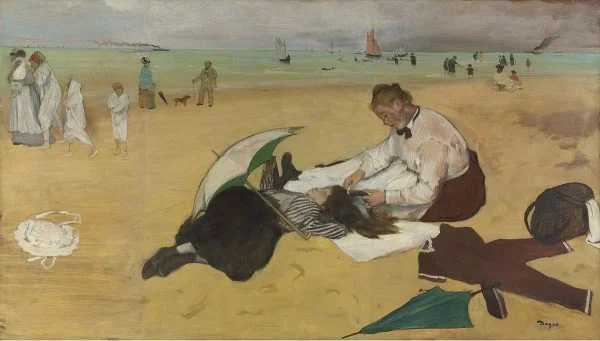
Degas did not finish the first version of this composition. He abandoned it and began again; the abandoned version, carried out in greys, is now in Chicago, where the Art Institute records it as Young Spartan Girls Challenging Boys (acc. no. 1961.334). There the landscape is more worked up and a classical building stands in the middle distance, which is gone from the London version – the plain is empty, and the scene comes closer to the viewer for it. Closest to this early, narrative side of Degas in our range are David and Goliath, another ancient and biblical subject from the same years, The Absinthe Drinker, where the painter has already turned to the Paris of his own day, and Beach Scene, where he spreads figures across the same wide, low format.
How is our hand-painted version made?
It is made with a brush and oil colours, not a printer. The painter works from a high-resolution reference and keeps what is hardest in the original: the dry, unfinished surface on which the separate strokes do not merge into a smooth plane, and the relation between the pale pink sky and the green plain. With nine figures in the foreground, the placing of the groups is measured out before any colour reaches the linen. Every reproduction is made afresh and no two copies are quite the same, because a hand does not repeat the same stroke twice; every hand-painted copy is therefore its own. This family has no photographs of our finished canvases, because the work has not been painted since we began photographing every piece – so we show and describe none here. The photograph of your canvas reaches you before dispatch.
Which size for which wall?
If you do not know which: 120 x 90 cm. The format is landscape and comparatively low, so the work needs width; on a narrow wall the frieze of the two groups is squeezed together and loses exactly that empty centre which holds the scene together. The 80 x 60 and 90 x 65 cm sizes are for a smaller wall, a hallway or a group of lesser works; 100 x 70 and 110 x 80 cm go above a chest of drawers or a desk; 120 x 90 and 140 x 100 cm are the sizes above a sofa, where wall art of this width finally has room to breathe, and where this work most often ends up. The 155 x 109.5 cm size is a special one, because it is exactly the size of the original in London, only written the other way round; 180 x 130 cm is the largest and belongs in a high room. Measure your chosen size on the wall with a paper cut-out first – with a format this wide the mistake is nearly always made in the width. None of the sizes is held in stock as a finished item: a large painting of this kind is made only to order, and each copy stays a single piece.
Custom size, stretcher bar and frame
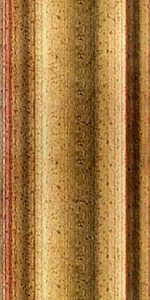
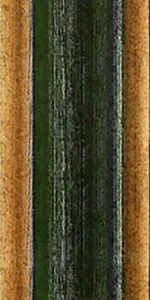
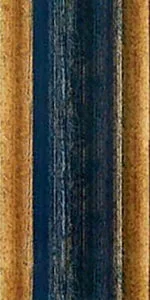
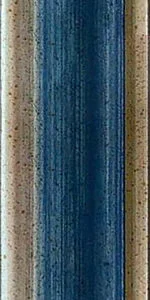
If none of the eight sizes suits your wall, we paint to your measurements and keep the proportions of the scene, so that the groups on the left and the right do not lose the emptiness between them; that is our painting made to order. Every copy is delivered stretched on a wooden bar, ready to hang. For the frame, use our 3D application: on this motif it shows every moulding profile we carry, so you can compare gold, silver, black, white and natural wood – it is for choosing a frame and nothing else. If you want to see how the work looks on your own wall, that is our separate room-placement service.
Delivery and guarantee
Every copy is made to order in our studio in Slovenia, so allow 15 to 45 days depending on the size you choose; for the two largest sizes the time is usually at the upper end. We send it stretched and protected for transport, framed if you chose a frame, to sixteen countries in the European Union, without customs duties; for destinations outside the EU, write to us before you order. You receive a photograph of the finished work for approval before dispatch, and our returns policy applies to every order. The whole range is in the Edgar Degas gallery, and the painter’s life is described in our article about Edgar Degas.
Frequently asked questions
What is happening in the scene?
Four Spartan girls are challenging five boys to exercise. The scene condenses a passage from Plutarch’s Life of Lycurgus.
Who is the old man in the middle distance?
Lycurgus, the lawgiver of Sparta. Around him stand the mothers of the children in the foreground.
Which mountain is in the background?
Taygetus, which overlooks Sparta. The museum’s entry notes that unwanted infants were thrown from it.
Why are the figures nude?
Because the subject requires it: Spartan exercise was taken without clothing. Degas also saw in the theme an opportunity to show his skill with the human body.
Was the work ever at the Salon?
No. It was made with the Salon in mind but never got there; it was shown in 1880 at the fifth Impressionist exhibition.
Why does the surface look unfinished?
Because it is. Degas was still working on it around 1879–80 and never varnished it.
Where is the original?
In the National Gallery in London, under accession number NG3860. The first, abandoned version is in the Art Institute of Chicago.
Is this a print?
No. It is painted by hand in oil on canvas; the brushstrokes are visible and can be felt.
Which size should I choose?
Above a sofa usually 120 x 90 cm, for a smaller wall 100 x 70 cm. The size guide is above.
Can I have a size that is not listed?
Yes, we paint to measure and keep the proportions of the scene while doing it.
Is it suitable as a gift?
Yes, especially for a reader of the ancient world or a lover of history painting. Because every copy is made to order, allow for the making time; if you would rather leave the choice to them, there is our gift voucher.
- Subject: four Spartan girls challenge five nude boys, with the mothers, Lycurgus and Mount Taygetus behind
- Original: Edgar Degas, about 1860, oil on linen, 109.5 x 155 cm, National Gallery in London (NG3860)
- Ours: hand-painted in oil, eight sizes from 80 x 60 to 180 x 130 cm, stretched and framed on request
- Worth knowing: the four girls have ten legs on the canvas instead of the expected eight – Degas took the movement apart the way film would later take it apart