







































Description
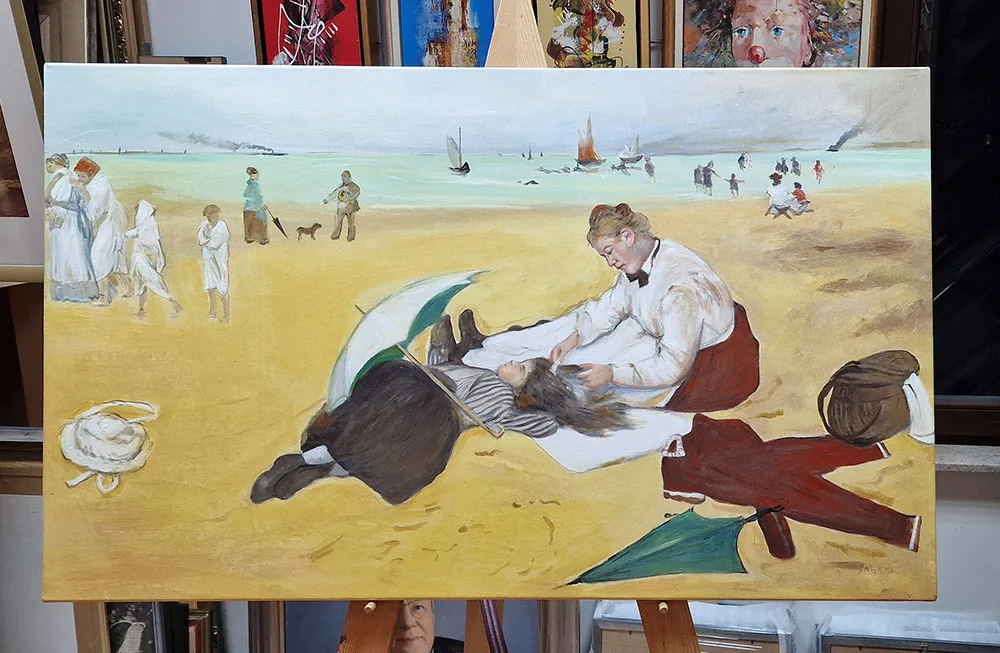
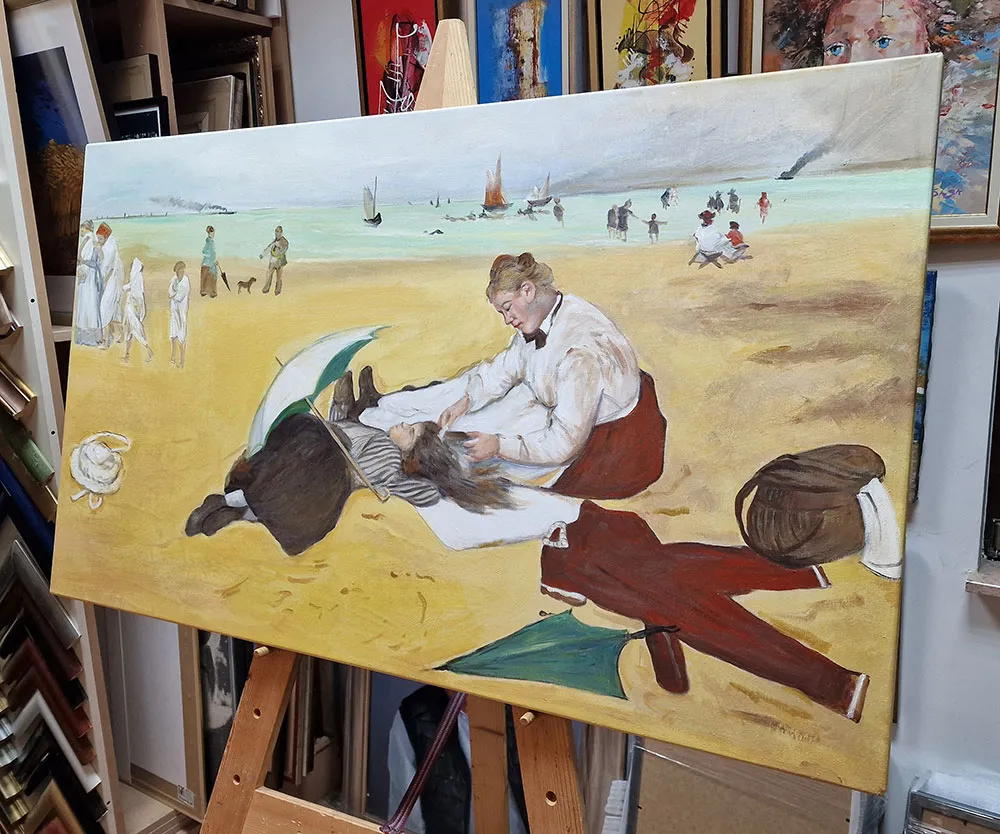
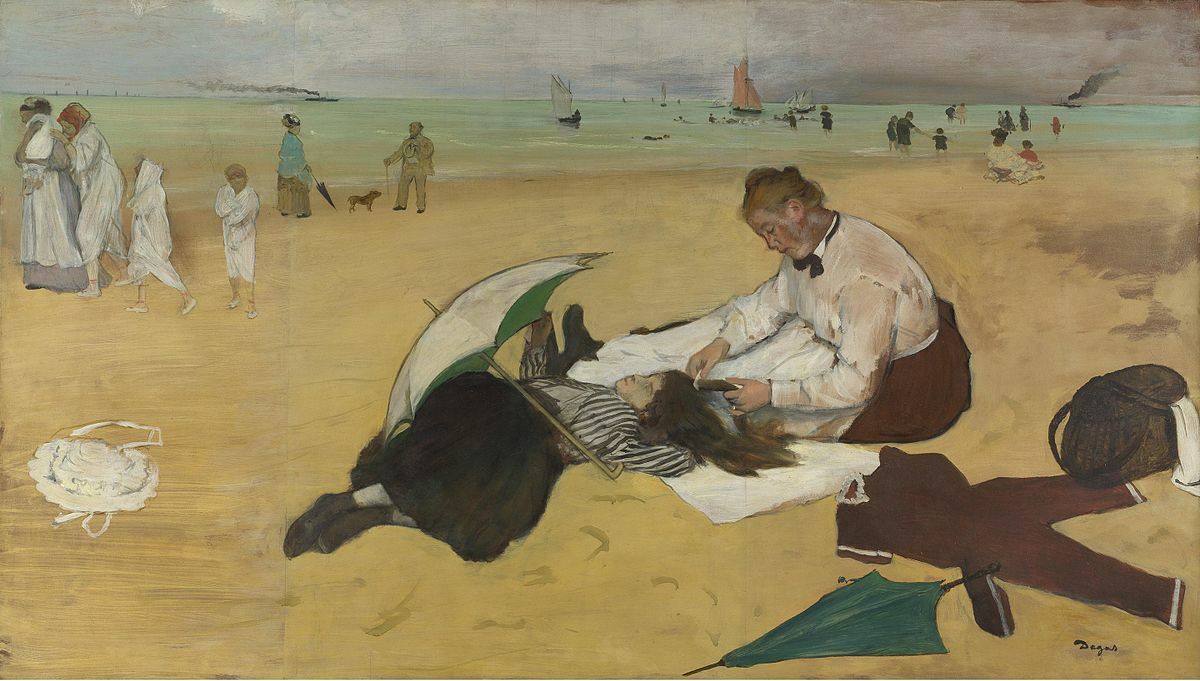
Beach Scene shows a girl lying on a white cloth and a maid combing her hair after bathing; two parasols, a basket and a summer bonnet lie scattered around them, and in the background a family wrapped in towels leaves the shoreline. As a canvas painting this is a wide, low and almost empty plane of sand in which a single quiet gesture takes place. The original is held by two institutions, each under its own accession number. We make it as a hand-painted oil on linen canvas, in eight sizes or to your own measurements, and you receive a photograph of the finished work for approval before dispatch.
| Title: | Beach Scene |
| Painter: | Edgar Degas (1834–1917) |
| Year painted: | about 1869–70 |
| Original size: | 47.5 cm x 82.9 cm |
| Original technique: | Oil on paper, mounted on canvas |
| Painting style: | Impressionism |
| Located at: | National Gallery, London (acc. no. NG3247) and Hugh Lane Gallery, Dublin (acc. no. 3247) |
| In the collection since: | 1917 (National Gallery, London) |
| Our reproduction: | hand-painted oil on linen canvas, 8 sizes from 70 x 40 cm to 180 x 100 cm, custom sizes on request |
Beach Scene – Edgar Degas
Who is shown?
A maid and a girl. By the entry of the National Gallery in London for NG3247, the maid combs the hair of a girl who has been swimming, and the girl’s bathing suit is stretched out on the ground to dry. Two parasols, a basket and a summer bonnet lie around them as well. In the background a family group, some of them wrapped in towels, is leaving the shoreline, while other people stroll further off across the sand. There are no names: these are roles, not portraits.
What is on the canvas?
The format is very wide and low, so that sand takes up almost the whole surface. The girl lies on a white cloth with her back to us, her head tipped back, her hair falling across the maid’s hands. The maid kneels behind her in a white blouse and a brick-red skirt, bent over the work. To the left stands an open parasol, white outside and green within; a second, furled and also green, lies at the lower right. Along the right edge are a brown summer bonnet and a red skirt, and at the lower left a pale wicker basket. The upper third is sea: pale green water, a few sailing boats and two steamers trailing long horizontal plumes of smoke. At the upper left stands a group dressed in white, among them a child and a dog. The sky is grey and even, without sun.
Why does this particular scene matter?
Because it is one of four beach scenes Degas painted around 1869, when he travelled to the northern French coast. The museum’s entry then adds something that turns the scene on its head: the painter later said himself that he had finished the work in the studio, explaining it with a sentence the entry quotes – the air you breathe in a picture is not necessarily the same as the air you breathe out of doors. The scene was therefore not painted in front of the motif but assembled. That is exactly what separates it from most coastal work of the period, which his contemporaries, among them Boudin and Monet, really did paint on the spot.
What does the scene mean?
Everyday care, raised to the main event. Everything around it – sea, sails, strollers – is pushed into a narrow band at the top, while the centre is held by a pair of hands in a girl’s hair. The museum’s entry notes that Degas was a great admirer of Japanese prints, and that the motif of a woman combing her hair or having it combed entered his repertoire from there. It is an impressionist painting by milieu and by date rather than by method: impressionism usually means painting in front of the motif, while this is an assembled scene. The work is therefore quiet and does not tire the eye – the sand is a large empty plane to rest on, and it is the sort of wall art you stop noticing and then keep returning to.
The motif among Degas’s works
The sea appears in Degas more than once, but only here does it get so much empty surface. Closest to this scene in our range are Landscape by the Sea, where the same coast is seen without people, View of Saint-Valéry-sur-Somme, where the coast opens into a town with houses, and Peasant Girls Bathing in the Sea at Dusk, where the bathing itself is the setting. If you want an empty coast without a story, look there; here the story is in two pairs of hands.
How is our hand-painted version made?
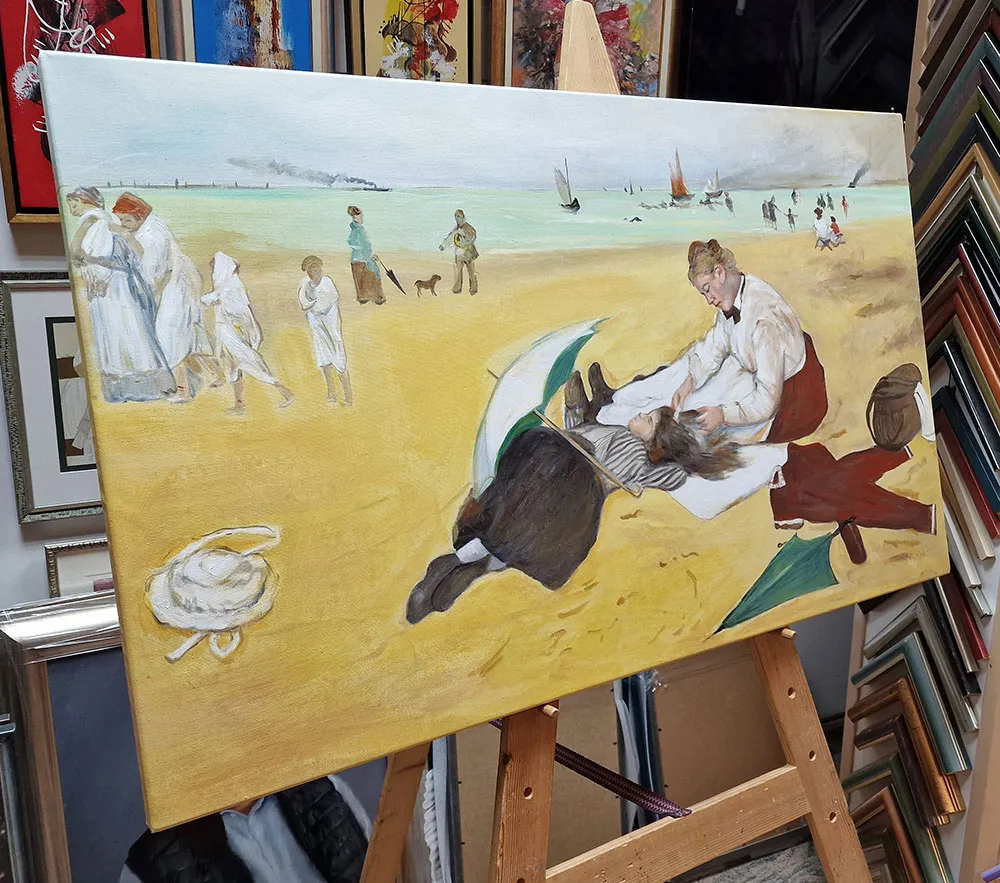
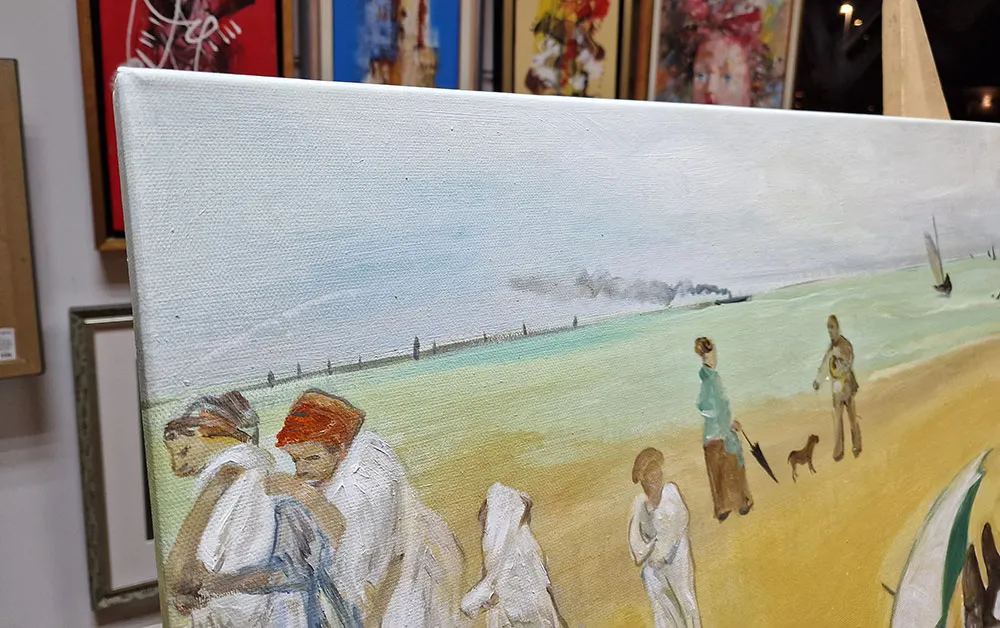
It is made with a brush and oil colours, not a printer, and this motif has a peculiarity worth saying plainly. The original is not painted in oil on canvas: the museum’s entry gives oil on paper, mounted on canvas, and adds that Degas painted with essence – oil colour from which most of the oil had been removed with blotting paper, thinned with turpentine to give the effect of watercolour. Our version is true oil paint on linen, so its surface is by nature fuller than the original’s; the painter answers that by laying the colour thin and leaving the sand as an even, barely worked plane. In the first photograph the finished canvas stands on an easel in our studio, so the whole composition is visible; the second and third photographs are taken from the side and show the depth of the stretcher bar and the edge the canvas is wrapped over, and in the third the signature is visible at the lower right. In the fourth photograph there is a close view of the upper left: the group in white, a steamer’s smoke, and the weave of the linen showing through the thinly laid colour. Every reproduction is made afresh and no two copies are quite the same; every hand-painted copy is therefore its own. The photograph of your canvas reaches you before dispatch.
Which size for which wall?
If you do not know which: 100 x 60 cm. The format is markedly wide, so the work needs wall length rather than height; above a narrow chest of drawers or between two windows it does better than on a square wall. The 70 x 40 and 81 x 46 cm sizes are for a smaller room or a hallway, and 81 x 46 cm is almost exactly the size of the original; 90 x 50 and 100 x 60 cm go above a chest or a bed and are the sizes most people choose; 110 x 60 and 120 x 70 cm are the sizes above a sofa, where the work finally opens out. The 150 x 85 and 180 x 100 cm sizes are for a long wall where the sand should run edge to edge – at those two a large painting gets air and the sea becomes a thin ribbon along the top. Measure your chosen size on the wall with a paper cut-out first; with a format this wide the mistake is nearly always made in the width. None of the sizes is held in stock as a finished item: every copy is made to order and stays a single piece.
Custom size, stretcher bar and frame
If none of the eight sizes suits your wall, we paint to your measurements and keep the proportions of the scene, so that the band of sea at the top does not grow too heavy and the sand keeps its emptiness; that is our painting made to order. Every copy is delivered stretched on a wooden bar, ready to hang. For the frame, use our 3D application: on this motif it shows every moulding profile we carry, so you can compare gold, silver, black, white and natural wood – it is for choosing a frame and nothing else. If you want to see how the work looks on your own wall, that is our separate room-placement service.
Delivery and guarantee
Every copy is made to order in our studio in Slovenia, so allow 15 to 45 days depending on the size you choose; for the two largest sizes the time is usually at the upper end. We send it stretched and protected for transport, framed if you chose a frame, to sixteen countries in the European Union, without customs duties. You receive a photograph of the finished work for approval before dispatch, and our returns policy applies to every order. The whole range is in the Edgar Degas gallery, and the painter’s life is described in our article about Edgar Degas.
Frequently asked questions
What is happening in the scene?
A maid is combing the hair of a girl who has just come out of the water. The girl’s bathing suit is drying on the sand beside them.
What are the objects around them?
By the museum’s entry, two parasols, a basket and a summer bonnet. The open parasol is lined in green; the furled one lies at the lower right.
Was it painted on the beach?
No. Degas said himself that he finished it in the studio, although he saw the motif on the northern French coast.
Why is the original on paper?
Because Degas painted it in essence on paper, which was later mounted on canvas. That is why the original’s surface is matter and closer to a watercolour.
Is our version the same in technique?
No. Ours is oil paint on linen, so a fuller surface; the composition, the colours and the proportions follow the original.
Why are two institutions listed?
Because the record gives the work two accession numbers: NG3247 at the National Gallery in London and 3247 at the Hugh Lane Gallery in Dublin. We give both, as they stand.
What are the long streaks above the sea?
Smoke from two steamers. It runs horizontally across the horizon and emphasises the width of the format.
Is this a print?
No. It is painted by hand in oil colours on linen; the brushstrokes are visible and can be felt.
Which size should I choose?
For a living room usually 100 x 60 cm, for a smaller room 81 x 46 cm. The size guide is above.
Can I have a size that is not listed?
Yes, we paint to measure and keep the proportions of the scene while doing it.
Is it suitable as a gift?
Yes, especially for someone who likes the sea and quiet scenes. Because every copy is made to order, allow for the making time; if you would rather leave the choice to them, there is our gift voucher.
- Subject: a maid combing a girl’s hair on a white cloth, parasols, a basket and a bonnet around them, a narrow band of sea above
- Original: Edgar Degas, about 1869–70, oil on paper mounted on canvas, 47.5 x 82.9 cm, National Gallery in London (NG3247) and Hugh Lane Gallery in Dublin (3247)
- Ours: hand-painted in oil, eight sizes from 70 x 40 to 180 x 100 cm, stretched and framed on request
- Worth knowing: the 81 x 46 cm size is almost exactly the original’s – the only one on the list that repeats it at life size