







































Description
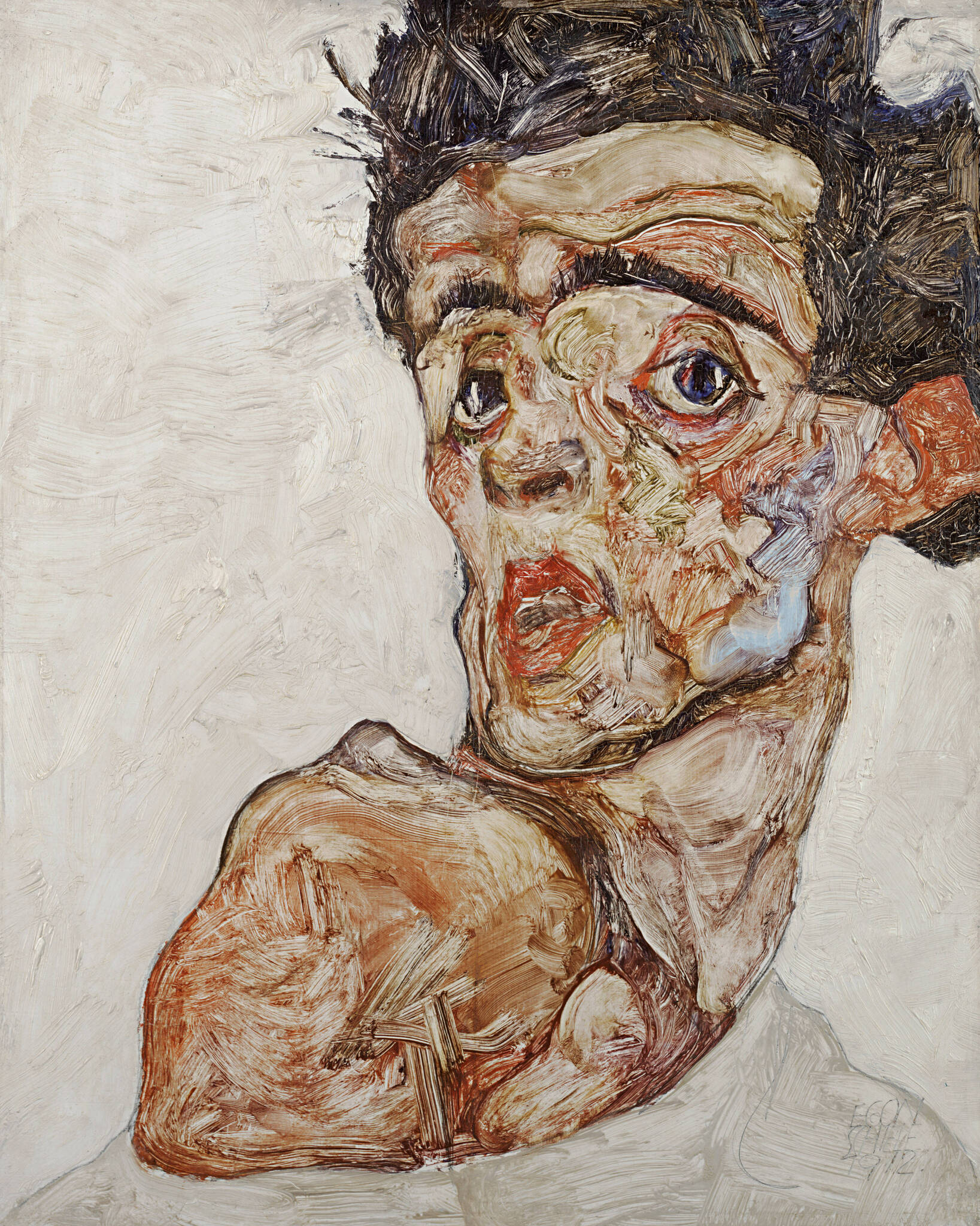
Self-Portrait with Raised Bare Shoulder is Schiele’s own likeness from 1912: a small upright self-portrait painted in oils on wood, in which a raised bare shoulder pushes into the picture beside the head. At the lower right, in pencil and scratched into the paint, it reads EGON SCHIELE 1912. The original is held by the Leopold Museum in Vienna under inventory number LM 653 and measures 33.9 x 42.2 cm. We paint it by hand in oils on canvas, in one of six sizes or to your own measurement, and before dispatch we send you a photograph of the finished work for approval.
| Title: | Self-Portrait with Raised Bare Shoulder |
| Other titles: | the museum’s German title is Selbstbildnis mit hochgezogener nackter Schulter |
| Painter: | Egon Schiele (1890–1918) |
| Year: | 1912 |
| Original size (width × height): | 33.9 cm x 42.2 cm |
| Original technique: | Oil on wood |
| Style: | Expressionism |
| Location: | Leopold Museum, Vienna (inv. LM 653) |
| Our reproduction: | hand-painted oil on canvas, 6 sizes from 60 x 75 cm to 135 x 170 cm, or a made-to-measure size |
Self-Portrait with Raised Bare Shoulder – Egon Schiele
What does the painting show?
Schiele painted himself, but this is not a classical portrait confined to the head. In the museum’s reading the shoulder pushes into the picture as a strangely amorphous outgrowth of the body and stands in for the rest of it. The museum reads the scene as a link to one’s own body that is fused and dissociated at the same time; the expression on the face registers that recognition with a mixture of disbelieving astonishment and a tormented cry. In the museum’s account this names a central theme of Viennese Modernism: the individual who becomes a stranger to himself. The format is small and upright, and the support is wood, not canvas.
Why do people love it?
Because it does a great deal on a small surface. It is one of those Schiele self-portraits you recognise instantly: face, shoulder, empty ground, and nothing to distract. That is exactly why it carries a wall on its own, with no second picture beside it – in a study, beside a staircase, in a hallway or above a bedroom chest. It is also a good choice for anyone who likes Schiele but does not want a nude: only the shoulder is bare and the picture stays a portrait. And because the original is small, our larger version shows how decisively it was painted.
Where does it sit among Schiele’s works?
Among Schiele’s self-portraits, the core of his work. It dates from 1912, when he was 22, from the years of his sharpest hand. The museum record counts it among those memorable small-format self-portraits that reach a particular force of expression despite, or because of, the limited size. Before 1949 it was with the Galerie Wolfgang Gurlitt in Munich, from 1952 with Rudolf Leopold, and since 1994 it has been in the Leopold Museum. The full selection is in the Egon Schiele gallery, with more on his life in our article about Egon Schiele.
How is our hand-painted version made?
A painter works every canvas in oils, stroke by stroke: a hand-painted painting made for your order, not a machine print. The hardest part here is the face. In a self-portrait every millimetre counts: a mouth a shade too open or eyes a touch too round and the expression tips into caricature. The second difficulty is the shoulder, which has to stay strange – an outgrowth, not an anatomically correct body. The original is oil on wood; our copy is a hand-painted oil on canvas, because canvas is what goes on a stretcher bar and onto a wall, and it reads as densely as a panel. When it is finished we photograph it and send you the photograph for approval, and only then does it ship. This work has not yet been photographed in our workshop, so there are no workshop photographs of it on this page yet.
Which size for which wall?
The original is small, 33.9 cm wide and 42.2 cm high, so every size we offer is larger. Above a desk or in a hallway, 60 x 75 cm; above a bedroom chest or beside a staircase, 80 x 100 cm; in a living room as the only picture on the wall, 100 x 125 cm or 110 x 135 cm; on a large clear wall or in a tall room, 125 x 155 cm or 135 x 170 cm. Prices run from 277 EUR for 60 x 75 cm to 1408 EUR for 135 x 170 cm. A portrait works best when the face is roughly at the viewer’s eye level, that is with the centre of the picture 145-150 cm from the floor, and when there is some empty wall around it. Above a sofa, choose a width of about two thirds of the sofa.
Custom size, stretcher bar and frame
If none of our sizes suits your wall, we paint the work to your own measurement. If you choose “YES” under the Stretcher option, the canvas comes stretched on a wooden stretcher bar, ready to hang. Our 3D application is for choosing a frame only, not for showing the work on your wall. The frame is chosen separately and need not be part of the order.
Delivery and guarantee
We paint to order and deliver to sixteen countries in the European Union, among them Slovenia, Croatia, Austria, Italy, Hungary, Germany and France; the United Kingdom and Ireland are not currently among them. The painting arrives protectively packed and, if you chose “YES” under Stretcher, stretched on the stretcher bar; before dispatch we send you a photograph of the finished work to approve. Production time depends on the size and on the studio’s workload. Every order is covered by our Returns and Refund Policy.
Frequently asked questions
Who is in the picture?
Egon Schiele himself. It is a self-portrait of 1912, when he was 22. Schiele painted and drew himself more often than anyone else in his circle, and these self-portraits are regarded as the core of his work.
Is the painting signed?
Yes. According to the museum record it is signed and dated at the lower right, in pencil and scratched into the paint: EGON SCHIELE 1912. A scratched signature is rarer in Schiele than a painted one, so it is an interesting detail.
Why is the shoulder raised?
In the museum’s reading the shoulder enters the picture as a strange outgrowth of the body and stands in for the rest of it; the museum sees in that a bond with one’s own body that is fused and dissociated at once. It is a deliberate choice, then, not an awkward pose.
Is this a nude?
No. Only the shoulder is bare, and the picture itself is a portrait: head, neck and shoulder. If you want a Schiele for a room where a nude would not do, this self-portrait is a good choice.
What is the original painted on, and what is your copy made of?
The original is oil on wood, that is on a wooden panel rather than canvas. Our copy is always a hand-painted oil on canvas; the canvas goes on a stretcher bar and arrives ready to hang.
Does it work as a gift?
Yes; if you are unsure which size to choose, there is a gift voucher.