



Description
Still Life with Books is a painting by Egon Schiele, begun in 1914 and dated 1916: his own desk, tipped up towards the viewer, with a tall stack of books and papers, a brass candlestick and two small wooden horses. The original, 78 x 117.5 cm, is in the Leopold Museum in Vienna. We paint it by hand in oils on canvas at the size you choose, and before dispatch we send you a photograph of the finished work for approval.
| Title: | Still Life with Books |
| Other titles: | The Artist’s Desk · Stillleben mit Büchern · Schreibtisch des Künstlers |
| Painter: | Egon Schiele (1890–1918) |
| Year: | 1914–16, signed and dated lower left “EGON SCHIELE 1916” |
| Original size (width × height): | 78 cm x 117.5 cm |
| Original technique: | Oil on canvas |
| Style: | Expressionism |
| Location: | Leopold Museum, Vienna (inv. 458) |
| Our reproduction: | hand-painted oil on canvas, 5 sizes from 40 x 60 cm to 99 x 151 cm, or a made-to-measure size |
Still Life with Books – Egon Schiele
What does the painting show?
The desk is black and tipped up so steeply that it fills most of the canvas, and on it the books rise in a single column from the bottom edge almost to the top: pale grey and cream volumes, one ochre, one blue-green, one dark green, with loose white sheets pushed out to both sides. To the left of the stack stands a brass candlestick, and at the lower right are a little inkwell and a bundle of pens. On the top edge of the desk stand two small wooden horses, a red one with a rider on the left and a larger white one on the right. Behind them is a pale cream wall, and down the whole left side hangs a curtain with wavy black and white stripes. In the lower left corner the Austrian painter set his name and the date in red block letters inside a small square.
Why do people love it?
Because it feels like a portrait without a person in it. The desk says a lot about its owner: books, pens, a candle, and two toys set on top like a small joke. The composition is simple and strong, a dark upright block against a light wall, held in place by the black and white stripes on the left and the red accents at the top and bottom. And it is rare: still lifes are few in Schiele’s work, so this one shows a quieter side of an artist better known for tense figures.
Where does it sit among Schiele’s works?
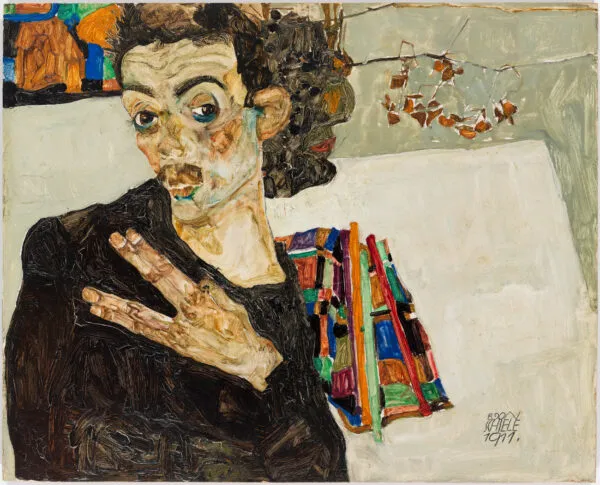
It belongs with the few works in which Schiele painted his own surroundings and belongings rather than people. The Artist’s Room in Neulengbach shows his own room, Interior is an early room scene, and in Self-Portrait with Black Clay Pot he paints himself beside a black clay vessel. The full selection is in the Egon Schiele gallery, and there is more on his life in our article about Egon Schiele.
How is our hand-painted version made?
Each copy is a hand-painted painting made for your order, not a print: a painter builds it up in oils, stroke by stroke, and like the original our copy is oil on canvas. The hard parts here are the black desk, which has to stay deep without swallowing the dark books, and the many pale greys and creams of the stacked volumes, which must keep their small differences. The wavy stripes of the curtain need a steady but free hand, and the red horse and the red signature square have to be the same warm red as in the original. When the work is finished we photograph it and send you the photograph for approval, and only then does it ship. We have not yet photographed this work in our workshop; photographs will be added to this page once we have them.
Which size for which wall?
The original measures 78 x 117.5 cm; of our sizes, 80 x 120 cm comes closest to it. 40 x 60 cm or 50 x 75 cm suit a spot beside a bookcase, above a desk or in a study, where the subject is at home; 60 x 90 cm a hallway or the wall between two doors; 80 x 120 cm or 99 x 151 cm the space above a sideboard or a tall living-room wall. A canvas painting with this much black likes a light wall and good light, so the dark books keep their colour. Hang it with the centre at eye level, about 145–150 cm from the floor.
Custom size, stretcher bar and frame
If none of the five sizes suits your wall, we paint the work to your own measurement. If you choose “YES” under the Stretcher option, the canvas comes stretched on a wooden stretcher bar, ready to hang. Our 3D application is for choosing a frame only. The frame is chosen separately and need not be part of the order.
Delivery and guarantee
We paint to order and deliver to sixteen countries in the European Union, among them Slovenia, Croatia, Austria, Italy, Hungary, Germany and France; the United Kingdom and Ireland are not currently among them. The work arrives protectively packed and, if you chose “YES” under Stretcher, stretched on a stretcher bar. Before dispatch we send you a photograph of the finished work to approve. Production time depends on the size and on the studio’s workload. Every order is covered by our Returns and Refund Policy.
Frequently asked questions
What is on Schiele’s desk?
A tall stack of books and loose papers, a brass candlestick, an inkwell, pens and a blotting paper holder, as the Leopold Museum lists them. Schiele tipped the desk up into the picture, so the books seem to pile up vertically rather than lie flat.
What are the two horses?
They are wooden toys from Schiele’s own collection of folk art: a red horse with a rider and a larger white horse. According to the Leopold Museum, one of these toy horses is itself in the museum’s collection today.
When did Schiele paint it?
The museum dates it 1914–16. On stylistic grounds he probably began it in 1914, but according to the red date at the lower left he went on working on it until 1916.
Did Schiele paint many still lifes?
No. The Leopold Museum calls this picture of his desk a rarity in his work, which is dominated by portraits, figures and landscapes. The striped curtain on the left also links it to his private life: the same pattern reappears as a garment of his wife, Edith.
Where is the original?
In the Leopold Museum in Vienna, under inventory number 458. It is an oil painting on canvas and measures 78 x 117.5 cm.
Who owned it before the Leopold Museum?
The museum’s provenance names, in order, the Galerie Würthle in Vienna, Kurt Wieser and Rudolf Leopold. In 1994 it passed to the Leopold Museum Private Foundation.
Does it work as a gift?
Yes; if you are unsure which size to choose, there is a gift voucher.