







































Description
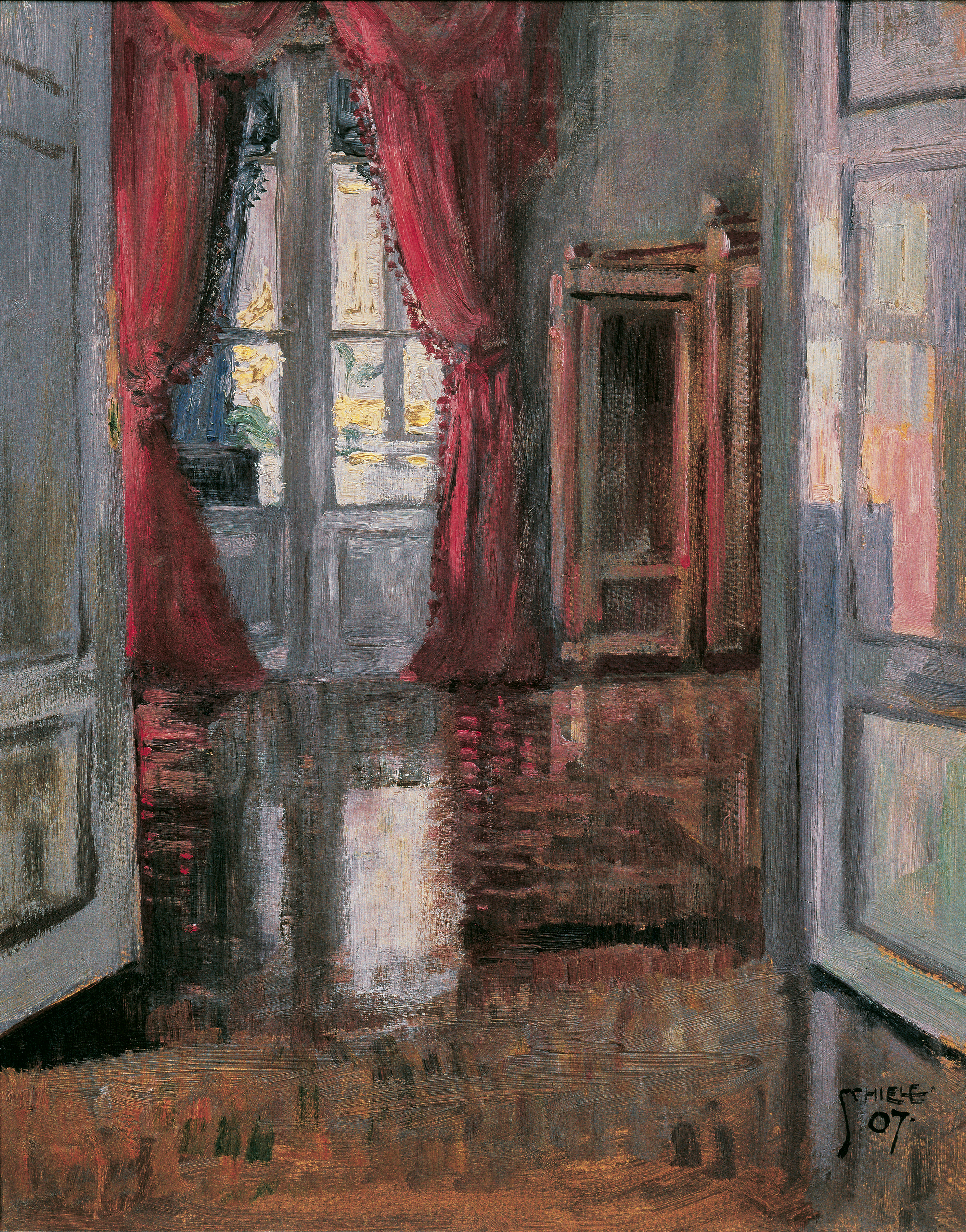
Interior is a painting by Egon Schiele from 1907: a view through an open double door into a room with a tall window, red curtains and a polished floor that mirrors the light. We paint it by hand in oils at the size you choose, and before dispatch we send you a photograph of the finished work for approval.
| Title: | Interior |
| Other titles: | Interieur · View into the apartment of Leopold and Marie Czihaczek |
| Painter: | Egon Schiele (1890–1918) |
| Year: | 1907, signed and dated lower right “SCHIELE. / 07” |
| Original size (width × height): | 31.2 cm x 39.1 cm |
| Original technique: | Oil on cardboard |
| Style: | Early Schiele, before Expressionism |
| Location: | Belvedere, Vienna |
| Our reproduction: | hand-painted oil on canvas, 13 sizes from 50 x 65 cm to 160 x 205 cm, or a made-to-measure size |
Interior – Egon Schiele
What does the painting show?
The Austrian painter looks from one room into the next. On the left and the right, the two leaves of an open double door frame the view, their panels in pale grey-blue with a touch of lilac. Beyond them stands a tall window with white glazing bars, and through the glass comes daylight with a few yellow and green patches. Heavy red curtains with fringed edges hang on either side of it, drawn back. To the right of the window rises a tall, dark cabinet framed in red-brown. The floor is dark, polished parquet that throws the window and the curtains back in long vertical streaks; towards the front it turns into a warm brown, laid on in loose strokes. The signature and the year stand at the lower right.
Why do people love it?
Because it lets you in. There is nobody in the room, only light, a window and a shining floor, and the open door in the foreground puts you on the threshold. The red of the curtains is the one strong colour against grey-blue and brown, so the work stays calm on a wall and still has a point where the eye comes to rest. It suits a hallway, a bedroom, a reading corner or a wall between two doors.
Where does it sit among Schiele’s works?
Among the other Schiele works in our shop, you can compare it with The Hermits, Trude Engel and Portrait of Wally Neuzil; if you are choosing between them, open them side by side. The full selection is in the Egon Schiele gallery, with more on his life in our article about Egon Schiele.
How is our hand-painted version made?
One of our artists paints it by hand in oils, stroke by stroke, for your order – it is not a print. A hand-painted painting keeps its brushstrokes, and you can see and feel them on the surface. Two places decide the result. The first is the floor: the reflections of the window and the curtains have to stay loose vertical streaks; painted too smoothly, the floor becomes a mirror and the room loses its depth. The second is the red of the curtains, the only strong colour here – too loud and it takes over the scene, too muted and everything turns grey. The original is painted on cardboard and ours is oil on canvas, so the surface will not be identical. When it is finished we photograph it and send you the photograph for approval, and only then does it ship. This work has not yet been photographed in our workshop.
Which size for which wall?
Short answer: this is a quiet scene with depth, so give it a wall you can step back from. We offer it in thirteen sizes, from 50 x 65 cm to 160 x 205 cm. In a hallway or a bedroom, 50 x 65 cm or 60 x 75 cm; above a chest of drawers or a bed, 70 x 90 cm or 80 x 100 cm; above the sofa in a living room, 100 x 130 cm or 120 x 150 cm; on a large wall or in a stairwell, 140 x 180 cm or 160 x 205 cm. A canvas painting of this size needs some distance: close up you see the single strokes in the floor and the curtains, and the room opens up from a distance of a few steps.
Custom size, stretcher bar and frame
If none of the thirteen sizes suits your wall, we paint the work to your own measurement. If you choose “YES” under the Stretcher option, the canvas comes stretched on a wooden stretcher bar, ready to hang. Our 3D application is for choosing a frame only, not for showing the work on your wall. The frame is chosen separately and need not be part of the order.
Delivery and guarantee
We paint to order and deliver to sixteen countries in the European Union, among them Slovenia, Croatia, Austria, Italy, Hungary, Germany and France; the United Kingdom and Ireland are not currently among them. The work travels protectively packed. Before dispatch we send you a photograph of the finished work to approve. Production time depends on the size and on the studio’s workload. Every order is covered by our Returns and Refund Policy.
Frequently asked questions
What does Schiele’s Interior show?
A view into the Vienna apartment of Leopold and Marie Czihaczek. An inscription on the back of the cardboard describes it as the bedroom with a view through to the salon, at Circusgasse 47. There is nobody in the rooms: only the open door, the window with its red curtains and the polished floor.
Who were Leopold and Marie Czihaczek?
Leopold Czihaczek was Schiele’s uncle by marriage: his wife Marie was a sister of Schiele’s father. After the father’s death he became guardian of Egon and his sister Gertrude and supported the young painter financially, so that he could attend the Vienna Academy of Fine Arts from the age of 16. Their relationship later cooled, and Czihaczek eventually gave up the guardianship.
When did Schiele paint Interior?
In 1907: it is signed and dated lower right “SCHIELE. / 07”. Schiele, born in 1890, was then 16 or 17 and a student at the Vienna Academy, which had admitted him the year before as the youngest in his class. He painted it in oils on cardboard, 31.2 x 39.1 cm.
Where is Interior today?
In the Belvedere in Vienna, under inventory number 6621. The museum’s record lists Schiele’s sister Gertrude Peschka-Schiele, Vienna, as an owner and a purchase from Anton Peschka, Vienna, in 1982.
Why does Interior look so unlike Schiele’s later work?
Because it comes before his own style. The Belvedere notes that Gustav Klimt’s work had a decisive influence on Schiele at the start of his career, and that only after co-founding the Neukunstgruppe in 1909 did he quickly develop a visual language entirely his own. Interior, painted two years earlier, still shows a quiet, light-filled room rather than the tense figures he is known for.
Does it work as a gift?
Yes; if you are unsure which size to choose, there is a gift voucher.