Description
Study for Bathers at Asnières (London) is Seurat’s oil study on wood from 1883–1884: the grassy bank of the Seine with young men beside the water, laid in with broad, quick strokes before the large canvas grew out of them. The original is held by the National Gallery in London under accession number NG6561. We make it as a hand-painted canvas painting, oil on canvas, in eight sizes or to your own measurements, and you receive a photograph of the finished work for approval before dispatch.
| Title: | Study for Bathers at Asnières (London) |
| Other titles: | Study for “Bathers at Asnières” · Croqueton |
| Painter: | Georges Seurat (1859–1891) |
| Year painted: | 1883–1884; the museum record notes no signature |
| Original size: | 25 cm x 15.2 cm |
| Original technique: | Oil on wood |
| Painting style: | Early oil study (croqueton) – before the dots |
| Located at: | The National Gallery, London (acc. no. NG6561) |
| Our reproduction: | hand-painted in oil on linen, 8 sizes from 25 x 16 cm to 120 x 75 cm, custom sizes on request |
Study for Bathers at Asnières (London) – Georges Seurat
Who is in the painting?
Young workers by the river, whom the museum record does not name. At the right a boy sits in a dark jacket and straw hat, in profile towards the water; in front of him the bare back of a second, seated lower on the bank. A pale figure stands knee-deep in the river, and further out another wades towards the middle. Asnières was an industrial suburb west of Paris, and these young men spent their free time there — they are not sitters but people the painter saw. That is precisely why they cannot be named, and we do not try.
What is on the panel?
A horizontal wooden panel barely the size of a hand. The lower half is a grassy bank in warm green and ochre strokes, broad and visibly fast; above it opens a blue-grey sheet of water, closed at the top by the low line of the far bank. The figures sit in a band above the middle, one beside another, with no facial detail. The paint is laid in straight, short strokes rather than fine dots: this was made on the bank and in one go, not in a studio. That speed is exactly why the study reads differently from the finished canvas.
Why does this study matter?
Because it stands at the start of this French painter’s road to the large composition. Bathers at Asnières was Seurat’s first big canvas, and before he painted it he made a run of panels like this one on the bank of the Seine in the summers of 1883 and 1884. Each answered a single question: how the sun falls on a back, how water meets grass, where a figure should sit. The pointillism he is known for is not developed here — the large work was painted before it and retouched afterwards. The National Gallery keeps the study in Room 44, part of Heinz Berggruen’s gift of 1995.
What does the scene mean?
The leisure of a working suburb, seen without sentiment. Seurat painted neither poverty nor idyll; he painted young men sitting by the water because it was hot. That reserve is what makes the large canvas strange later on: the figures are monumental, and yet nobody poses and nobody tells a story. On this panel the position is plainer still, because there is neither composition nor finish — only a look. At home it is calm and undemanding: a river, a bank, a few people, a summer afternoon.
What happened to the original?
The National Gallery publishes the panel’s whole route. It was with the dealer Ambroise Vollard in Paris, then with Eugène Devet and with Maurice Fabre at Gasparets; on 16 March 1911 it was sold at the Hôtel Drouot in Paris as lot 68. It then passed to the painter Maurice Denis at St-Germain-en-Laye and later to Pierre Berès in Paris. Heinz Berggruen bought it in 1993 and presented it to the National Gallery in 1995. Those details are the museum’s; we add none of our own.
Where does this study sit in Seurat’s work?
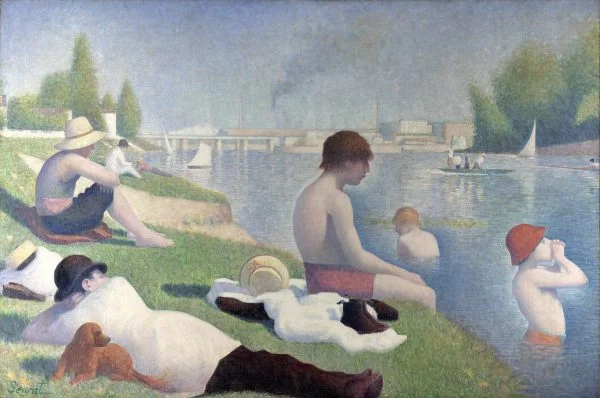
Among the preparations for Bathers at Asnières, the finished canvas the same National Gallery holds as NG3908. We also sell Boys Bathing — a second study for the same canvas, in the Musée d’Orsay — so both preparations stand side by side here. From the same London collection comes Study for La Grande Jatte (London), the next step of the same method that led to Sunday Afternoon on the Island of La Grande Jatte — the famous painting these panels were built towards.
How is our hand-painted version made?
It is made with a brush and oil paint, never a printer. Our painter works from a high-resolution museum file and keeps exactly what this work is: broad, quick strokes and a visible direction of brush. Fine dots would be wrong here — the panel was made before the painter had developed that technique, and “correcting” it into dots would be painting a different work. Because everything is done by hand, no two canvases are ever quite the same and every hand-painted copy stays a one-off. We do not yet hold our own photographs of a finished canvas for this work; the first time it is painted we will photograph it and the photographs will appear here.
Which size for which wall?
If you do not know which: 60 x 40 cm. The original measures 25 x 15.2 cm and our smallest size, 25 x 16 cm, is effectively one to one with it — exactly the small thing it was. The format is horizontal, close to an 8 : 5 ratio, so it sits well above a narrow chest, between two doors, or in a group of smaller works. 50 x 30 and 60 x 40 cm are the everyday choices for a hallway or bedroom; 70 x 45, 80 x 50 and 90 x 55 cm stand alone above a bed or a desk; 100 x 60 and 120 x 75 cm belong in a living room, where the bank gets some air. Every copy of this subject is made to order.
Custom size, stretcher bar and frame
If none of the eight sizes fits your wall, we paint to your measurements and keep the ratio of the original so the bank and the waterline do not shift; that is our custom size painting service. You can order the painting in three forms: as a rolled canvas without a stretcher, stretched on a wooden stretcher bar and ready to hang, or framed; you choose the form when you order. You choose the frame in our 3D frame viewer: on this subject it shows every profile we carry — gold, silver, black, white, natural wood — and it is for choosing a frame and nothing else. To see the work on your own wall, use our separate room-visualisation service, ordered on its own.
Delivery and guarantee
Every copy is made to order in our Slovenian studio, so allow 15 to 45 days depending on the size. We ship it in the form you chose when ordering — rolled, stretched or framed — protected for transport, across the EU, customs-free. Before dispatch you approve a photograph of the finished work, and our returns policy applies to every order. The full range is in the Georges Seurat gallery, and his life and Neo-Impressionism are described in our article about Georges Seurat, which also explains what separates a good oil painting reproduction from a poor one.
Frequently asked questions
Where is the original?
In the National Gallery in London, Room 44, under accession number NG6561. The museum received it in 1995 as Heinz Berggruen’s gift.
Do the young men on the panel have names?
No. The museum record names none of them; they are young workers from the suburb, not sitters.
Is this the same work as Bathers at Asnières?
No. This is a preparatory study on wood, 25 x 15.2 cm; the finished canvas measures 301.5 x 201 cm and hangs in the same gallery as NG3908. Both are in our Seurat gallery, as separate products.
Is this a print?
No. The work is painted by hand in oil on linen; the brushwork is visible and can be felt.
Which size should I choose?
For a hallway or bedroom, 60 x 40 cm; for the size of the original, 25 x 16 cm. The full guide is above.
Can I have a size that is not listed?
Yes. We paint to measure, keeping the side ratio of the original.
Why are there no fine dots here?
Because there are none on the original. The panel dates from 1883–1884, before the painter worked out his dotted method; adding them would be correcting history.
What is the painting about, in one sentence?
A hot afternoon on the bank of a working suburb, caught in a handful of strokes.
Is the original for sale and what is it worth?
No. The panel is in the public collection of the National Gallery in London and is not for sale; a hand-painted canvas of ours is the only way to have it at home.
How high should I hang it?
Centre at eye level, about 145–150 cm from the floor. At the small sizes hang it lower and nearer where you sit.
Is it suitable as a gift?
The smaller sizes make a good gift: the subject is quiet and fits almost any wall. If you would rather leave the choice to the person receiving it, there is our gift voucher.
- Subject: the grassy Seine bank at Asnières with young men by the water, in broad strokes – 1883–1884
- Original: 25 x 15.2 cm, oil on wood, The National Gallery, London (acc. no. NG6561)
- Ours: a hand-painted fine art reproduction in oils, eight sizes, 25 x 16 to 120 x 75 cm, as a rolled canvas, stretched or framed — your choice
- Worth knowing: there are no dots on this panel yet – Seurat developed them only after the large canvas already stood