




Description
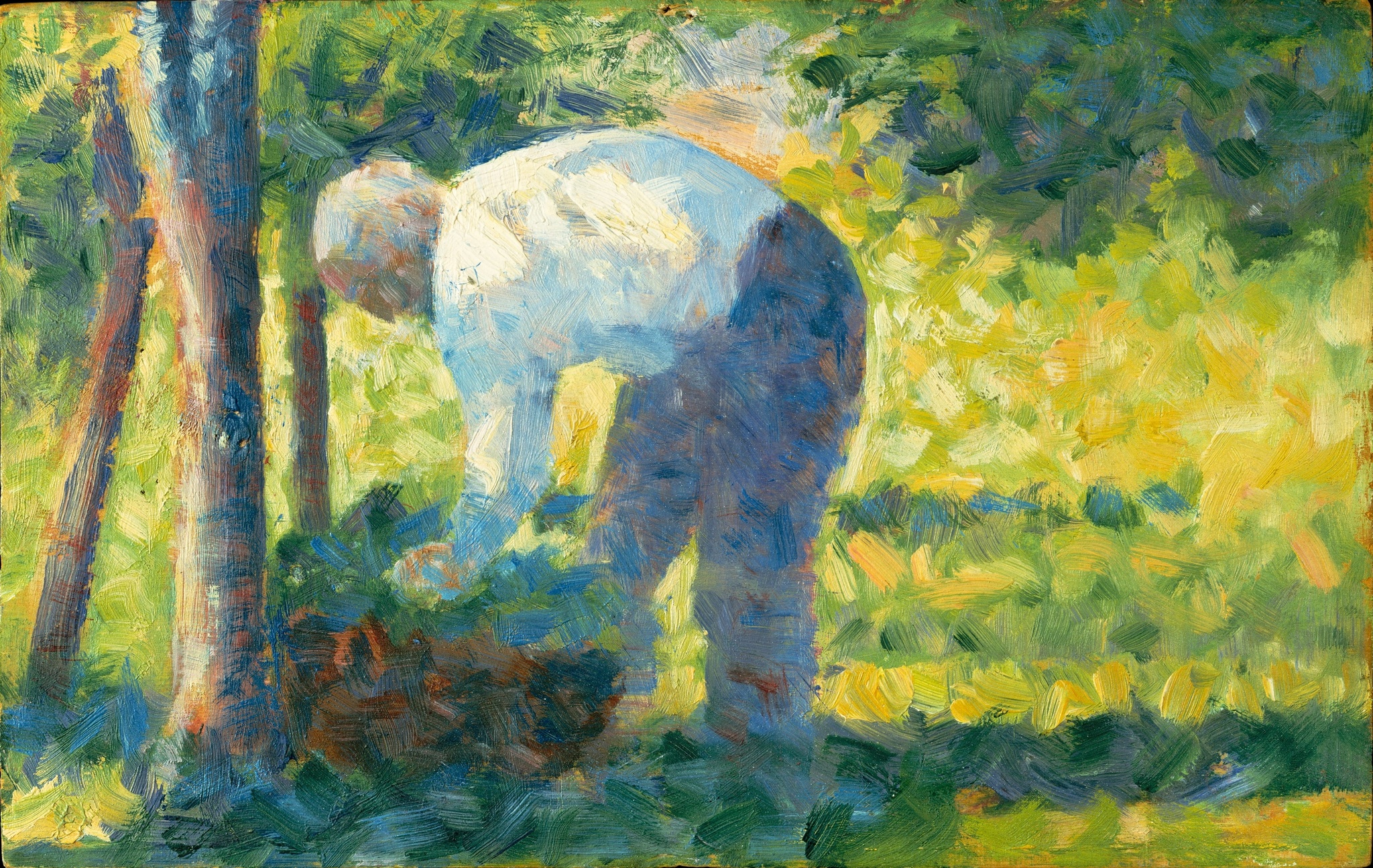
The Gardener is Seurat’s small oil sketch on a wood panel of 1882–83: a man at work in a garden, painted already in bright hues. The original measures 24.8 x 15.9 centimetres and is held in New York by The Metropolitan Museum of Art under object number 67.187.102, where it hangs in Gallery 825. From us it is painted entirely by hand, oil on canvas, in eight sizes or to your own measurements, and before dispatch you receive a photograph of the finished work for approval.
| Title: | The Gardener |
| Other titles: | The Gardener – the title the museum itself uses |
| Painter: | Georges Seurat (Paris 1859–1891) |
| Year painted: | 1882–83 |
| Original size: | 24.8 cm x 15.9 cm |
| Original technique: | Oil on wood |
| Painting style: | Early open-air oil sketch (croqueton), already in bright hues – before the dots |
| Located at: | The Metropolitan Museum of Art, New York (object no. 67.187.102, on view in Gallery 825) |
| Our reproduction: | hand-painted oil on canvas, 8 sizes from 25 x 16 cm to 150 x 100 cm, custom size on request |
The Gardener – Georges Seurat
What is on the canvas?
A gardener at work. The museum sets the scene in a wider frame: although Seurat is best known for his scenes of urban life, many of his paintings of 1881–84 depict rural labourers and landscapes. This panel is one of them — a man, a tool, earth, nothing else.
A canvas painting this size cannot narrate. It can catch a posture, though: the bent back, the hands at work, the green all round. That is exactly what interested Seurat then, and exactly what he got onto the board in a single sitting outdoors.
Ogden Rood and the bright hues
The museum says something precise about the colour. At first Seurat favoured an earth-toned, muted palette reminiscent of earlier painters of the countryside, such as Jean-François Millet. The bright hues of this picture, the museum says, show something else: his growing interest in Impressionist techniques and his reading of treatises on colour.
One book is named: Modern Chromatics by the American Ogden Rood, published in English in 1879 and in French in 1881. That is not a guess of ours — it is what the museum writes. It is worth noting because the Guggenheim names the same man beside Farm Women at Work, where Rood stands with Chevreul and Charles Henry. Two institutions, independently, on one name.
Out of that reading came pointillism, a few years later. It is not here yet: the colour is bright but still laid on in strokes rather than dots. The method arrived later, and slowly.
A pair from the same room
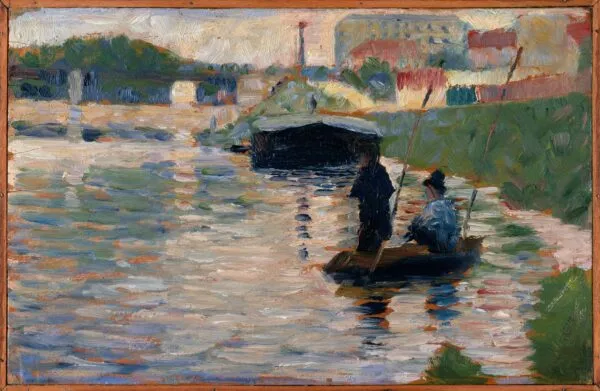
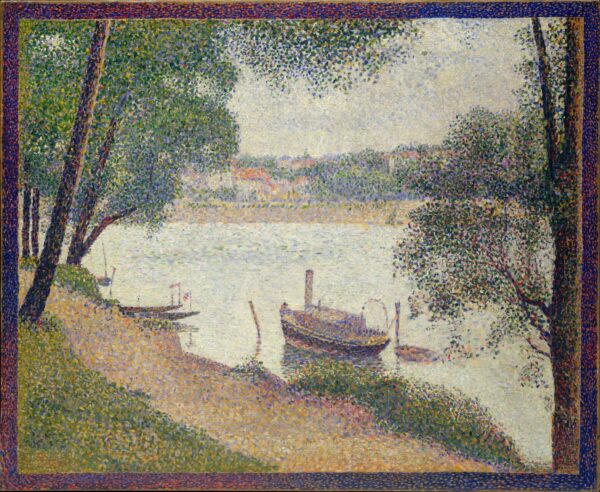
This panel has a twin in our Seurat gallery, and it is the museum’s own record that pairs them. View of the Seine is from the same years, painted on the same kind of wood, measures exactly the same — 24.8 x 15.9 centimetres — and hangs in the same Gallery 825. Two small panels, the same two years, the same room.
Seen together they show two things: how little the painter needed for a scene, and how far apart two subjects can be under one procedure. One is a working river with freight and smokestacks; the other is a garden. Same brush, same format, two worlds.
From the same period we also sell The Stone Breaker from the National Gallery of Art in Washington and Figure in a Landscape at Barbizon, named for the village that gave the Barbizon school its name — the school the museum points to.
Wood, not canvas — and what that means for our version
The original is painted on a wood panel. Wood is a smooth, hard ground: it takes the colour at once and does not give under the brush, so a stroke ends where you set it down. That is exactly why boards like this were handy for working outdoors.
Our version is painted in oil on a canvas, and we do not blur that. What we carry across is the stroke and the colour; we do not imitate the ground, because canvas and wood do not behave alike and we will not promise they do. At the smallest sizes the difference is barely noticeable; at the large ones the canvas makes itself felt.
Why is the year a span?
Because the museum itself does not give a single year. Its own record reads 1882–83, a span, and that is how we give it. Nowhere on this page is one year of making written down as a fact, because the institution that holds the work has not written it that way.
The firm years are other ones, and none of them is a year of making: 1879 and 1881, when the book Seurat was reading appeared, and 1967, when the work came to the museum as the bequest of Adelaide Milton de Groot. That is exactly why we name them for what they are.
How is our hand-painted version made?
By hand and with a brush, never with a printer. Our painter works in oil colours on canvas, and with this subject the hardest thing is to keep the brightness: the colours here are open and clean, and if they mix into each other the scene goes dull at once. That is why every hand-painted copy is one of a kind and no two are quite alike.
For this subject we have no studio photographs of our own yet. When we next paint it, we will photograph it, and the photographs will appear on this page. What holds meanwhile holds for every oil painting reproduction we make: before dispatch you receive a photograph of the very canvas painted for you, and it leaves only once you have approved it.
Which size for which wall?
The original measures 24.8 x 15.9 centimetres, width first and then height, the way we give measurements everywhere. It is a small panel, one that fits in the hand.
Our smallest rung, 25 x 16 cm, is the original rounded to whole centimetres; the museum gives the measurement itself, independently of our ladder, which is why we can say so. If you want the work at the size it was made, that is the size to choose. For a shelf or a table, 25 x 16 cm; for a living room, 50 x 30 and 60 x 40 cm; 70 x 45 and 80 x 50 cm stand on their own; 90 x 60, 120 x 75 and 150 x 100 cm turn a small sketch into a large work, which an open colour carries better than many other subjects.
Custom size, stretcher and frame
If none of the eight sizes fits your wall, we paint to your measurements and keep the ratio of the original, so the scene is never stretched; that is our custom size painting. You can order the painting in three forms: as a rolled canvas without a stretcher, stretched on a wooden stretcher and ready to hang, or framed; you choose the form when you order.
You choose the frame in our 3D frame viewer. With a bright subject it is worth thinking about: a warm, light frame supports the colours, a heavy dark one presses them down. Our separate room-placement service shows how it will look on your own wall.
Delivery and guarantee
Every copy is made to order in our studio in Slovenia, so allow 15 to 45 days depending on size. We ship it in the form you chose when ordering — rolled, stretched or framed — protected, across the EU, customs-free. You approve a photograph first, and our returns policy applies. The full range by this painter is in the Georges Seurat gallery, and his work is described in our article on Georges Seurat. A fine art reproduction of a famous painting is always made here the same way.
Frequently asked questions
Where is the original?
In New York, at The Metropolitan Museum of Art, object number 67.187.102. The museum records that it is on view in Gallery 825.
What year is it from?
The museum gives 1882–83 – a span and not a single year, so that is how we give it.
How big is the original?
The museum gives 15.9 x 24.8 centimetres by height and width, which in our width-by-height notation is 24.8 x 15.9 cm.
What was Seurat reading?
The museum names a book: Modern Chromatics by Ogden Rood, in English in 1879 and in French in 1881.
Why are the colours brighter than in Millet?
Because, the museum’s record says, Seurat was beginning to take an interest in Impressionist techniques; before that he used a muted, earth-toned palette.
Is this painted in dots?
No. The work is from 1882–83, some years before the method of fine dots; the colour is bright but laid on in strokes.
Why is our version not on wood?
Because we work in oil colours on canvas. We carry the stroke and the colour across; the ground we do not imitate.
Which size should I choose?
For a living room, 60 x 40 cm. If you want the size of the original, choose 25 x 16 cm.
Can I have a size that is not on the list?
Yes. We paint to measure and keep the ratio of the sides of the original.
Is this a print?
No. The work is painted by hand in oil colours; the strokes can be seen and felt, which a print cannot imitate.
Is it suitable as a gift?
Yes. The subject is cheerful and quiet, and small sizes read as personal. To leave the choice to the recipient, there is a gift voucher.
- Subject: a gardener at work – a small early country study, already in bright hues
- Original: 24.8 x 15.9 cm, oil on a wood panel, The Metropolitan Museum of Art (67.187.102)
- Our version: a hand-painted canvas, eight sizes from 25 x 16 to 150 x 100 cm
- Important: this French painter was reading Rood on colour – neo-impressionism was still ahead of him