







































Description
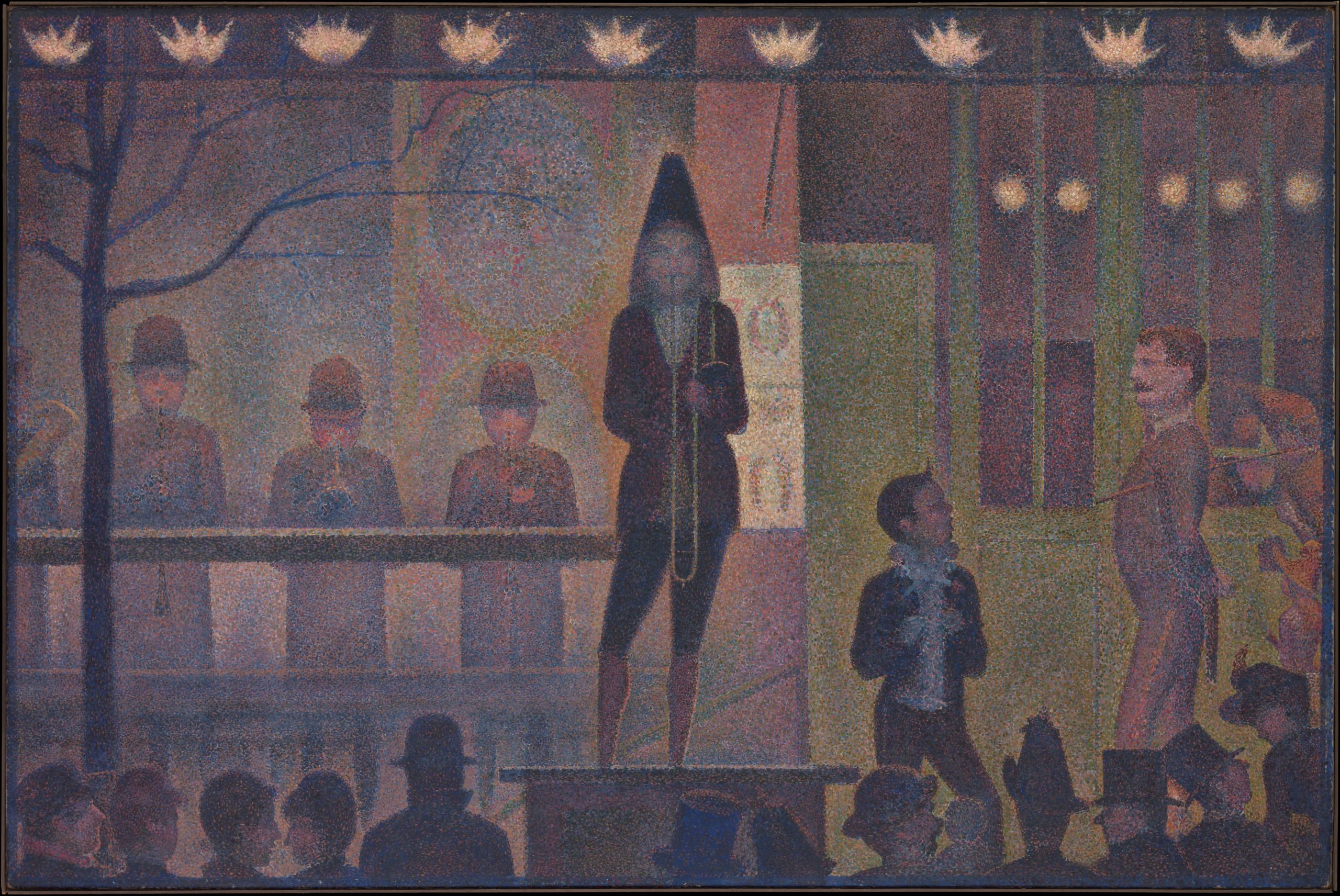
Invitation to the Sideshow is Seurat’s night scene in front of the circus tent, painted in 1887 and 1888 and built entirely from tiny dots of pure colour. The original measures 149.9 x 99.7 centimetres and is held in New York by the Metropolitan Museum of Art under inventory number 61.101.17. From us it is painted entirely by hand, oil on canvas, in eight sizes or to your own measurements, and before dispatch you receive a photograph of the finished work for approval.
| Title: | Invitation to the Sideshow |
| Other titles: | Parade de cirque · Circus Sideshow |
| Painter: | Georges Seurat (1859–1891) |
| Year painted: | 1887–1888 |
| Original size: | 149.9 cm x 99.7 cm |
| Original technique: | Oil on canvas |
| Painting style: | Pointillism |
| Located at: | The Metropolitan Museum of Art, New York (inv. no. 61.101.17, Gallery 825) |
| Our reproduction: | hand-painted oil on canvas, 8 sizes from 60 x 40 cm to 150 x 100 cm, custom size on request |
Invitation to the Sideshow – Georges Seurat
What is in the painting?
An evening scene in front of the entrance to a circus. A trombone player stands in the middle, narrow and motionless, a row of gas lamps above him, a group of musicians to the left, and along the bottom the dark heads of spectators, turned away from us. Everything is arranged in horizontal bands and verticals, as though the scene had been measured out. The colour is cool and artificial: a bluish darkness into which the lamps pour yellow-orange dots. Nobody moves and nobody looks at anybody – the scene is a quiet, almost ritual waiting.
What was a circus parade?
A free performance before the paid one. Parisian circuses and fairground tents put on a short act outside the entrance, with which they persuaded passers-by to buy a ticket for the show inside. The title of the work – Parade de cirque in the original – names precisely that ritual. Seurat therefore did not paint the performance but the invitation to it: the moment when nothing has happened yet and everyone is waiting. That is where the unusual calm of a scene comes from in which selling is actually going on.
Where can you see the method, and what does the work mean?
Everywhere, and that is exactly the point. From 1887 the painter worked exclusively in tiny dots, and a night scene is the hardest possible test of such a procedure: the darkness has to be assembled out of light points. A canvas painting built that way is not a rendering of night but its construction – which is why it feels more like the memory of an evening than a photograph. The meaning lies in that restraint: brilliance without joy, music without sound, a crowd without faces.
How did it reach the Metropolitan?
By bequest. The museum’s acquisition entry names the bequest of Stephen C. Clark in 1960, while the inventory number 61.101.17 is from 1961 – a year passes between the bequeathing and the recording, which is usual with large estates. Today the work hangs in Gallery 825 among the European paintings. The route before Clark the museum’s entry does not publish, and so we do not describe it: we state what the museum states, and we add nothing it does not record.
Where does it sit in Seurat’s work?
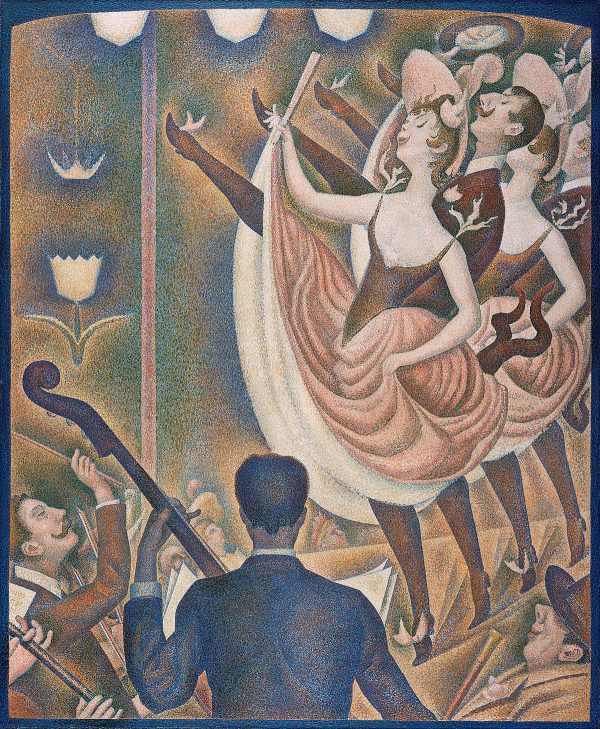
Among the last four large canvases, and the first of them to look into the night. In our Seurat gallery you will find The Models, painted immediately before it, and Le Chahut, which carries the same road on into the theatre and the dance. An earlier landmark is Bathers at Asnières, and the summit of his daylight painting is held by the Art Institute of Chicago; here you will find it as Sunday Afternoon on the Island of La Grande Jatte. Pointillism is fully formed here, and neo-impressionism as a movement already had its name by then.
How is our hand-painted version made?
By hand and with a brush, never with a printer. Our painter works in oil paint on linen and on this subject lays a dark blue ground first, then sets warm dots into it until there is enough light. With a night scene the procedure is at its most unforgiving: a few dots too many and the night brightens, a few too few and the lamps go out. Every hand-painted copy is therefore one of a kind and no two are quite alike; this is not an oil painting reproduction printed onto canvas but a painting made from scratch. Before dispatch we photograph the piece and send you the photograph for approval.
We hold no studio photographs of the finished work for this subject at present. When it is next painted we will photograph it and the shots will appear on this page.
Which size for which wall?
If you do not know which: 100 x 70 cm. On this subject the largest size is unusual: 150 x 100 cm is practically one to one with the original, which measures 149.9 x 99.7 cm – matches like that are rare in our Seurat gallery. The format is horizontal, close to a 3 : 2 ratio, and so it asks for a long, quiet wall: 60 x 40 and 70 x 50 cm for a hallway or a staircase, 80 x 55 and 90 x 60 cm for an office or a bedroom, 100 x 70 and 110 x 75 cm work as a standalone piece above a sofa, and 130 x 90 and 150 x 100 cm want a wall of their own and a darker room, where the dots really come alive. Every fine art reproduction of this subject is made to order.
Custom size, stretcher bar and frame
If none of the eight sizes fits your wall, we paint the work to your measurements and keep the ratio of the original so the scene is never stretched; that is our custom size painting service. You can order the painting in three forms: as a rolled canvas without a stretcher, stretched on a wooden stretcher bar and ready to hang, or framed; you choose the form when you order. You choose the frame in our 3D frame viewer: on this subject it shows every frame profile we carry, so you can compare gold, silver, black, white and natural wood — it is for choosing a frame and nothing else. To see how the work will look on your own wall, use our separate room-visualisation service.
Delivery and guarantee
Every copy is made to order in our studio in Slovenia, so allow 15 to 45 days depending on the size you choose. We ship it in the form you chose when ordering — rolled, stretched or framed — protected for transport, across the EU, customs-free. Before dispatch you receive a photograph of the finished work for approval, and our returns policy applies to every order. The full range by this painter is in the Georges Seurat gallery, and his path from daylight scenes to night ones is described in our article about Georges Seurat, which also explains what separates a good famous painting copy from a poor one.
Frequently asked questions
Where is the original?
In New York, at the Metropolitan Museum of Art, under inventory number 61.101.17. The museum records it under the title Circus Sideshow (Parade de cirque) and shows it in Gallery 825.
What year is the work from?
The museum dates it to 1887 and 1888. That is a span, not a single year, and we write it that way; we give no single year anywhere.
How large is the original?
The museum gives a height of 99.7 and a width of 149.9 centimetres, so 149.9 x 99.7 cm in our width-by-height notation. We already gave the same measurement, the museum confirmed it, and we changed nothing.
Is “Parade de cirque” the same work?
Yes. That is the French form of the same title; in English it appears as “Circus Sideshow”. It is one and the same canvas.
Why does it look so calm for a circus?
Because it does not show the performance but the invitation to it — the short free act outside the entrance with which passers-by were persuaded to buy a ticket. The original title names precisely that ritual.
Which size should I choose?
For a living room, 100 x 70 cm; if you want the size of the original, choose 150 x 100 cm, which is practically one to one with it. The full size guide is above.
Can I have a size that is not listed?
Yes. We paint to measure, keeping the side ratio of the original.
Is this a print?
No. The work is painted by hand in oil on linen; the strokes are visible and can be felt, which a print cannot imitate.
How is it delivered?
In the form you chose (rolled, stretched on a stretcher or framed), 15 to 45 days after you approve the photograph of the finished work.
Is the original for sale?
No. The canvas is in the public collection of the Metropolitan Museum of Art and is not for sale; a hand-painted canvas is the only way to have the subject at home.
Is it suitable as a gift?
Yes, especially for a darker room and for someone who likes quiet, unusual scenes. If you would rather leave the choice to the person receiving it, there is a gift voucher.
- Subject: a night scene in front of the circus tent – a trombone player, gas lamps and the dark heads of the spectators
- Original: 149.9 x 99.7 cm, oil paint on canvas, Metropolitan Museum of Art, New York (61.101.17), Gallery 825
- Ours: hand-painted in oil on linen, eight sizes from 60 x 40 to 150 x 100 cm, as a rolled canvas, stretched or framed — your choice
- Worth knowing: this French painter assembled the whole night out of light dots – the largest size, 150 x 100 cm, is almost one to one with the original