

Description
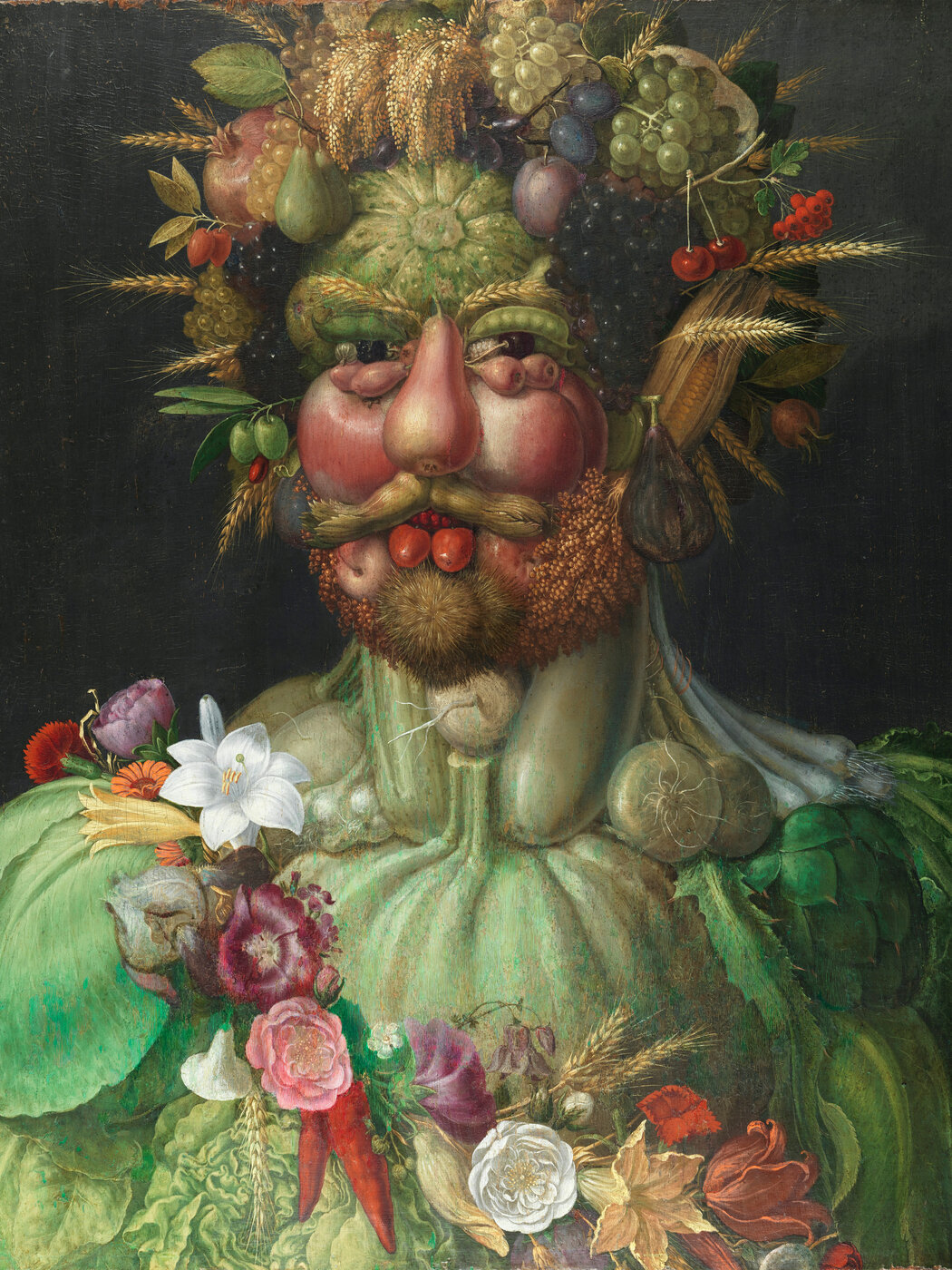
Rudolf II (Holy Roman Emperor) as Vertumnus is Giuseppe Arcimboldo’s portrait of the Habsburg emperor as the Roman god of the changing seasons, composed of fruit, vegetables and flowers: a pear is the nose, apples are the cheeks, an ear of maize is the ear, and a band of flowers crosses the chest. The original, dated 1591 and painted in oil on a wooden panel, is held by Skokloster Castle in Sweden under object number 11615_SKO, and the museum gives its size as 70 cm high and 58 cm wide. We make it as a hand-painted reproduction in oil on canvas, in fifteen sizes or a size of your own, and you receive a photograph of the finished painting for approval before dispatch.
| Title: | Rudolf II (Holy Roman Emperor) as Vertumnus |
| Other titles: | Vertumnus · Rudolf II. kot Vertumno · Rudolf II. kao Vertumno · Rudolf II. als Vertumnus · Rodolfo II come Vertunno · II. Rudolf mint Vertumnus |
| Painter: | Giuseppe Arcimboldo (1527–1593) |
| Year: | 1591, as the museum dates it; made in Prague |
| Original size: | 70 cm high and 58 cm wide, as the museum gives it |
| Original technique: | oil on a wooden panel |
| Style: | Mannerism |
| Location: | Skokloster Castle, Sweden (object no. 11615_SKO) |
| Our reproduction: | hand-painted oil on canvas, fifteen sizes from 30 x 40 to 130 x 155 cm, custom size on request |
Rudolf II (Holy Roman Emperor) as Vertumnus – Giuseppe Arcimboldo
What does the painting show?
A bust of a man seen almost from the front, on a dark ground, built entirely from fruit, vegetables and flowers. The museum describes it as a bust portrait composed of fruits, vegetables and flowers. The man is the Habsburg emperor Rudolf II, who lived in Prague, and he is shown as Vertumnus, whom the museum calls the Roman god of the seasons, growth, plants and fruit. So the painting is at the same time a portrait of a real ruler and a figure of a god, and every part of the face is something that grows.
What is the face made of?
The forehead is a large, ribbed green gourd. Over one eye lies a pea pod and over the other a few ears of wheat. The nose is a pear, and the cheeks are two round red apples. Two pale seed heads form the moustache, and two cherries make the lips. The beard is a russet mass of tiny grains, with a spiny chestnut husk at the chin. The ear is an ear of maize half out of its husk, and below it hangs a fig. The crown is heaped with green and black grapes, pears, plums and cherries, with a pomegranate at the top left, a cluster of small red berries at the top right, small green olives at the left and ears of wheat standing out all round. The throat is a pale root with fine rootlets. The chest is a large pale-green pumpkin, with onions, white leeks and an artichoke at the right and broad cabbage leaves over the left shoulder. From that shoulder a band of flowers runs down across the chest: a white lily, pink and white roses and red carnations, with ears of wheat and two red peppers among them.
Why does this painting matter?
Here the painter turned his method on the emperor himself. The museum calls the portrait a tribute to Rudolf II and an imperial allegory that corresponds with Arcimboldo’s series of the seasons, with the emperor seen as the ruler of them all; in its words, the flowers and fruit come from all the seasons. It is also much later than the Librarian at the same castle: the museum dates the Vertumnus to 1591, and the Librarian to 1562–1566, with a question mark, counting it among the early works made soon after Arcimboldo came to the Habsburg court in Prague. How the painter built his composed heads is the subject of our article about Arcimboldo.
What does the painting mean?
The museum gives the reading directly: the variety of flowers and fruit from every season signifies that a golden era has returned under the emperor’s rule, and the emperor, as Vertumnus, is seen as the ruler of all the seasons. That is the museum’s reading, and we add nothing to it; the page describes what can be seen and what the record says.
From Prague to Skokloster
The museum’s record traces the painting’s path. It was made in Prague and dated 1591. After the emperor’s death in 1612 it stayed in Prague, where it is recorded in the inventories of the imperial collections in 1621 and 1635. In 1648 the Swedish army took and plundered the Lesser Town of Prague in a surprise attack, and this painting, with hundreds of others, fell into Swedish hands as war booty. The record names Hans Christoffer von Königsmarck as a previous owner, and it notes that at Skokloster the painting is first found in 1845. The record also lists an inscription, N 51, without explaining it.
Other works by the painter
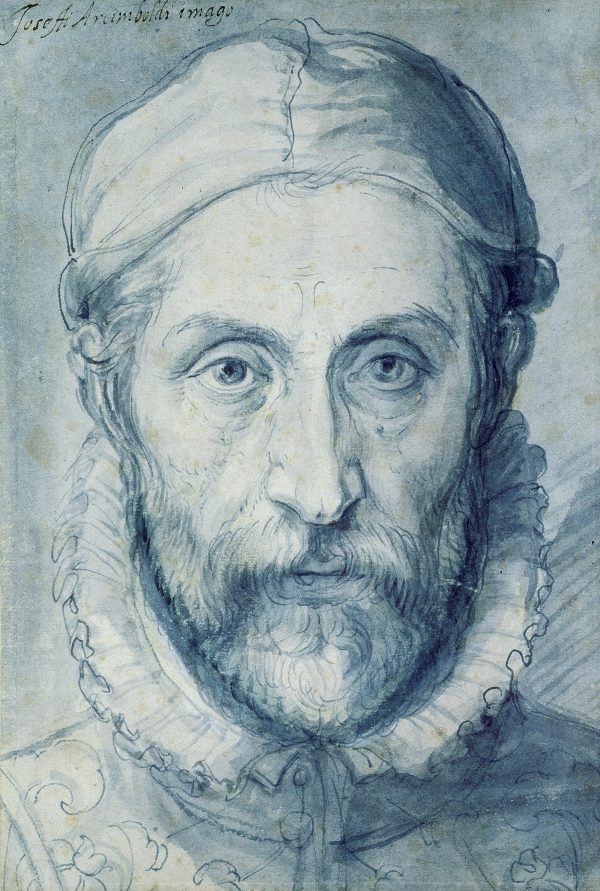
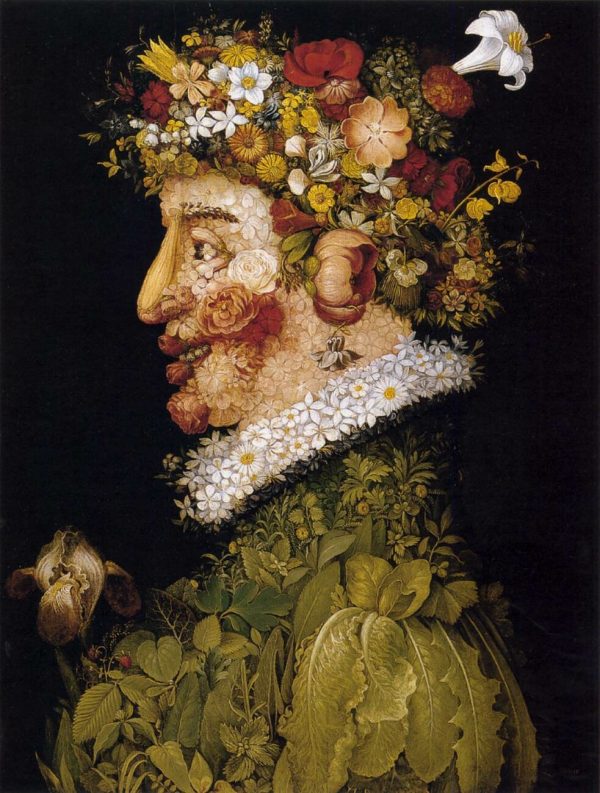
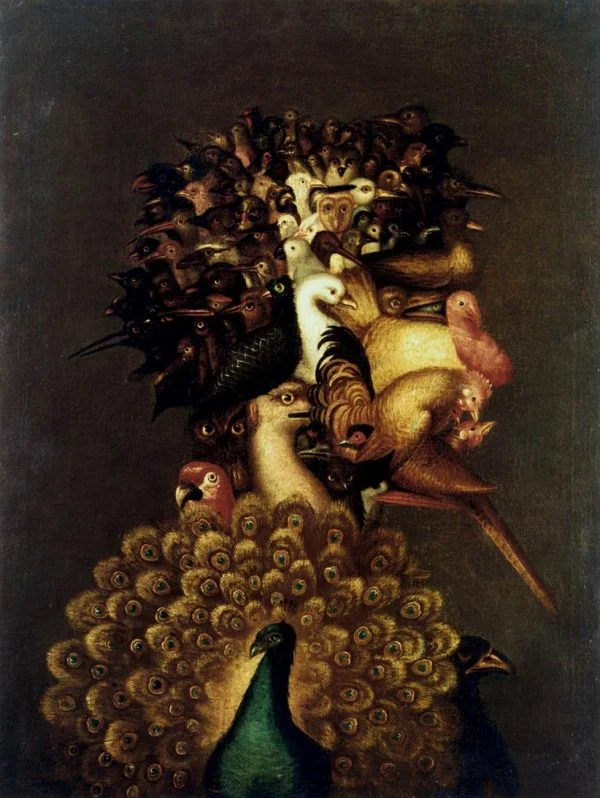
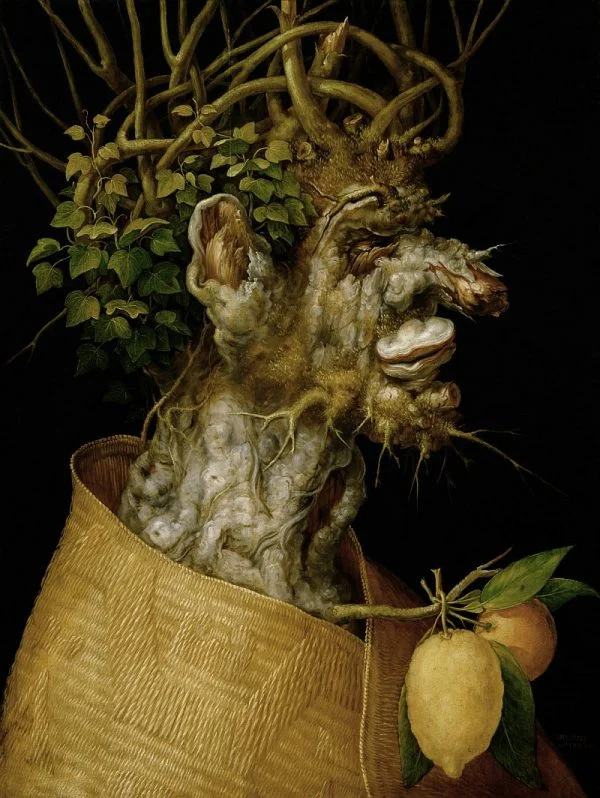
Skokloster also holds Arcimboldo’s Librarian, which came from Prague the same way: a man composed entirely of books, which the museum dates to 1562–1566, with a question mark, and whose sitter, it says, is most likely Wolfgang Lazius. Arcimboldo’s series of the seasons, which the museum says the Vertumnus corresponds with, is also in our range: Spring, Summer, Autumn and Winter. All of our Arcimboldo paintings are gathered on the Giuseppe Arcimboldo page.
How is our hand-painted version made?
Every oil painting reproduction we make is painted by hand on canvas; none is printed. The Vertumnus is demanding because nearly every part of it is a different surface: the waxy skin of the pear and the apples, the dull bloom of the grapes, the papery husk of the maize, the petals of the lily and the roses. Our painter first lays in the dark ground and the outline of the bust, then the large forms, the gourd, the pumpkin and the cheeks, and only then the small things, the grapes, the grains of the beard and the ears of wheat. The flowers come last, because they sit over everything else. The original is painted on a wooden panel, while our version is made on canvas, as is usual for work of this kind. The brushstrokes stay visible close up, and no two copies are ever quite the same.
Which size for which wall?
For most living rooms 50 x 60 cm or 57 x 70 cm is right. Our 57 x 70 cm is 1 cm narrower than the panel, which the museum gives as 58 cm wide, and exactly as high, at 70 cm, so it shows the painting at almost its own size. The smaller sizes, 30 x 40 cm and 40 x 50 cm, suit a kitchen, a hallway or a place above a desk, where the fruit can be seen close up. 70 x 90 cm and 80 x 100 cm suit a wall over a sofa, and 100 x 120 cm needs a free wall with room to step back. The eight largest sizes, between 119 and 130 cm wide and 150 to 160 cm high, differ from one another by at most 11 cm in width and 10 cm in height. In the smaller sizes the face reads first; in the larger ones every grape, grain and petal can be followed on its own.
Custom size, stretcher bar and frame
If none of the fifteen sizes fits, we paint in the size you ask for; send width and height through the paintings made to order page and we will prepare a quote. The painting is delivered stretched on a wooden stretcher bar and ready to hang, or rolled in a tube. You choose the frame on this page: the 3D frame selector offers 62 profiles, and the painting can also be ordered without a frame.
Delivery and guarantee
We paint to order, so it takes a few weeks, depending on size and on how busy the workshop is. We ship to sixteen countries in the European Union. Before dispatch you receive a photograph of the finished painting; if something is not as you expected, we correct it before it goes out, at no extra cost.
Frequently asked questions
Where is the original?
At Skokloster Castle in Sweden, object number 11615_SKO. The year, size, material and history on this page come from the museum’s public record.
Who is shown in the work?
The emperor Rudolf II, shown as Vertumnus, the Roman god of the seasons. The museum names him in its record and calls the portrait a tribute to him.
Why fruit and flowers from every season?
In the words of Skokloster Castle, which holds the painting, the variety of flowers and fruit from all seasons signifies that a golden era has returned under the rule of the emperor Rudolf II.
Is this a print?
No. Every copy is painted by hand, in oil on canvas.
Which size should I choose?
If you cannot decide, take 57 x 70 cm, which is close to the size of the original panel. For a large free wall, 100 x 120 cm or larger.
Can I have a size that is not listed?
You can. We paint in any size; send width and height through the custom order page.
How is it delivered?
Stretched on a wooden stretcher bar and ready to hang, or rolled in a tube.
How did the painting get to Sweden?
As war booty: the museum records that the Swedish army took it from Prague in 1648.
Is the original for sale and what is it worth?
It is not for sale: it belongs to the collection at Skokloster Castle. We give no value, because the museum’s record carries none.
How high should I hang it?
Centre it about 145 cm from the floor; over furniture, with the lower edge 20 to 30 cm above it.
Is it suitable as a gift?
It is, and if you cannot pick a size you can give a gift voucher instead, leaving the choice to whoever receives it.
- Subject: the emperor Rudolf II as Vertumnus, a bust made of fruit, vegetables and flowers, with a pear for a nose, apples for cheeks and an ear of maize for an ear.
- Original: oil on a wooden panel, 70 cm high and 58 cm wide as the museum gives it, dated 1591, Skokloster Castle, Sweden (object no. 11615_SKO).
- Ours: hand-painted in oil on canvas, in fifteen sizes or your own, with a photograph for approval before dispatch. You choose the frame on this page, or order the painting without one.
- Worth knowing: the painting stayed in Prague after the emperor’s death and was taken by the Swedish army as war booty in 1648.