













Description
Spring is the bust of a young, smiling gentleman that Giuseppe Arcimboldo assembled entirely from flowers and leaves: roses, peonies and pansies make the head, daisies the lace ruff, cabbage leaves the sleeve. The original of 1563, oil on panel, is held by the Royal Academy of Fine Arts of San Fernando in Madrid under inventory number 0606, and the museum gives its size as 66 x 50 cm. With us it is made as a hand-painted reproduction in oil on canvas, in six sizes or a size of your own, and you receive a photograph of the finished painting for approval before dispatch.
| Title: | Spring |
| Other titles: | La Primavera · Pomlad · Proljeće · Der Frühling · A tavasz |
| Painter: | Giuseppe Arcimboldo (1527–1593) |
| Year: | 1563 |
| Original size: | 66 x 50 cm, as the museum gives it |
| Original technique: | oil on panel |
| Style: | Mannerism |
| Location: | Royal Academy of Fine Arts of San Fernando, Madrid (inv. 0606) |
| Our reproduction: | hand-painted oil on canvas, six sizes from 30 x 40 to 80 x 100 cm, custom size on request |
Spring – Giuseppe Arcimboldo
What does the painting show?
The museum describes the work as the bust of a young, smiling gentleman. He is seen in profile, looking towards the left edge, and wears court dress with a high lace ruff. The record gives no name, nor do we: this is not the portrait of a particular person but spring in human form. On the back of the wooden panel, according to the Academy, an Italian inscription says that Spring is to be accompanied by Air, a head made of birds.
What is the head made of?
There is not a scrap of skin on the face. Cheek, brow and chin are a dense carpet of small pale flowers, out of which larger ones stand forward: a rose on the cheek and a large bloom forming the ear. Among the flowers of the head the museum names roses, peonies and pansies. The nose is an elongated pale bud, the lips are red buds, the eye a tiny flower cup. The hair is a wreath of flowers in every colour, from white lilies at the top to red, yellow and blue blooms crowding above the brow. The ruff is painted in white daisies and the costume below it in leaves: the museum names the cabbage leaves on the sleeve. At lower left an iris rises out of the dark, which the record reads as the pommel of a sword, part of the gentleman’s outfit. The almost black ground has no depth, so the flowers glow as if on a stage. Step close and you see a herbarium; step two paces back and you see a young man smiling.
Why does this painting matter?
The Academy explains in its record that these composite heads were conceived at the imperial court in Vienna, where the painter worked with his fellow countryman Giambattista Fonteo, and that they formed a whole of four seasons and four elements joined in pairs: Air and Spring, Fire and Summer, Earth and Autumn, Water and Winter. Together they were an allegory of the power of the Emperor Maximilian II. The Spring in Madrid is dated 1563, the same year carried by the Summer and the Winter in Vienna. It has also been lent to exhibitions: the Academy’s list names Washington, Milan, Tokyo, Bilbao and Metz. How the painter built his heads is the subject of our article about Arcimboldo.
What does the painting mean?
At first glance it is a game; at a second, it is politics. The Academy summarises the reading of Professor Thomas da Costa Kaufmann, who studied the paintings together with Fonteo’s manuscript: a human being is a microcosm that sums up time and space, and the emperor rules over both. The seasons are also linked to the four ages of man, and in that reading spring belongs to youth, which fits the young, smiling face. The pairs of seasons and elements, according to the same record, reflect Maximilian’s marriage policy: with his many children the emperor filled Europe’s vacant thrones and so avoided war.
How did the painting reach Madrid?
The date and circumstances in which the work entered the Academy are not known. The Academy writes that it was probably among the works by Arcimboldo that contemporary sources mention in the bedroom of Philip II in the Alcázar of Madrid, and that it may also have reached the Academy in the eighteenth century as a gift from a Bourbon king. The record also lists a restoration in 1963 and work on the frame in 1994.
Which Spring is this?
The one we paint is the Madrid panel of 1563. The Academy itself notes that the painter later made new versions of the whole series, and that among them is the Louvre’s Spring, which came from the collection of the Electors of Saxony in Dresden. The Louvre records it as oil on canvas, 76 cm high and 63.5 cm wide, dated to the third quarter of the sixteenth century; it bought the painting in 1964, and today it is at the Louvre-Lens. The two paintings share a subject but are not the same work.
The Four Seasons
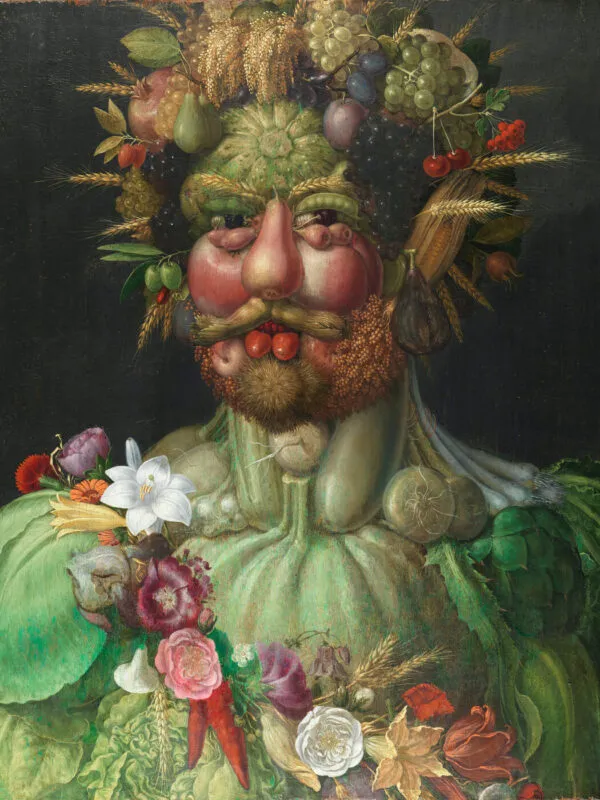
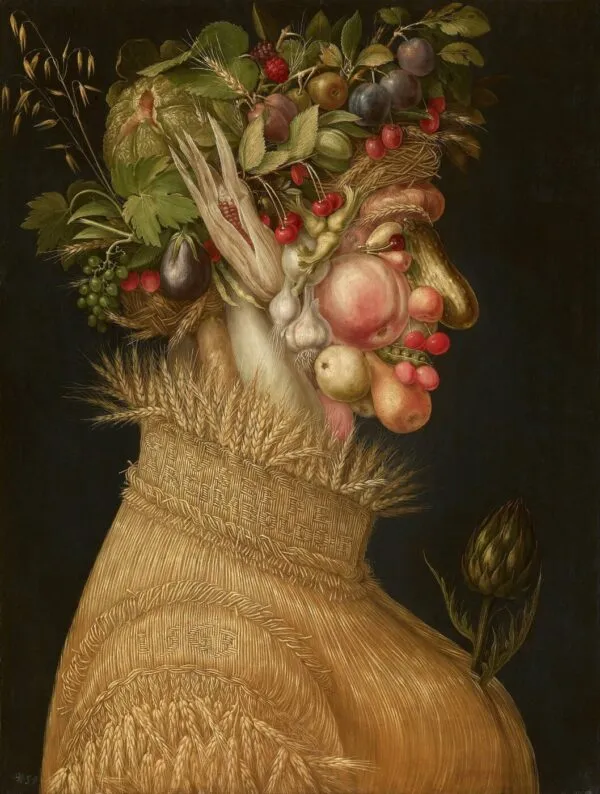
This painting belongs to a cycle. All four are available here:
- Giuseppe Arcimboldo – Spring
- Giuseppe Arcimboldo – Summer
- Giuseppe Arcimboldo – Autumn
- Giuseppe Arcimboldo – Winter
Hung as a matched group of four, the sizes 30 × 40, 40 × 50, 50 × 60, 64 × 76, 70 × 80 cm work — every one of the four is available in them.
More on both cycles as a wall group: Arcimboldo’s Four Seasons and Four Elements as a wall group
How is our hand-painted version made?
Every copy is hand-painted in oil on canvas; none is printed. Spring is among the more demanding subjects, because it is made of a multitude of small flowers, each of which must stay recognisable on its own while all of them together melt into a smooth cheek. Our painter first lays in the dark ground and the outline of the head, then builds the face from the small pale flowers towards the larger ones, and finally adds the wreath in the hair and the white daisies of the ruff, which must stay a cool white beside the warm pink cheeks. To be clear: the original is painted on a wooden panel, while our version is made on canvas, as is usual for work of this kind. The result is an oil painting reproduction made by hand, not by machine, with the brushstrokes visible close up.
Which size for which wall?
For most living rooms 50 x 60 cm is right. The smaller sizes, 30 x 40 cm and 40 x 50 cm, belong in a hallway or above a desk, where single flowers can be picked out close up. The middle sizes, 50 x 60 cm and 64 x 76 cm, go over a chest of drawers, a sofa or a bed. The larger ones, 70 x 80 cm and 80 x 100 cm, need a free wall seen from several metres, where the face of flowers works best. 64 x 76 cm is close to the canvas of the Louvre’s later version, which is 63.5 cm wide and 76 cm high: ours is 5 mm wider and the same height. The Madrid panel we paint measures 66 x 50 cm, as the museum gives it; the record does not say which figure is the height.
Custom size, stretcher bar and frame
If none of the six sizes fits, we paint in the size you ask for; send width and height through the paintings made to order page and we will prepare a quote. The painting is delivered stretched on a wooden stretcher bar and ready to hang, or rolled in a tube. You choose the frame on this page: the 3D frame selector offers 62 profiles, and the painting can also be ordered without a frame.
Delivery and guarantee
We paint to order, so it takes a few weeks, depending on size and on how busy the workshop is. We ship to sixteen countries in the European Union. Before dispatch you receive a photograph of the finished painting; if something is not as you expected, we correct it before it goes out, at no extra cost.
Frequently asked questions
Where is the original?
At the Royal Academy of Fine Arts of San Fernando in Madrid, inventory number 0606. The record is public and linked in the table; the year 1563, the size and the technique come from it.
Who is shown in the work?
The museum speaks of a young, smiling gentleman but gives no name.
Is Le Printemps in the Louvre the same work?
No. Le Printemps is the Louvre’s title for its later version, on canvas; La Primavera, the Madrid Academy’s title, names the panel we paint.
Is this a print?
No. Every copy is painted by hand, in oil on canvas.
Which size should I choose?
If you cannot decide, take 50 x 60 cm. For a wall seen close up a smaller size suits better; for a large free wall, 70 x 80 cm or 80 x 100 cm.
Can I have a size that is not listed?
You can. We paint in any size; send width and height through the custom order page.
How is it delivered?
Stretched on the bar and ready to hang, or rolled in a tube.
What is the work about, in one sentence?
That spring is youth, and that a man made of flowers is a small world of time and space over which the emperor rules.
Is the original for sale and what is it worth?
It is not for sale: it belongs to the Academy’s collection in Madrid. We give no value, because the record carries none.
How high should I hang it?
Centre it about 145 cm from the floor, the eye height of an average adult; over furniture, with the lower edge 20 to 30 cm above it.
Is it suitable as a gift?
It is, and if you cannot pick a size you can give a gift voucher instead, leaving the choice to whoever receives it.
- Subject: a young, smiling gentleman made of roses, peonies, pansies, daisies and cabbage leaves; a herbarium close up, a face from across the room.
- Original: oil on panel, 66 x 50 cm as the museum gives it, 1563, Royal Academy of Fine Arts of San Fernando, Madrid (inv. 0606).
- Ours: a hand-painted copy in oil on canvas, six sizes or your own, with a photograph for approval before dispatch. You choose the frame on this page, or order the painting without one.
- Worth knowing: the back of the panel says that Spring is to be accompanied by Air, a head made of birds; the paintings were meant in pairs.