


Description
| Title: | Fight between a Tiger and a Buffalo |
| Other titles: | Fight Between a Tiger and a Buffalo (the museum’s title) |
| Painter: | Henri Rousseau |
| Year painted: | 1908 |
| Original size: | 170 cm x 189.5 cm (height x width) |
| Original technique: | oil on canvas |
| Painting style: | naive art (primitivism) |
| Held at: | Cleveland Museum of Art, Cleveland, USA |
| Our reproduction: | hand-painted oil on canvas, ten sizes or a size made to order |
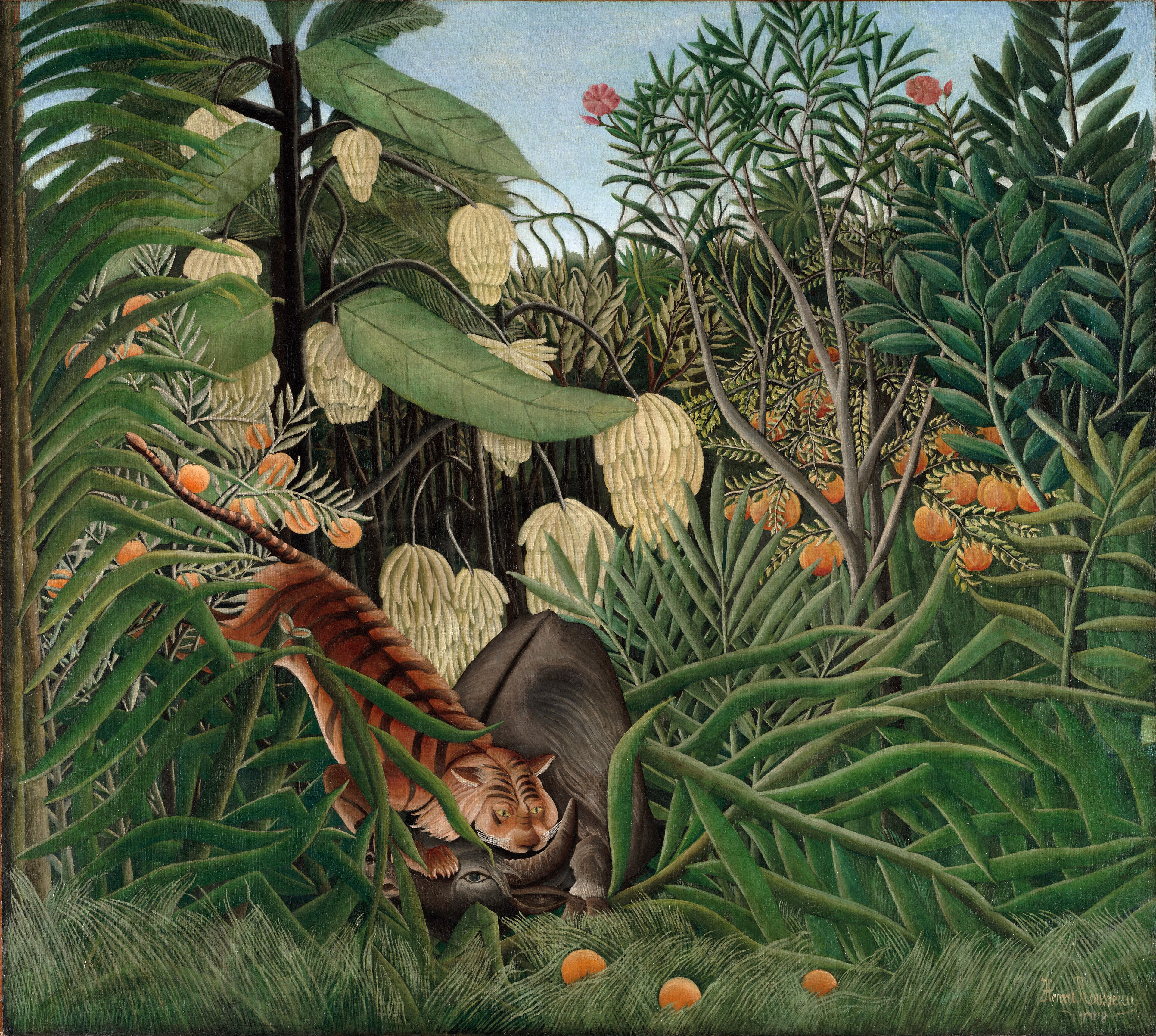
Fight between a Tiger and a Buffalo is a painting by Henri Rousseau, oil on canvas, dated 1908 by the Cleveland Museum of Art. What you see: a striped tiger leaping on a dark buffalo in the middle of a dense jungle hung with bunches of bananas, oranges and red flowers. We paint it by hand in oils, in ten sizes or to measure, and send you a photograph of the finished painting before dispatch.
Fight between a Tiger and a Buffalo
What is on the canvas?
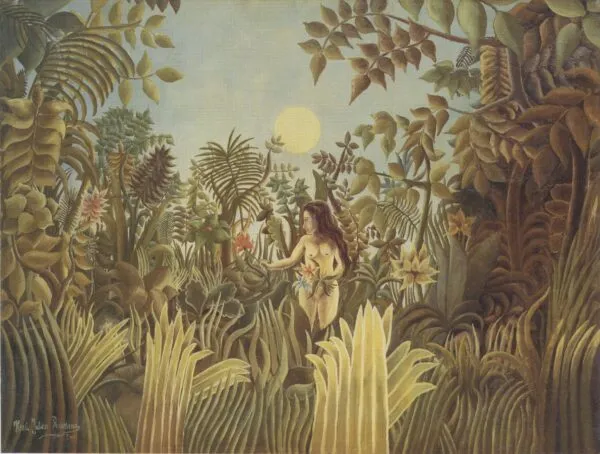
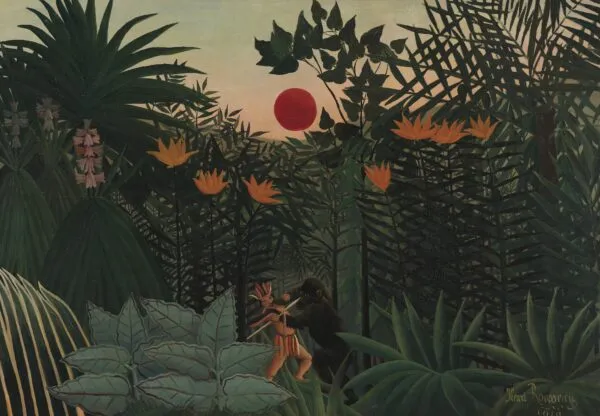
At the bottom centre an orange tiger with black stripes throws itself on a dark grey buffalo and bites into its head; the buffalo’s horn and eye look out from the grass. Around them the jungle opens up: big pale yellow bunches of bananas hang from the trees, orange fruit glows among the leaves at the right, a few lie in the grass in front, and at the top two red flowers bloom. The leaves are sharply outlined in countless greens, with a pale blue sky above them. The signature and year, Henri Rousseau 1908, are at the lower right. A similar fight by the same painter is In a Tropical Forest: Struggle between Tiger and Bull.
What does the painting mean?
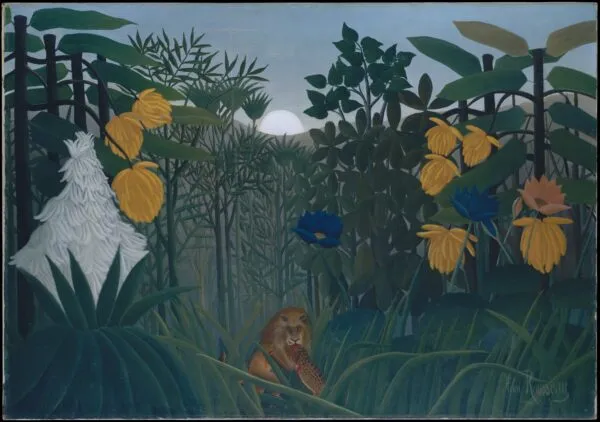
The Cleveland Museum of Art writes that Rousseau never left France: he built his jungles from travel books and visits to the botanical garden in Paris. The scene is imaginary and botanical accuracy mattered little to him, so the bananas grow upside down and hothouse plants are enlarged to fearsome proportions. The museum adds that Rousseau was working on the painting while imprisoned for fraud in December 1907; he was released early so he could finish it for the Salon des Indépendants in March 1908. According to the museum it is one of his largest and most important works. Another attack in the jungle is The Hungry Lion Throws Itself on the Antelope.
Which size suits which room?
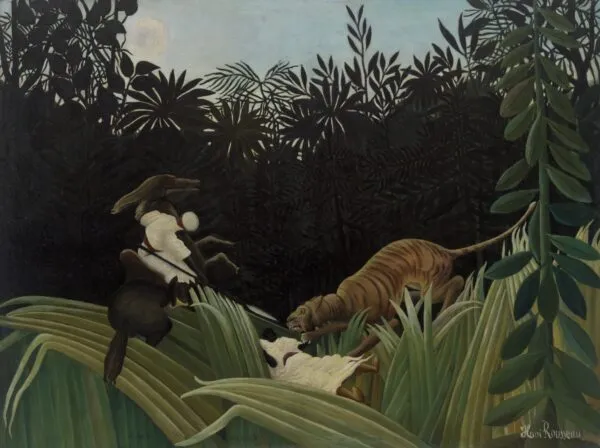
The original is 170 cm high and 189.5 cm wide, almost square and very large; 130 x 115 cm keeps its proportion most exactly. Ten sizes are available: 70 x 60, 80 x 70, 90 x 78, 100 x 86, 105 x 96, 111 x 101, 120 x 105, 130 x 115, 140 x 120 and 150 x 130 cm; even the largest is smaller than the original. Because the painting lives on its dense leaves and small details, we recommend 120 x 105 cm or larger for a living room; the smaller sizes suit a study or a hallway. Above a sofa the painting usually takes about two thirds of the width of the furniture; above a bed it should stay narrower than the headboard. Custom sizes are ordered through the made-to-order painting page, where you enter the width and height; we suggest keeping the proportion of the original and changing only the scale. A tiger in the jungle is also Scouts Attacked by a Tiger.
How is the painting made, and does it come framed?
Your canvas is begun only after you order it, and is painted by hand in oils in our workshop in Slovenia, at the size you choose. The painter lays in the sky and the dark layers of leaves at the back first, then the trees with their bananas and oranges, then the sharply outlined leaves in front, and last the tiger with every stripe, and the buffalo. We do not print, and no machine application is used, so no two versions are exactly alike. The canvas is stretched on a wooden frame and arrives ready to hang; a picture frame is not included in the price and is chosen separately. Before packing we photograph the finished painting and send you the photograph for approval; only then does it travel. A jungle with monkeys by the same painter is Tropical Forest with Monkeys. The whole collection is in the Henri Rousseau gallery.
How is it delivered, and what do we guarantee?
We deliver to Slovenia, Croatia, Italy, Austria, Hungary and Germany. Depending on its size, the canvas travels rolled in a rigid tube or stretched on its frame, always in protective wrapping and as a tracked parcel. The making time depends on the size and is confirmed when you order. We guarantee that every painting is painted by hand and that you see a photograph of the finished work before dispatch; if anything in it is not as you wish, we correct it before it leaves the workshop.
Frequently asked questions
Where is the original kept?
At the Cleveland Museum of Art in Cleveland, USA.
When was it painted?
In 1908; Rousseau signed and dated it at the lower right.
Is a frame included?
No. The canvas is stretched on a wooden frame and ready to hang without a picture frame; a frame can be chosen separately.
Is this a print?
No. It is painted by hand in oils, and the layers of paint can be seen and felt.
Is the painting suitable as a gift?
Yes, especially for someone who loves animals, jungles and bold colour. If you would rather the recipient chose, there is a gift voucher.
- Subject: a striped tiger leaps on a buffalo in a jungle of hanging bananas, oranges and red flowers.
- Original: oil on canvas, 170 x 189.5 cm, Cleveland Museum of Art; 1908.
- Our version: hand-painted oil, ten sizes from 70 x 60 to 150 x 130 cm or to measure, unframed, photograph before dispatch.
- Of note: according to the museum, the bananas grow upside down because botanical accuracy did not matter to Rousseau.