


Description
| Title: | The Snake Charmer |
| Other titles: | La Charmeuse de serpents (the original French title) |
| Painter: | Henri Rousseau (1844–1910) |
| Year of creation: | 1907, as the museum dates it |
| Original size: | 189.5 cm x 167 cm |
| Original technique: | oil on canvas |
| Painting style: | naive art (primitivism), Paris after Impressionism |
| Located at: | Musée d’Orsay, Paris (inv. RF 1937 7) |
| Our reproduction: | hand-painted oil on canvas, ten sizes or a size made to order |
The Snake Charmer – Henri Rousseau
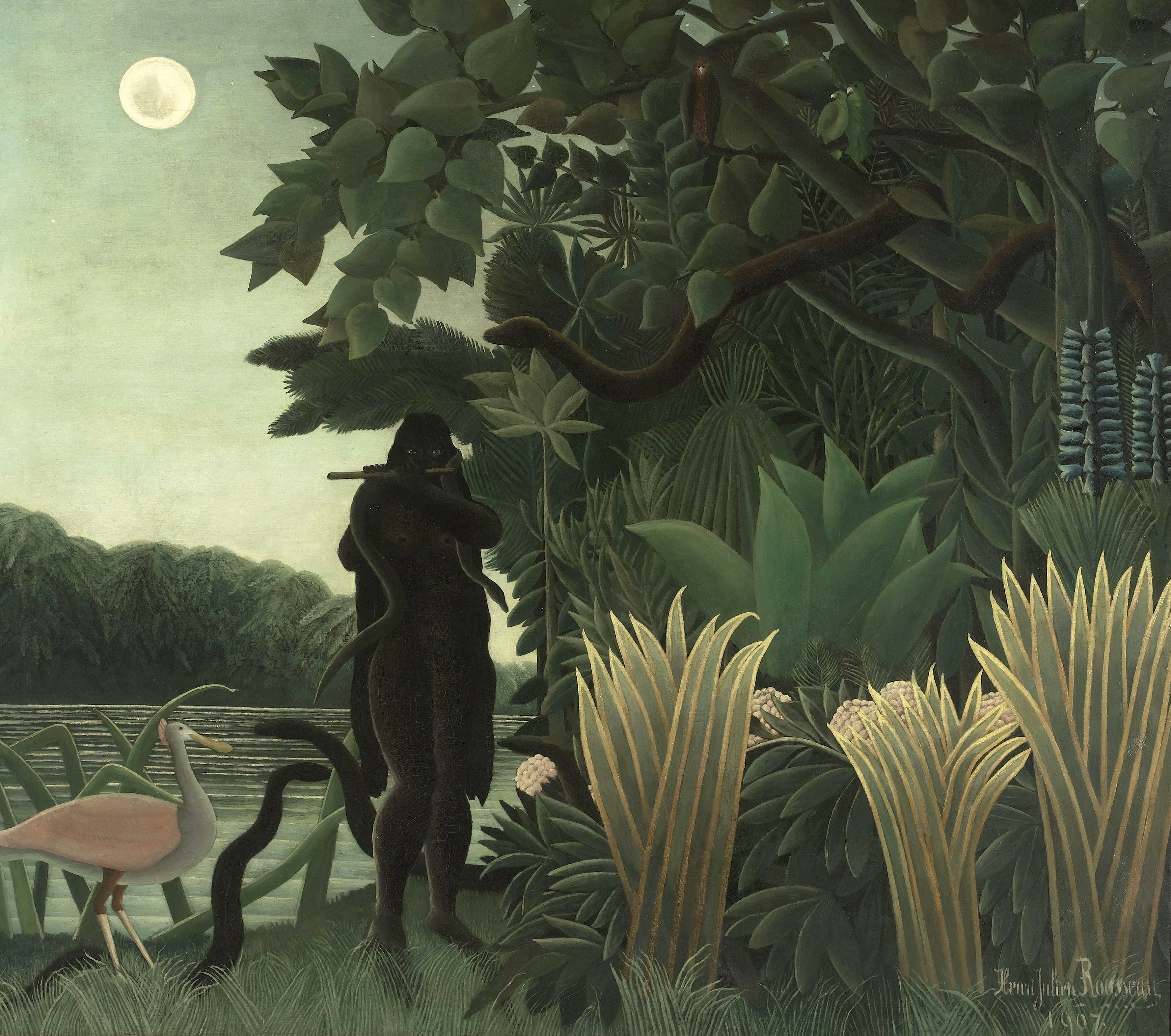
The Snake Charmer is a night jungle scene and one of the largest canvases by this painter. A dark silhouette of a woman with a flute stands in the thicket, with snakes, a bird and a pale moon around her. The original is held by the Musée d’Orsay in Paris under inventory number RF 1937 7; the museum dates it 1907 and gives a height of 167 cm and a width of 189.5 cm. Here it is made as a hand-painted reproduction in oil, on canvas, in ten sizes from 70 x 59 cm to 140 x 120 cm or to your own measurement. Before dispatch we send you a photograph of the finished canvas for approval.
What is on the canvas?
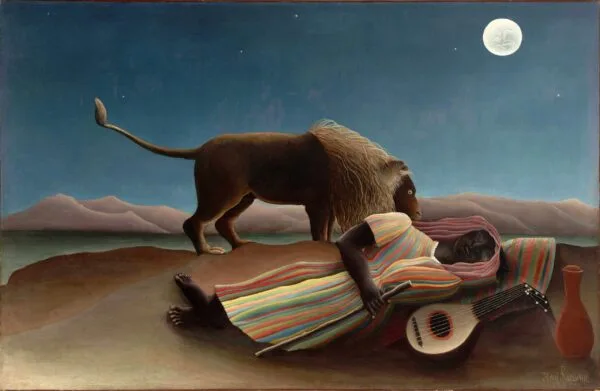
A woman stands in the thicket, turned towards the viewer, playing a transverse flute. The body is painted as an almost complete silhouette: out of the darkness only the whites of the eyes catch the light. A snake winds over her shoulder, a second rises in an arc from the grass, a third lies along a branch. At the lower left a large bird with a long beak steps forward; behind it runs a band of water, and above the water stands a dark wall of forest. High to the left hangs a pale moon. All of that is also what the work is recorded as showing: a woman, a flute, a snake, a bird, the Moon, a watercourse, reed and landscape. A night scene filled instead with bodies and pattern is The Dream.
Why was the stated size corrected on this work?
Because it was the wrong way round. Our table gives measurements as width by height, and on this work it had been reading 167 x 189 cm — narrower than tall, that is an upright canvas. The museum gives the opposite: a height of 167 cm and a width of 189.5 cm. The canvas is landscape, wider than it is tall. That the error was in the order and not in the numbers is confirmed by the range itself: every size offered for this painting is landscape, from 70 x 59 to 140 x 120 cm. The table was contradicting the very product it sits on; it now reads 189.5 x 167 cm, as the museum’s record has it.
Why does the silhouette carry the whole scene?
Because the main figure has almost no internal drawing. All that defines her is the outline — shoulders, hips, arms raised to the flute — and two bright points of eyes. That is why the scene holds at a distance: the silhouette reads as a sign rather than as a portrait. It is a rarity among this painter’s jungle canvases, where every leaf is otherwise drawn separately and no shape is left to outline alone. Here the whole weight of the picture rests on a single dark plane.
How does the night jungle differ from the daylight ones?
A pale moon, a grey-green sky and water without glitter put the scene in twilight, and that separates it from this painter’s other jungles. The canvas Tiger in a Tropical Storm takes its direction and light from the storm, and elsewhere in his work the thicket is lit and open. Here the growth does not open at all — it closes around the figure and holds her in place. The colour range is narrower: dark green, black, cream, and a single pink stroke at the bird.
What does the painting mean?
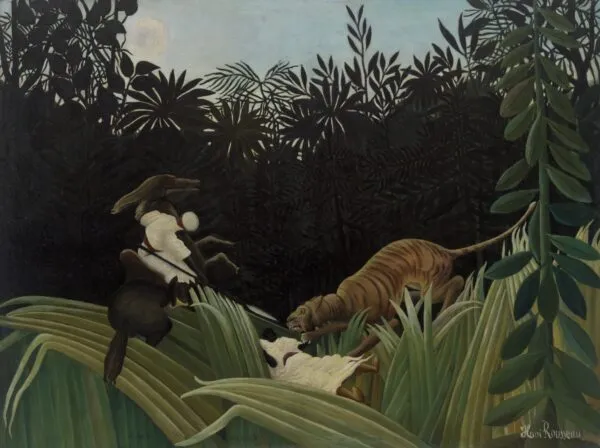
The scene does not explain who the woman is or why she plays. The snakes neither retreat nor attack; the bird does not flee; the moon lights nothing. The whole reads as a rite that began before the viewer arrived and will continue after they leave. Some read it as an image of accord between a person and animals, others as a quiet threat made stronger by never happening. The painting takes neither side, and that is where its hold comes from. A more direct confrontation is In a Tropical Forest: Struggle between Tiger and Bull.
How did the painting reach the museum?
The museum records that it entered the collection as the bequest of Jacques Doucet in 1936, and that it is inventoried as RF 1937 7. That is the whole of what the institution publishes about the canvas’s path: no list of earlier owners, no sale history. So we give nothing else. The museum also publishes the frame’s measurements — 195 cm high, 218 cm wide and 10 cm deep — which says how much wall the original actually occupies.
What does naive art mean in this work?
Naive art is the name for painting by self-taught artists who trained in no academic studio and kept to none of its rules on perspective, shading and anatomy. In this canvas it shows in growth with no aerial perspective, and in a figure built from outline instead of modelling. Rousseau was a customs clerk who began to paint seriously only in his forties. The label naive art therefore does not mean ignorance, but a style you recognise at first glance. There is more on the painter’s path in our article about the painter.
How is your canvas made here?
Your canvas is begun only after your order, in our workshop in Slovenia. The oil is built up in layers, from the sky and the water towards the growth and last of all towards the figure. With this subject the silhouette is the hardest part: if the outline is even slightly too soft, the figure loses the sharpness the whole scene stands on. We do not print and we use no mechanical application; a hand-painted canvas differs from a print by touch alone, because the body of the paint is visible and can be felt. The canvas is stretched on a wooden frame. The full range by this painter is in the Henri Rousseau gallery.
Which size for which wall?
Ten sizes: 70 x 59, 70 x 65, 80 x 68, 90 x 78, 100 x 85, 105 x 96, 115 x 97, 120 x 105, 130 x 110 and 140 x 120 cm. Being a landscape canvas, it needs a wide and uninterrupted wall: above a sofa, above a sideboard, or in a dining room. For a living room the usual choice is 120 x 105 cm or larger. Below 90 x 78 cm the foliage and the snakes begin to merge into a dark plane and the silhouette loses the surroundings that define it. Because the original is 189.5 cm wide, none of our sizes reaches it; the largest is about three quarters of its width.
How do I order a custom size, a stretcher and a frame?
Custom sizes go through the painting made by order page, where you enter width and height. Proportions matter here: the figure stands a little left of centre and the water and the moon need room beside her, so bringing the canvas closer to a square loses exactly that arrangement. For non-standard measurements we suggest keeping the ratio and changing only the scale. The canvas is always stretched on a wooden frame. A frame is not included in the price and is chosen separately.
How is it delivered and what do we guarantee?
We deliver to Slovenia, Croatia, Italy, Austria, Hungary and Germany. The canvas travels rolled in a hard tube or stretched on its frame, depending on the size, always in protective wrapping. We guarantee that every work is painted by hand and that you will see a photograph of the finished piece before dispatch; if something there is not as you wish, we correct it before the work leaves the workshop. Production time depends on the size and is confirmed when you order.
Frequently asked questions
Which museum holds the original today?
The Musée d’Orsay in Paris, under inventory number RF 1937 7. The museum gives oil on canvas, a height of 167 cm and a width of 189.5 cm.
What year is the painting from?
The museum dates it to 1907, with a single year, no span and no hedge.
Why was the measurement corrected?
Because the order was reversed. The canvas is landscape: 189.5 cm wide and 167 cm high.
Does any size reach the size of the original?
No. The largest size offered is 140 x 120 cm, while the original is 189.5 cm wide.
Is this a print?
No. Every canvas is painted by hand in oils, to order. The body of the paint is visible and can be felt, which a print cannot imitate.
Which size should I choose?
For a living room 120 x 105 cm or larger, for a narrower wall 100 x 85 cm. The landscape format asks for width, not height.
Can I have a size that is not on the list?
Yes, a made-to-order size carries no surcharge for a non-standard format. We recommend keeping the proportions.
How did the work reach the museum?
As the bequest of Jacques Doucet in 1936; it is inventoried as RF 1937 7. The museum publishes no other detail.
What is depicted?
A woman with a flute, snakes, a bird, the Moon, a watercourse, reed and landscape — exactly what the work is recorded as showing.
How is the painting delivered?
Rolled in a tube or stretched on its frame, with tracked shipping. Production time is confirmed when you order.
Is it suitable as a gift?
The subject is calm and dark, so it works in a room where you do not want a loud picture. If you would rather leave the choice to the recipient, there is a gift voucher.
- Subject: a dark silhouette of a woman with a flute, snakes, a bird and a moon above water
- Original: 1907, oil on canvas, 167 cm high and 189.5 cm wide, Musée d’Orsay, Paris, inv. RF 1937 7
- Our version: hand-painted oil, ten sizes from 70 x 59 to 140 x 120 cm or made to measure
- Corrected: the stated measurement was reversed and showed the canvas as upright; it is landscape