







































Description
| Title: | View of the Clichy Bridge at Asnières |
| Other titles: | not confirmed |
| Painter: | Henri Rousseau |
| Year painted: | not confirmed |
| Original size: | not confirmed; the original is a little taller than it is wide |
| Original technique: | oil on canvas |
| Painting style: | naive art (primitivism) |
| Held at: | not confirmed |
| Our reproduction: | hand-painted oil on canvas, eight sizes or a size made to order |
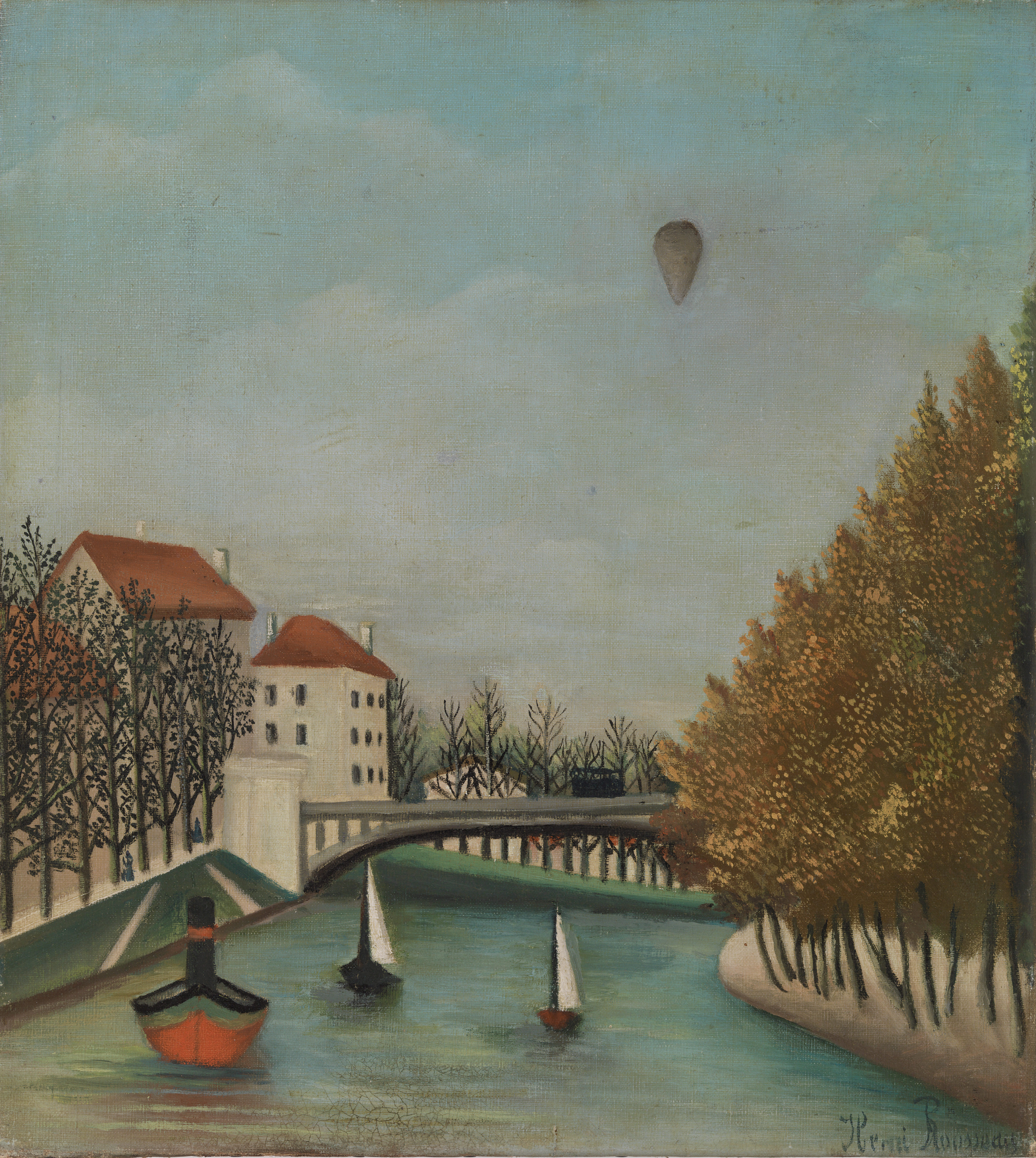
View of the Clichy Bridge at Asnières is a painting by Henri Rousseau, oil on canvas. What you see: a river curving away into the distance, a red tug and two small sailboats on the water, a bridge with a tram car crossing it, white houses with red roofs and autumn trees, and high in the sky a grey balloon. We paint it by hand in oils, in eight sizes or to measure, and send you a photograph of the finished painting before dispatch.
View of the Clichy Bridge at Asnières
What is on the canvas?
At the lower left a tug with a red hull, a green band and a black funnel sits on the water, with two small sailboats with white sails behind it. The river curves away under a bridge with an iron arch, where a dark tram car is crossing. On the left bank two white houses with red roofs and chimneys stand behind a row of thin trees, and two tiny figures walk along the quay. The right bank is sandy, crowded with autumn trees with white trunks in orange and brown. More than half the painting is pale sky, with a grey balloon floating high up. The signature, Henri Rousseau, is at the lower right. Another bridge over the river by the same painter is View of the Bridge at Sèvres.
What does the painting mean?
Rousseau paints a quiet riverside on the edge of Paris and sets signs of the new age inside it: a steam tug, a tram on the bridge and a balloon in the sky. Everything is painted with the same care and the same stillness, with no waves on the water and no wind in the trees, so the scene reads like a keepsake postcard. We could not simply confirm which collection holds the original or exactly when it was painted, so we give neither. Another view of the outskirts of Paris is Environs de Paris.
Which size suits which room?
The original is a little taller than it is wide; 80 x 90 and 90 x 100 cm come closest to its proportion. Eight sizes are available: 60 x 65, 70 x 80, 80 x 90, 90 x 100, 110 x 120, 130 x 150, 150 x 160 and 172 x 200 cm. Because the sky takes up so much of it, the painting suits a tall wall: 70 x 80 cm is enough above a chest of drawers or in a hallway, and for a living room we recommend 110 x 120 cm or larger. Above a sofa the painting usually takes about two thirds of the width of the furniture; above a bed it should stay narrower than the headboard. Custom sizes are ordered through the made-to-order painting page, where you enter the width and height; we suggest keeping the proportion of the original and changing only the scale. A river and its boats also fill The Great Laundry Boat at Charenton Bridge.
How is the painting made, and does it come framed?
Your canvas is begun only after you order it, and is painted by hand in oils in our workshop in Slovenia, at the size you choose. The painter lays in the sky and the balloon first, then the houses, the bridge and the trees on both banks, then the water, and last the tug, the sailboats and the tiny figures on the quay. We do not print, and no machine application is used, so no two versions are exactly alike. The canvas is stretched on a wooden frame and arrives ready to hang; a picture frame is not included in the price and is chosen separately. Before packing we photograph the finished painting and send you the photograph for approval; only then does it travel. Another river bank outside Paris by the same painter is The Banks of the Bièvre near Bicêtre. The whole collection is in the Henri Rousseau gallery.
How is it delivered, and what do we guarantee?
We deliver to Slovenia, Croatia, Italy, Austria, Hungary and Germany. Depending on its size, the canvas travels rolled in a rigid tube or stretched on its frame, always in protective wrapping and as a tracked parcel. The making time depends on the size and is confirmed when you order. We guarantee that every painting is painted by hand and that you see a photograph of the finished work before dispatch; if anything in it is not as you wish, we correct it before it leaves the workshop.
Frequently asked questions
Where is the original kept?
We could not confirm this reliably, so we name no collection.
When was it painted?
We could not confirm the date reliably, so we give none.
Is a frame included?
No. The canvas is stretched on a wooden frame and ready to hang without a picture frame; a frame can be chosen separately.
Is this a print?
No. It is painted by hand in oils, and the layers of paint can be seen and felt.
Is the painting suitable as a gift?
Yes, especially for someone who loves rivers, boats and old Paris. If you would rather the recipient chose, there is a gift voucher.
- Subject: a river with a tug and two sailboats, a bridge with a tram, white houses, autumn trees and a balloon in the sky.
- Original: oil on canvas; the collection, date and size of the original are not confirmed, so we do not give them.
- Our version: hand-painted oil, eight sizes from 60 x 65 to 172 x 200 cm or to measure, unframed, photograph before dispatch.
- Of note: the grey balloon high in the sky is the smallest and most unexpected thing in the painting.