


Description
| Title: | Environs de Paris |
| Other titles: | Environs de Paris (also the museum’s French title) |
| Painter: | Henri Rousseau |
| Year painted: | about 1906–1910 |
| Original size: | 38 cm x 46 cm (height x width) |
| Original technique: | oil on canvas |
| Painting style: | naive art (primitivism) |
| Held at: | Barnes Foundation, Philadelphia, USA (inv. BF844) |
| Our reproduction: | hand-painted oil on canvas, eight sizes or a size made to order |
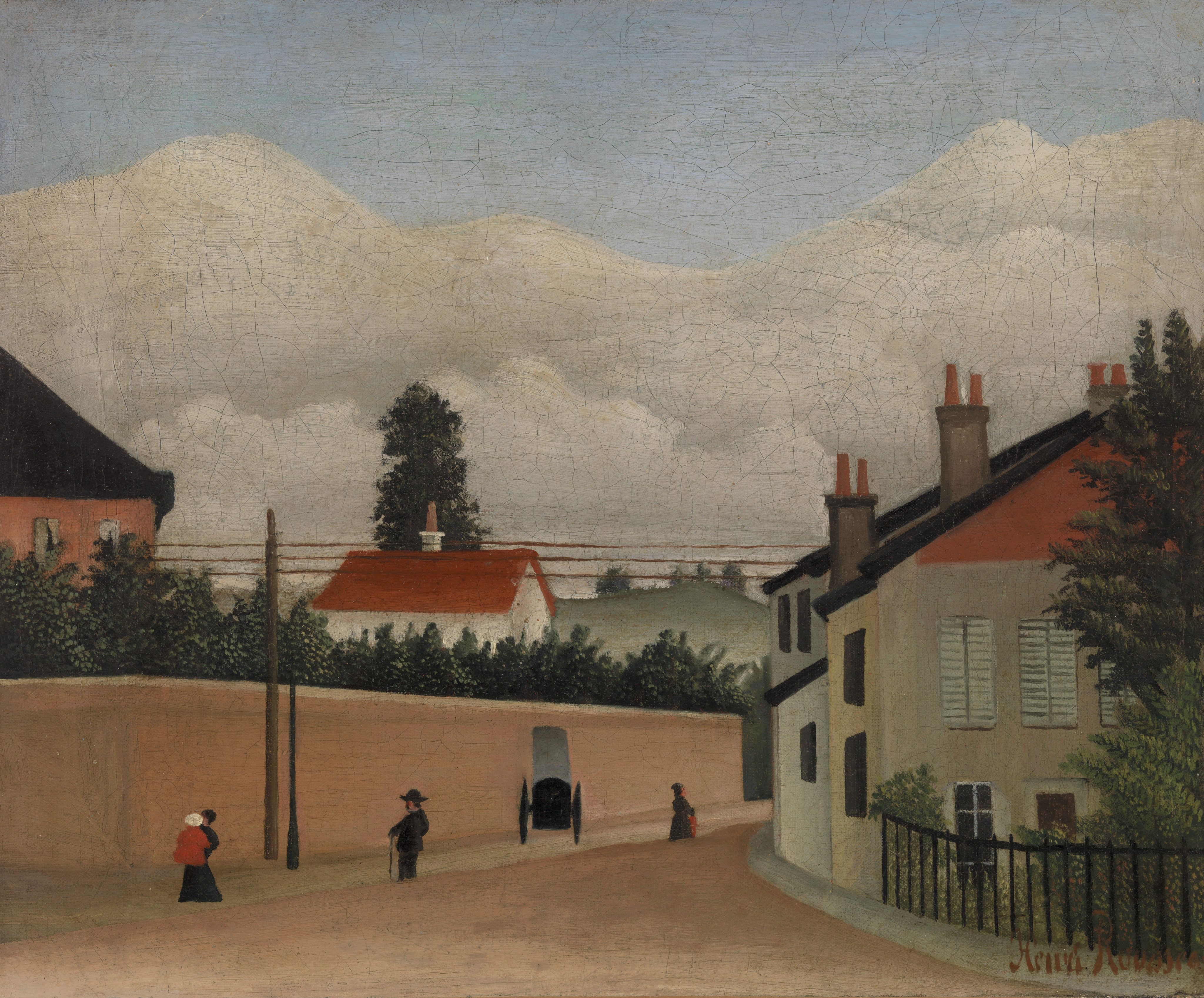
Environs de Paris is a painting by Henri Rousseau, oil on canvas, dated by the Barnes Foundation to about 1906–1910. The original is 38 cm high and 46 cm wide and is held by the Barnes Foundation in Philadelphia under inventory number BF844. What you see: a quiet street on the edge of a town, a long pink wall with a hooded buggy in front of it, four small figures, poles and wires, and a vast bank of white cloud over the rooftops.
Environs de Paris
What is on the canvas?
The canvas is a little wider than it is high. A broad pinkish-ochre street comes in from the lower left and bends away to the right. Across the middle runs a long pink wall; in front of it stands a dark hooded buggy and, to its left, two thin poles carrying wires that stretch away to the right. There are four people on the road: at the left a woman in black carrying a small child in red, nearer the centre a man in a wide black hat leaning on a stick, and further on a woman in dark clothes walking to the right. On the right stand pale two-storey houses with red roofs, chimney pots, grey shutters and a black iron railing; at the far left is the edge of a darker house with a black roof. Above the wall rise hedges, a white house with a red roof and a tall dark tree, and above everything a vast mass of white and grey cloud fills almost half the canvas beneath a strip of blue sky. The signature, Henri Rousseau, is in red at the lower right.
Why might Rousseau have known this street?
The museum puts it cautiously: Rousseau worked as a customs clerk on the outskirts of Paris, and it is possible that he painted this very neighbourhood. The National Gallery in London describes the same job more precisely, as an inspector at a toll station on the edge of Paris from 1871 to 1885, which is where his nickname le Douanier, the customs officer, comes from. Neither museum names the street, so we do not either. A toll station also gives its name to another painting we offer: Toll Gate.
Why are the clouds bigger than the houses?
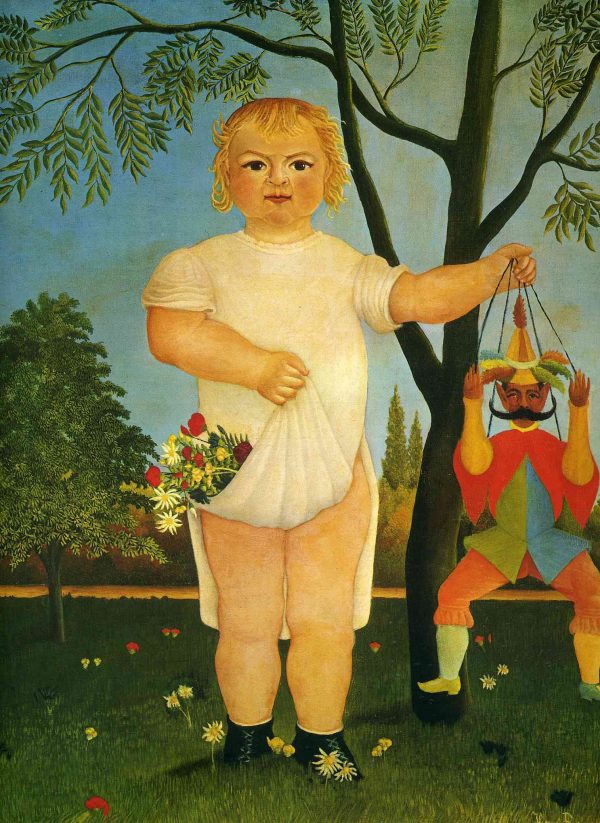
The museum calls them a monumental soufflé of clouds and links that dramatic, graphic quality to Rousseau’s taste for popular imagery: postcards and the covers of adventure novels. The clouds are larger and more worked than any building beneath them, which is why the street seems low and pressed against the bottom edge. The telephone wires, which the museum also names, tie the scene to a modern suburb rather than a village. The Barnes holds another Rousseau scene set outdoors against a white wall, The Family.
How large is the original, and what does that mean on a wall?
The original is 38 cm high and 46 cm wide, smaller than every size we offer. Eight sizes are available: 70 x 58, 85 x 70, 100 x 80, 110 x 90, 120 x 100, 160 x 132, 180 x 149 and 200 x 160 cm. The smallest, 70 x 58 cm, is 24 cm wider and 20 cm taller than the original, and 85 x 70 and 160 x 132 cm keep its proportion most closely. The figures are tiny even on the original, so it takes a larger size before the buggy, the child in red and the man’s stick can be seen from a few steps away. The quiet palette of pinks, greys and greens sits well in a study or a hallway. Custom sizes are ordered through the made-to-order painting page. Another view on the edge of Paris is The Banks of the Bièvre near Bicêtre.
How is a hand-painted reproduction made?
We paint your canvas painting by hand in oils when you order it, at the size you want. From a high-resolution image of the original, the painter lays in the long straight line of the wall first and draws each wire in one unbroken stroke, because a hesitant wire is the first thing an eye catches; the clouds are then built up in layers. Every handmade canvas comes out slightly different from the next, which is something a print can never do. It is stretched on a wooden frame and ready to hang. The whole collection is in the Henri Rousseau gallery.
Frequently asked questions
Where is the original kept?
At the Barnes Foundation in Philadelphia, inventory number BF844. Check with the museum before a visit whether it is on view.
Is this the same painting as Outskirts of Paris?
No. The Barnes Foundation gives this canvas the English title Outskirts of Paris, but the painting we sell as Outskirts of Paris is a different work with its own page. That is why this one keeps its French title here.
When was it painted?
The museum dates it to about 1906–1910, and we keep the span rather than picking a year.
Is this a print?
No. It is painted by hand in oils, and the brushwork stands on the canvas where a print would be flat.
Is the painting suitable as a gift?
Yes, for anyone who likes quiet town views: the only drama in it is the sky. If you would rather let them choose, there is a gift voucher.
- Subject: a street on the edge of town, a long pink wall, a hooded buggy, four small figures, telephone wires and a vast bank of cloud.
- Original: oil on canvas, 38 x 46 cm (height x width), Barnes Foundation, Philadelphia, inv. BF844; about 1906–1910.
- Our version: hand-painted oil, eight sizes from 70 x 58 to 200 x 160 cm, or a size made to order.
- Of note: the museum’s English title for this canvas is Outskirts of Paris; here it keeps its French title, because we sell a different Rousseau under that English name.