



Description
| Title: | View of the Bridge at Sèvres |
| Other titles: | Вид моста Севр и холмов Кламара, Сен-Клу и Бельвю (the museum’s title) |
| Painter: | Henri Rousseau |
| Year painted: | 1908 |
| Original size: | 80 cm x 102 cm (height x width) |
| Original technique: | oil on canvas |
| Painting style: | naive art (primitivism) |
| Held at: | Pushkin State Museum of Fine Arts, Moscow, Russia (inv. Ж-3333) |
| Our reproduction: | hand-painted oil on canvas, ten sizes or a size made to order |
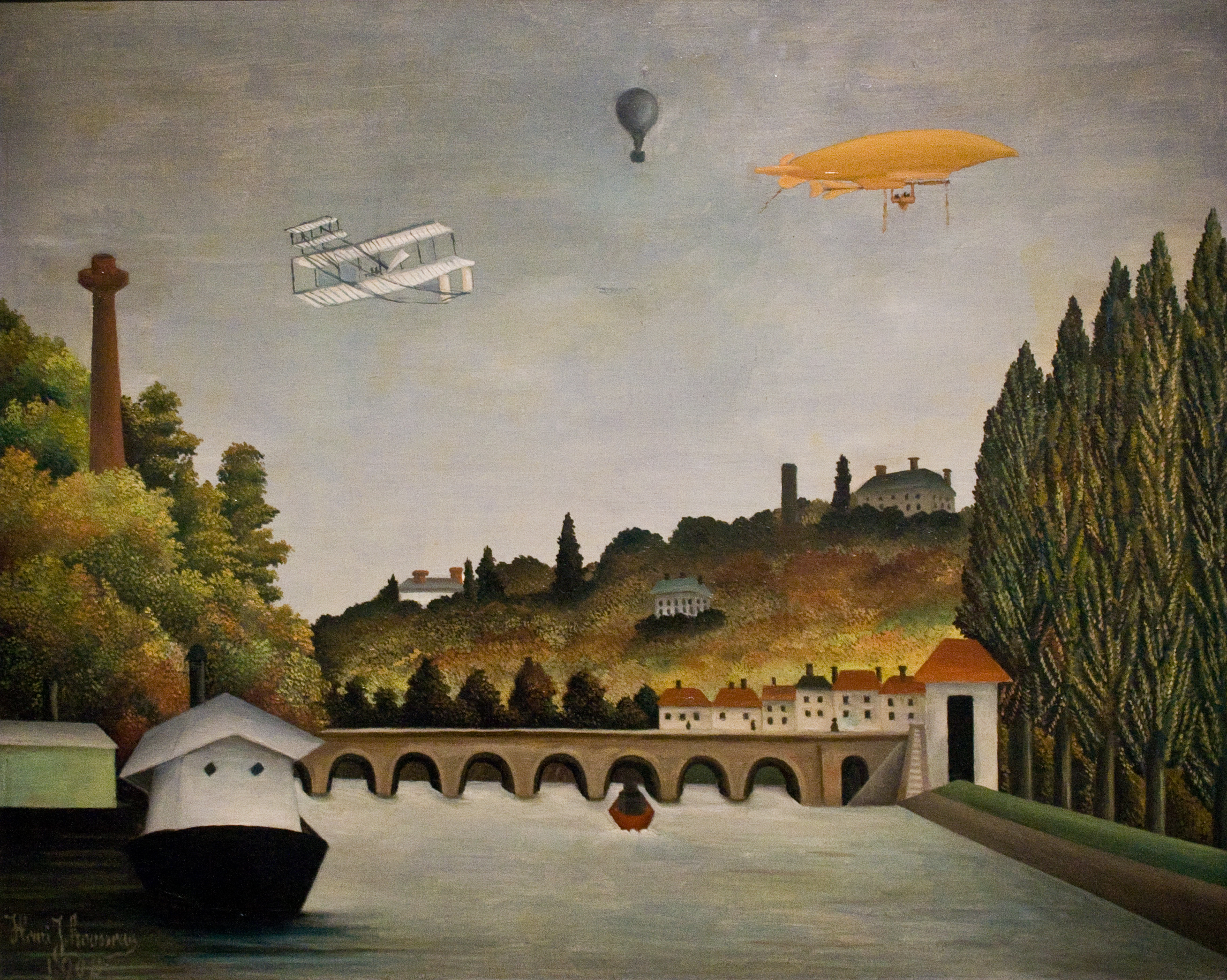
View of the Bridge at Sèvres is a painting by Henri Rousseau, oil on canvas, dated 1908 by the Pushkin Museum in Moscow, which holds it under inventory number Ж-3333. The original is 80 cm high and 102 cm wide. What you see: a river with a long stone bridge of arches, a moored barge, houses and trees on the banks, and in the grey sky three flying machines: a biplane, a balloon and an orange airship.
View of the Bridge at Sèvres
What is on the canvas?
The canvas is wider than it is high. A grey sky fills the upper half. At the upper left flies a white biplane with thin ribbed wings, at the top centre hangs a dark grey round balloon with its basket, and at the right floats a large orange elongated airship with a gondola. At the left a tall red-brown chimney rises out of autumn foliage in orange, gold and green; below it, moored at the bank, lies a broad barge with a black hull and a large white deckhouse with two small dark windows, a pale green shed behind it. A long pale stone bridge of arches runs across the centre. Behind its right end stand white houses with red roofs and a white building with a dark doorway, and a row of tall dark poplars closes the right edge. Behind everything rises a wooded hill in autumn colours with a few white villas and a dark tower. Below the bridge a small orange shape floats in mid-river. The signature is at the lower left. Another bridge on the edge of Paris is View of the Clichy Bridge at Asnières.
Which flying machines are in the sky?
The museum’s record counts them: three flying machines, painted with the same strict order as the bridge, the barges and the houses beneath them. The record also says where one of them comes from: it is known that on 14 July 1907 Rousseau watched the trial of an airship, which the museum’s text calls Rodina, and put it in this picture. The museum adds that the work is also read as a sign of the age that was coming. Another Paris view with a modern landmark on its skyline is View of the Eiffel Tower and the Trocadéro.
Did Rousseau paint the scene on the spot?
Not quite. According to the museum’s record, Rousseau shows a real place here but paints it not from nature but from a photograph, although a sketch made on the spot came before the painting. That is why the things in it are sharply outlined and free of detail, which, the museum says, gives them a particular monumentality. Another river with a boat by a bridge is The Great Laundry Boat at Charenton Bridge.
How large is the original, and what does that mean on a wall?
The original is 80 cm high and 102 cm wide. Ten sizes are available: 66 x 55, 75 x 58, 80 x 63, 90 x 71, 95 x 75, 100 x 81, 110 x 85, 115 x 90, 120 x 102 and 135 x 105 cm. The size nearest the original is 100 x 81 cm, while 115 x 90 cm keeps its proportion most exactly. On the original the balloon is only a few centimetres across, so it is at the larger sizes that the ribs of the biplane’s wings, the balloon’s basket and the airship’s gondola really show. Custom sizes are ordered through the made-to-order painting page. Another street on the edge of a town is Environs de Paris.
How is a hand-painted reproduction made?
We paint your canvas painting by hand in oils after you order it, at the size you choose. From a high-resolution image of the original, the painter lays in the sky and the hill first, then the river, the bridge and the houses, then the trees, one leaf at a time, and paints the flying machines and the barge last so that they stay sharply outlined. A hand-painted canvas always differs slightly from the next, and that difference is exactly what a print cannot give you. It is stretched on a wooden frame, ready to hang. The whole collection is in the Henri Rousseau gallery.
Frequently asked questions
Where is the original kept?
At the Pushkin State Museum of Fine Arts in Moscow, inventory number Ж-3333.
When was it painted?
In 1908, the date the museum gives; according to the museum’s record, Rousseau saw the airship on 14 July 1907.
How did the painting reach the museum?
The museum lists it in the collection of S. I. Shchukin until 1918, then in the State Museum of New Western Art until 1948; the Pushkin Museum has held it since 1948.
Is this a print?
No. It is painted by hand in oils, and the layers of paint can be seen and felt.
Is the painting suitable as a gift?
Yes, especially for someone who loves flight, rivers or Paris. If you would rather the recipient chose, there is a gift voucher.
- Subject: a river with an arched bridge, a moored barge and houses on the banks, with a biplane, a balloon and an orange airship in the sky.
- Original: oil on canvas, 80 x 102 cm (height x width), Pushkin Museum, Moscow, inv. Ж-3333; 1908.
- Our version: hand-painted oil, ten sizes from 66 x 55 to 135 x 105 cm, or a size made to order.
- Of note: according to the museum’s record, Rousseau watched the trial of an airship on 14 July 1907 and put it in this picture.