







































Description
Still Life with Apples and Peaches – the work the catalogue names after a vessel nobody looks at
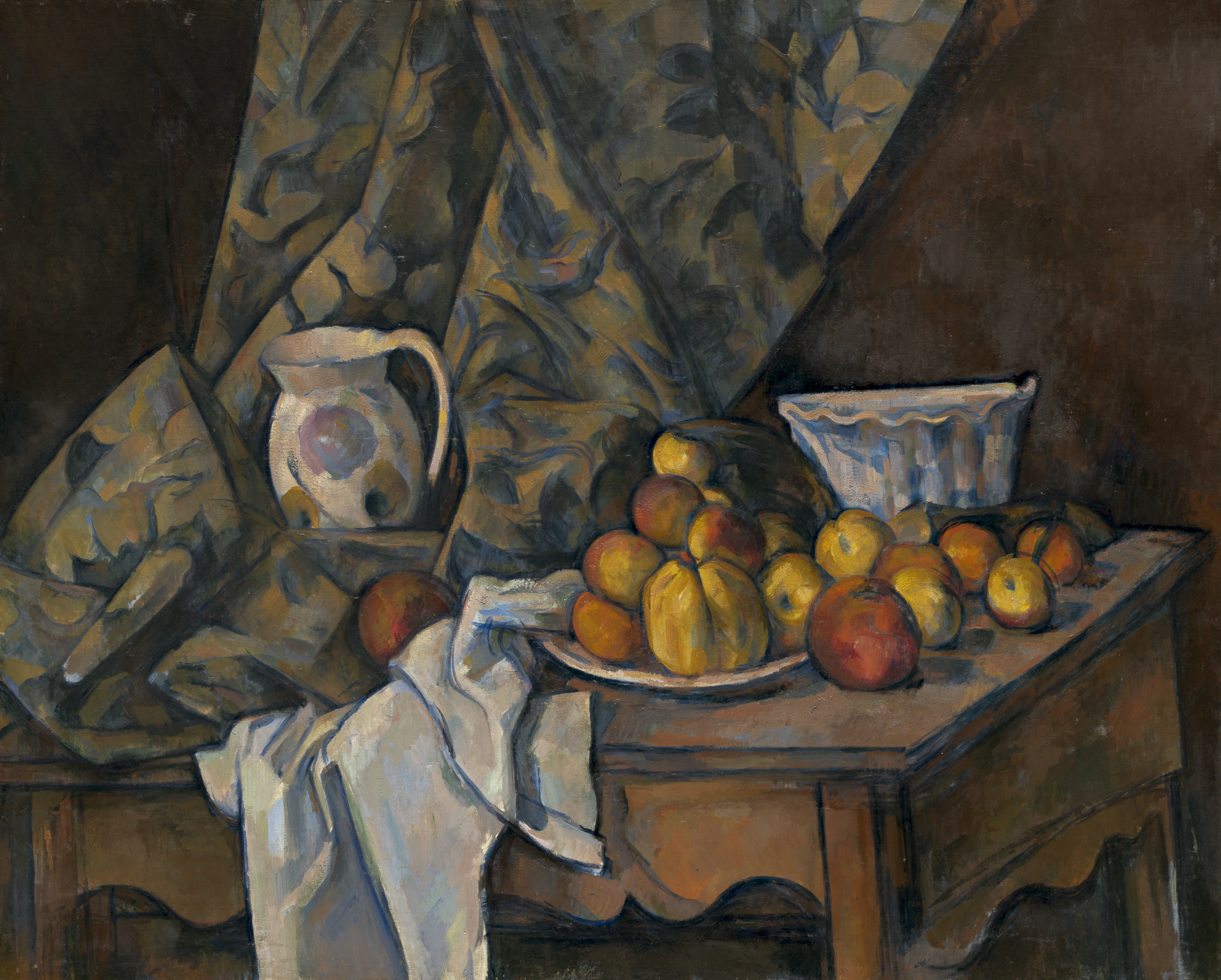
On a wooden table with a scalloped edge, on a white plate, lies a heap of apples and peaches, yellow, orange and red. At the left stands a pale pitcher with a flowered mark, at the upper right a white vessel with a crimped rim, and over the front edge of the table a white cloth falls. Behind them a patterned curtain of blue and brown foliage stretches the whole width. The hand-painted painting on canvas reproduces this work by Cézanne of about 1905, which in the original measures 81 × 100.5 centimetres and is kept under inventory number 1959.15.1 at the National Gallery of Art in Washington.
A title that points at another object
Every known name of this work speaks of fruit: the museum that keeps it calls it Still Life with Apples and Peaches, and among the alternate titles stand Nature morte avec pommes et pêches, Still Life, Still Life – Peaches and Stillleben mit Äpfeln und Pfirsichen. The catalogue raisonné, however, records it under an entirely different title: Nature morte au vase pique-fleurs – still life with the flower-holder. That vessel is white, with a crimped rim, stands at the upper right, is empty, and the eye passes over it easily. The record and the museum, then, do not agree on what the main thing in this work is.
From Vollard to Washington
The provenance is short and counts four entries. The first is the Paris dealer Ambroise Vollard. The second is written in square brackets – Edward Steichen in New York – and the square bracket is the sign that the record is not entirely firm here. The third carries an exact date: on 29 February 1912, a leap day, Agnes and Eugene Meyer of Washington bought the canvas. In 1959 it passed to the National Gallery of Art. In Vollard’s archives the work is also recorded with a photograph, at number 446.
Two works, the same donors, the same year
Agnes and Eugene Meyer did not hand the museum this work alone. In 1959 The Gardener Vallier also passed to the National Gallery of Art, and the two carry inventory numbers from the same year today: 1959.15.1 and 1959.2.1. The name of Edward Steichen stands in square brackets in both provenances as well. The acquisition note names both of them: gift of Eugene and Agnes Ernst Meyer.
Exhibited, but not in the catalogue
The Meyers lent the work often. In 1916 it was on loan at the Metropolitan Museum of Art in New York, in March 1917 at the Arden Gallery. From 17 April to 9 May 1920 it was at the Pennsylvania Academy of Fine Arts in Philadelphia, under the title Still Life and with the note hors catalogue: it was shown, then, but it did not appear in the printed catalogue. From 3 May to 15 September 1921 it was at the Metropolitan again, this time as number 17 and under the name Still Life – Peaches. In 1977 and 1978 it was in the exhibition Cézanne: The Late Work, mounted jointly by the Museum of Modern Art and the Réunion des Musées Nationaux.
A year that moved even within one author
The dating of this canvas is unusually scattered. Rewald places it about 1905, Venturi in the revised version between 1900 and 1905, and the photograph from Vollard’s archives carries the note circa 1899; who wrote it the record does not say. The most telling case is Georges Rivière: in 1923 he dated the work to about 1902, and in 1931 to about 1900. The same author, then, printed two different years in two of his own books.
Twelve headings for one table
The list of headings for this canvas is the most detailed of the whole group and runs to twelve entries. Among the edibles it names the fruit and the peaches, among the vessels the flowered pitcher, the pitcher, the plate and the vase, among the other objects the white cloth. Under furnishings the curtain, the blue and brown foliage fabric, the flowered fabric, the table and, separately, the table with a scalloped edge are listed – the record therefore counts the edge of the table as a motif of its own. Among the studios stands the address rue Boulegon.
The yellow, orange and red fruit on the white plate gives this work a warm, quiet light that carries well in a dining room and above a longer table. It comes in fifteen sizes: the smallest measures 50 × 40 and the largest 180 × 144 centimetres; every intermediate measurement we stretch on a stretcher frame made to order, and how the work will look in the chosen frame you can see in advance in our 3D application. Fruit returns in Still Life with Apples and in Flowers in a Ginger Jar and Fruit as well.
- Subject: Still Life with Apples and Peaches, Paul Cézanne, about 1905, National Gallery of Art, Washington
- Technique: hand-painted painting, oil on canvas, reproduction
- Sizes: 15 dimensions, custom size on request
- Of note: the catalogue raisonné names the work after the white flower-holder at the upper right, while the museum and every other name call it after the apples and peaches