






Description
The Gardener Vallier – a man with three trades in the record
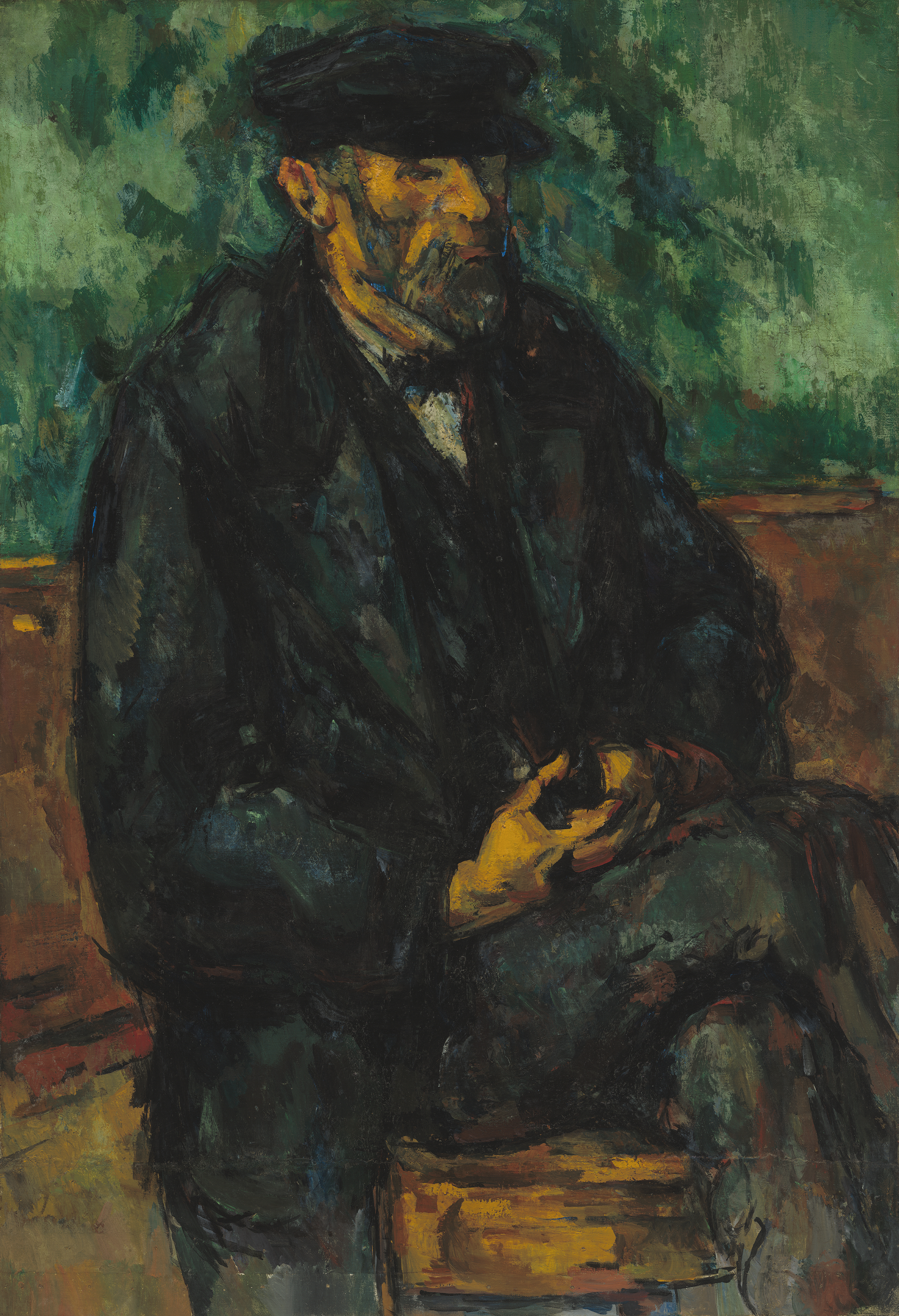
An elderly man in a dark cap sits turned slightly to the left, his hands crossed in his lap. He wears a dark blue-green coat that takes up almost the whole centre of the canvas; the face is built from ochre, brown and greenish planes. Behind him a brown horizontal rail runs the whole width, and above it a green wall of foliage rises. The hand-painted painting on canvas reproduces this work by Cézanne of 1902 to 1906, which in the original measures 107.4 × 74.5 centimetres and is kept under inventory number 1959.2.1 at the National Gallery of Art in Washington.
Gardener, sailor or peasant
The title under which the catalogue raisonné records this canvas is double: Le Jardinier Vallier; Le Marin – the gardener Vallier; the sailor. Among the alternate titles stand A Sailor, The Sailor and Le Marin; also known as Le Jardinier Vallier. The exhibitions followed now one, now the other: in 1921 the work was at the Metropolitan Museum of Art in New York as number 24, as A Sailor, and in 1959 at the National Gallery of Art as Le Marin. The dealer’s book names a third trade: in Vollard’s B stockbook the work is entered at number 4467 as Paysan assis les mains croisées, a seated peasant with crossed hands – and the hands on this canvas are indeed crossed in the lap. The list of headings, for its part, records among the people neither a gardener nor a sailor nor a peasant, but only the surname: Vallier. The record therefore does not decide, and we shall not decide in its place.
A canvas that was made larger
Among the technical headings for this work there stands a single one, and it is unusual: added strip(s) of canvas. The support was therefore widened – the canvas that today measures 107.4 × 74.5 centimetres was not that size from the start. Where these strips sit, how wide they are and who added them the record does not say, and we shall not fill it in. What is noted is only the circumstance that the work was enlarged.
A provenance that begins with a question mark
The first entry in the chain of owners is written in the catalogue in brackets and with a question mark: (estate of Paul Cézanne?). There follow Ambroise Vollard and the Galerie Bernheim-Jeune in Paris, the two together, with the date 12 February 1907. After them stands, in square brackets, the name of Edward Steichen in New York – and the square bracket is the sign that the record is not entirely firm here either. In 1916 Agnes and Eugene Meyer of Washington buy the canvas, and in 1959 it passes to the National Gallery of Art.
Forty-three years with the Meyers
Between 1916 and 1959 the work stayed in the same private collection, and the exhibition record shows how often it was lent. In March 1917 it was at the Arden Gallery in New York, lent by Meyer. From 7 May to 1 November 1920 it was in the exhibition for the fiftieth anniversary of the Metropolitan, where page 9 notes that Mrs. Eugene Meyer lent it. In 1921 it was in the same museum again, and from 10 July to 2 October 1932 in the exhibition The Taste of Today in Masterpieces of Painting before 1900. The inventory number the work carries today reads 1959.2.1, and the acquisition note names them both: gift of Eugene and Agnes Ernst Meyer.
The first months in the museum
As soon as it reached Washington the canvas was shown. From 25 April to 24 May 1959 it was at the National Gallery of Art in the exhibition Masterpieces of Impressionist and Post-Impressionist Painting, where on page 32 it is listed as Le Marin and dated to 1904-1905. Among scholars the dating lies apart as well – Rewald gives 1902 to 1906, Venturi in the revised version 1906 – and to the museum’s year we add nothing.
What the catalogue counts among the motifs
The remaining headings place this man in an interior. Among the wall decoration the chair rail is named, among the furnishings the chair. The titles send him to the garden or to sea, then, while the catalogue’s index sits him on a chair in front of a wall with a rail – and it is precisely that brown horizontal line that runs across the canvas behind his back, the whole width of it.
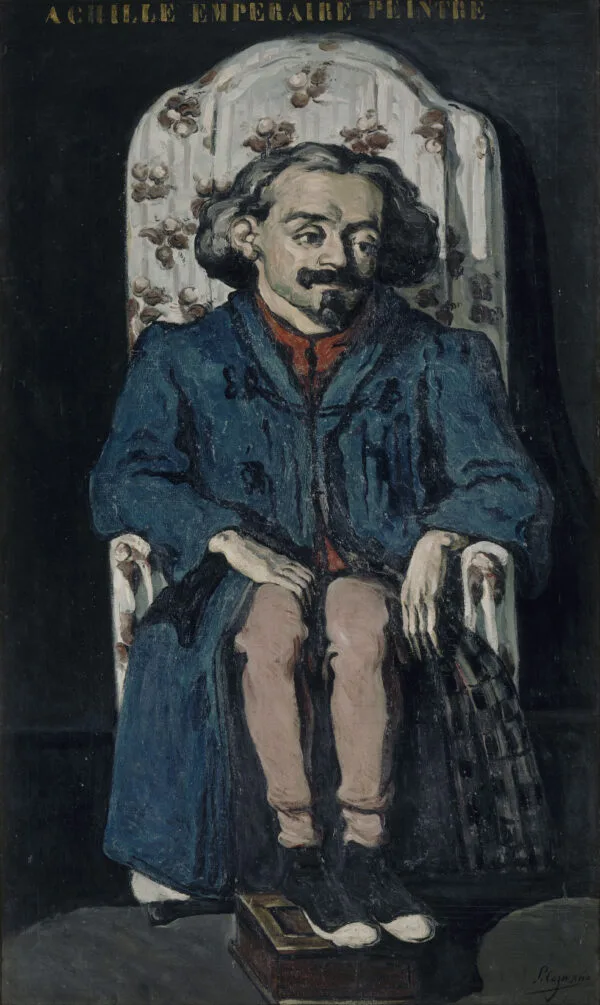
It is an upright, dark and settled work in a green-brown range, which works well on narrower walls and in rooms with soft light. Fifteen measurements are available, from 41 × 60 to 123 × 180 centimetres, all measurements in centimetres, in-between sizes made to measure, and the effect of the chosen frame is shown in advance by our 3D application. Among the seated figures there are also Seated Man and Peasant in a Blue Smock, and among the portraits Portrait of the Painter Achille Emperaire.
- Subject: The Gardener Vallier, Paul Cézanne, 1902–1906, National Gallery of Art, Washington
- Technique: hand-painted painting, oil on canvas, reproduction
- Sizes: 15 dimensions, custom size on request
- Of note: the catalogue records the canvas under a double title – gardener and sailor – while Vollard’s book lists it as a seated peasant with crossed hands