


Description
Seated Man – what is in his hand, and why the record cannot agree about it
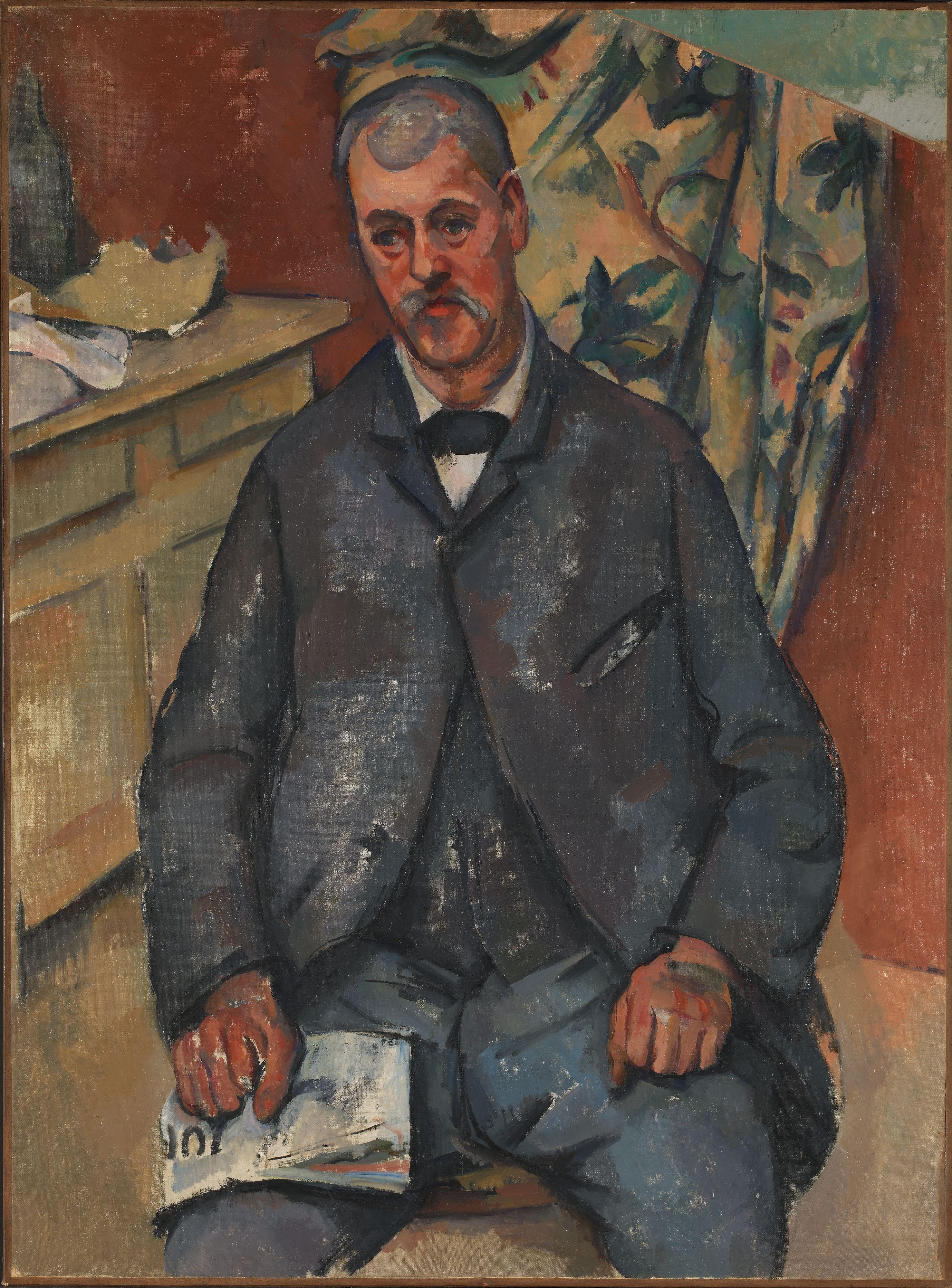
A grey-haired man with a grey moustache sits facing the viewer, in a dark coat, a white shirt and a black bow tie. Both hands rest on his knees; under the left one lies a folded white printed sheet. Behind him at the left stands a wooden chest with a white cloth thrown over its edge, at the right hangs a flowered curtain with blue and brown foliage, and between them runs a brick-red wall. This hand-painted painting on canvas reproduces Cézanne’s late work of 1898 to 1900, which measures 102.5 × 75.5 centimetres in the original and is held by the Nasjonalgalleriet in Oslo under the number NG.M.01287.
Newspaper or book
The catalogue raisonné lists nine titles for this canvas, and four of them describe the same object without agreeing. L’homme au journal means the man with the newspaper; Bauer, Zeitung lesend says a peasant reading a newspaper; Lesender Mann says only that he is reading; and Sitzender Mann mit Buch says a seated man with a book. The dealer Ambroise Vollard, who had the canvas in his shop, wrote un journal in his ledger, a newspaper. On the canvas the object lies flat across the left knee, folded down the middle, with no boards, no spine and no block of pages. What it was the record states in two ways; what is painted is a folded sheet, not a bound one.
A room that could be listed
Behind the seated man there is no emptiness but a precisely ordered corner. At the left the wooden chest, which the catalogue records among the furnishings as a coffre, with a white cloth over it. At the right the flowered curtain, which the catalogue carries under three separate headings: curtain, fabric with blue and brown foliage, and flowered textile. The wall between them is brick-red. It is that red which holds the work together: the grey-blue coat rebounds off it, and the hands stay the only warm, light surfaces in the lower half. The man shows nothing and does nothing – he sits upright, hands on his knees, the way somebody sits who has been asked to sit.
From Odilon Redon to Oslo
The first known owner of this canvas was the painter Odilon Redon, in Paris. After him the dealer Ambroise Vollard had it, then the Florentine and Parisian collector Egisto Fabbri, and on 31 May 1912 Paul Cassirer took it in Berlin. From Cassirer it went back to Vollard – who appears twice in this chain – and in March 1918 it reached Oslo. Six owners in a little over two decades, and the first of them was a man who painted himself.
A gift from the Friends of the Gallery, March 1918
The museum record for this work states not only where it is but how it got there: gift of the Friends of the National Gallery, 1918. The canvas was not bought by the institution out of its own funds but given by the society that supports it. What is striking is that the city had already seen it four years earlier: in the autumn of 1914 it hung in that same gallery in the exhibition Fransk Kunst, on loan from Vollard. The city was then called Kristiania – it took the name Oslo only in 1925. Both facts stand in the record, one after the other.
Five cities before Oslo
Before it settled in the north, the canvas travelled for some years. In April and May 1912 it hung in Berlin at Paul Cassirer’s as number 7, as Lesender Mann, lent by Vollard; from 25 May to 30 September of the same year it was in Cologne at the Sonderbund exhibition as number 142, titled there Sitzender Mann mit Buch – in those same two exhibitions hung Peasant in a Blue Smock. In 1914 came Copenhagen as number 24 and then Kristiania, and in the spring of 1917 Stockholm as number 3, where the record enters it with a query over the identification. In 1936 it was at the Orangerie in Paris as number 89, and in 1952 in Chicago.
What Vollard wrote beside number 3868
In Vollard’s stockbook this canvas carries the number 3868, and beside it a description that walks through the room piece by piece: huile; portrait d’homme tenant un journal à la main assis et les deux mains sur ses genoux un buffet fond rideaux – oil; portrait of a man holding a newspaper in his hand, seated, both hands on his knees, a sideboard, curtains behind. Next to it stand the measurement 104 × 76 centimetres and the price of 200 francs. Everything the dealer listed is on the canvas: the hands on the knees, the chest, the curtains. In its people field the catalogue gives the sitter no name – it records only that he is not identified.
This work has an unusually quiet weight: one seated person, two colours between wall and fabric, nothing happening. That is why it holds a room where people stay a while – a dining room, a library, a reception room. We paint it in fifteen sizes, from 41 × 55 to 133 × 180 centimetres, intermediate measurements we stretch on a made-to-measure stretcher, and how it will look in the chosen frame is shown in advance by our 3D application. Among the late portraits are also the Portrait of Gustave Geffroy and Woman with a Coffeepot.
- Subject: Seated Man, Paul Cézanne, 1898-1900, Nasjonalgalleriet, Oslo
- Technique: hand-painted painting, oil on canvas, reproduction
- Sizes: 15 dimensions, custom size on request
- Of note: the canvas’s titles speak once of a newspaper and once of a book, while what is painted is a folded sheet of paper