







































Description
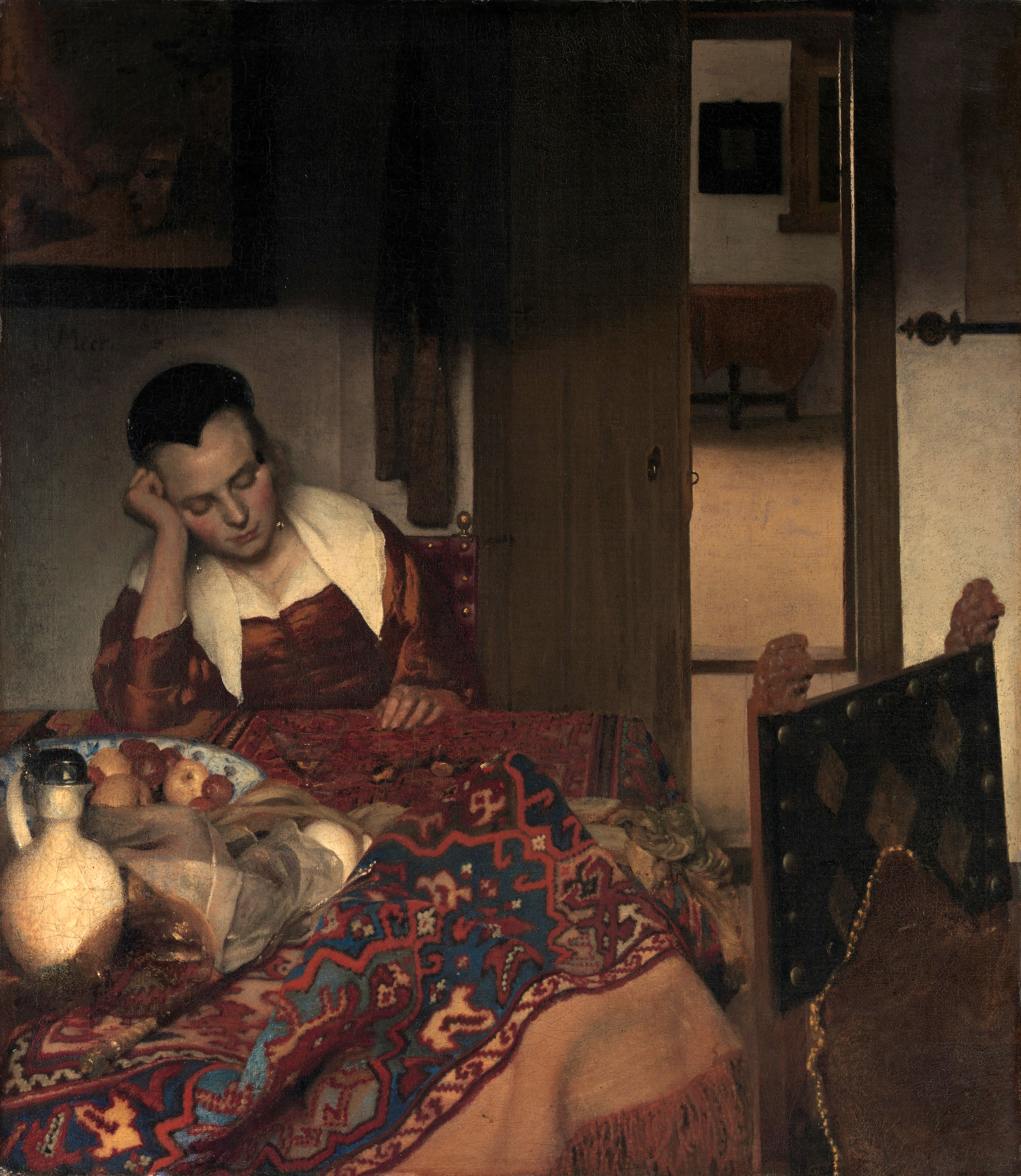
A Maid Asleep is an early work by Johannes Vermeer, painted around 1657: a young woman in a red-brown dress and white collar has dozed off at a table, her head propped on her hand. A heavy red carpet covers the table, with a jug, a bowl of fruit and a glass, and an open door behind her leads into a second room with a table and a mirror. The original, oil on canvas, is 87.6 cm high and 76.5 cm wide and belongs to the Metropolitan Museum of Art in New York. Our painter recreates it to order in oil on canvas, in one of 8 portrait sizes between 43 x 47 and 172 x 200 cm or a size you set, and sends you a photograph of the finished painting before dispatch.
| Title: | A Maid Asleep |
| Other titles: | Slapend meisje · A Girl Asleep |
| Painter: | Johannes Vermeer (1632–1675) |
| Year painted: | c. 1657 |
| Original size: | 87.6 cm x 76.5 cm (height x width) |
| Original technique: | Oil on canvas |
| Painting style: | Baroque, Dutch Golden Age |
| Located at: | The Metropolitan Museum of Art, New York (acc. no. 14.40.611) |
| Our reproduction: | Hand-painted oil on canvas, 8 sizes or made to measure |
A Maid Asleep – Johannes Vermeer
What does A Maid Asleep show?
A young woman sits at a table, asleep, her elbow on the tabletop and her cheek in her palm. Whether she is deeply asleep or has only closed her eyes for a moment, the scene leaves open.
She wears a red-brown dress with a white collar. Its warm brown almost merges with the carpet, so the eye goes first to her pale face and the white at her throat.
On the richly patterned red carpet stand a jug, a Chinese bowl of fruit and a glass that, according to Wikipedia, lies on its side. A chair with a cushion has been left at an angle beside the table.
Behind her a door opens into a second room, where another table stands and a mirror hangs on the far wall. The eye slips past the sleeper into an empty space deep in the house.
What is hidden in the scene of the sleeping maid?
Technical examination revealed that Vermeer first painted more: a man stood in the second room, watched by a dog. Later he painted both out and put a mirror on the far wall instead.
According to the art historian Walter Liedtke, the dog alluded to the kind of chance acquaintance dogs strike up in the street; with both gone, only a hint of the story remains.
The mirror is read as a reminder of how quickly the pleasures of the senses pass; the askew chair with its cushion may point to idleness and to recent company.
The wine jug, the overturned glass and perhaps a knife and fork on the table say the same, and the Chinese bowl of fruit is a symbol of temptation.
Why do Vermeer lovers prize A Maid Asleep so highly?
It was painted around 1657, early in the career of the Delft painter, of whom only a few dozen works are known. It already has what draws people to him: a quiet interior, a single figure and objects that say more than they first seem to.
It very likely belonged to Pieter van Ruijven, Vermeer’s patron, who also owned The Milkmaid. Both share one tension: tradition tied maids to romantic and sensual hints, yet Vermeer paints them with unusual sympathy.
It also has a practical rarity: it does not travel. Under the terms of the donor’s bequest it may not be lent elsewhere, so only New York shows it.
The history of the canvas and its hidden changes of composition are described in the Wikipedia article (in English).
Where is the original of A Maid Asleep?
The Metropolitan Museum of Art in New York holds it under accession number 14.40.611.
It was among the many Vermeer works sold on 16 May 1696 from the estate of Jacob Dissius. It is widely believed that the collection first belonged to Dissius’s father-in-law, Pieter van Ruijven of Delft, and reached Dissius through Van Ruijven’s daughter.
After that its trail goes cold until after 1873, when John Waterloo Wilson owned it in Paris. In March 1881 the Galerie Sedelmeyer bought it and that same year sold it to Rodolphe Kann, who kept it until 1907.
In 1908 Benjamin Altman bought it through the Duveen Brothers of London; it was shown in New York in 1909 and came to the Metropolitan Museum with his bequest in 1913.
A Maid Asleep or another Vermeer?
A Maid Asleep is a calm canvas painting for a dining room, a bedroom or a reading corner: the carpet, fruit and jug suit a room built around a table, the sleeping figure the quiet of a bedroom.
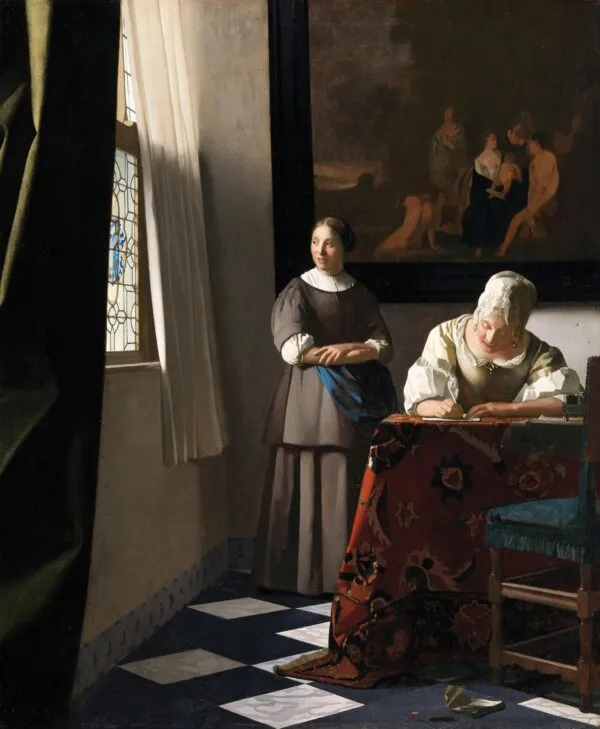
If Vermeer’s maids interest you, see also Mistress and Maid, two women brought together by a letter. From the same early years comes the larger, more crowded The Procuress, and earlier still the mythological Diana and her Nymphs.
All the famous Vermeer paintings we paint to order, from Delft streets to the late music scenes, are collected on the Johannes Vermeer page.
How does our painter paint your Maid Asleep?
The painter builds the work in oil on canvas, layer by layer, starting with the large light and dark areas: the warm shadow of the room, the bright doorway and the sleeping face.
The carpet asks for the most patience: its red pattern is built up gradually, rich but never louder than the face. Then come the gleam on the jug, the clear glass, the fruit and finally the mirror in the next room.
The result is a Vermeer reproduction with visible brushwork and a real body of paint that no print can match. Like every true oil painting reproduction, it looks cooler in morning light, while in the evening the reds glow warmer.
Which size for which wall?
In short: 43 x 47 or 56 x 64 cm for a small wall or above a sideboard, 64 x 76 or 72 x 85 cm for a dining room or above a chest of drawers, 90 x 107 or 120 x 140 cm above a sofa or a bed, and 135 x 160 or 172 x 200 cm for a tall wall or a stairwell.
There are 8 portrait sizes (width x height): 43 x 47, 56 x 64, 64 x 76, 72 x 85, 90 x 107, 120 x 140, 135 x 160 and 172 x 200 cm. The closest to the original is 72 x 85 cm, 4.5 cm narrower and 2.6 cm shorter.
At 72 x 85 cm you keep the feeling of looking through the door into the next room. As a painting for the living room or above a double bed it shows best at 90 x 107 or 120 x 140 cm; hang it with the sleeper’s face just below eye level.
Can I choose another size or a frame?
Of course. The original is a little taller than wide, so we can paint it in an unlisted size without losing the door or the edge of the carpet. Send the width and height via our made-to-order paintings page and we will reply with a price and delivery time.
Your painting can come rolled, stretched on a stretcher bar or framed; our workshop in Slovenia does the stretching and framing. You pick the frame in our 3D application, which serves that choice alone; seeing the painting on your own wall is a separate service.
Warm reds and browns go well with dark wood or warm gold; a pale frame would cool the scene.
When will A Maid Asleep arrive?
Once you confirm the order, the painter starts, and in 15 to 45 working days the painting is done. Before dispatch we send you a photograph of it and make any change you ask for.
There are no customs charges within the EU, Slovenia included, and every order is covered by our returns policy.
A Maid Asleep is a lovely gift for anyone who enjoys quiet domestic scenes or likes to lay the table for guests. To let them choose the size, give a wall art voucher instead.
Frequently asked questions
Where can the original be seen?
Only at the Metropolitan Museum of Art in New York, which may not lend it.
What is on the table in front of her?
A heavy red carpet with a jug, a bowl of fruit and a glass.
Is this a print?
No. Every one we make is a hand-painted copy, done with brush and oil colours on canvas.
How big is the original?
87.6 cm high and 76.5 cm wide; our nearest size is 72 x 85 cm.
Does it suit a bedroom or a dining room?
Yes, the sleeping figure suits a bedroom and the laden table a dining room.
Can I have it in a different size?
Yes, in any width and height you name; we quote the price first.
What was found beneath the surface?
A man in the second room and a dog looking at him; Vermeer later replaced them with a mirror.
How long does it take to make?
Between 15 and 45 working days; before it ships, a photograph shows you the finished canvas.
- Subject: a young woman in red-brown dozes at a carpet-covered table with a jug and fruit; a door opens onto a second room.
- Original: c. 1657, oil on canvas, 87.6 x 76.5 cm, Metropolitan Museum of Art, New York.
- Ours: oil on canvas, painted by hand to order, in 8 portrait sizes from 43 x 47 to 172 x 200 cm or a size you choose.
- Worth knowing: Vermeer first painted a man and a dog in the second room, then painted them out.