







































Description
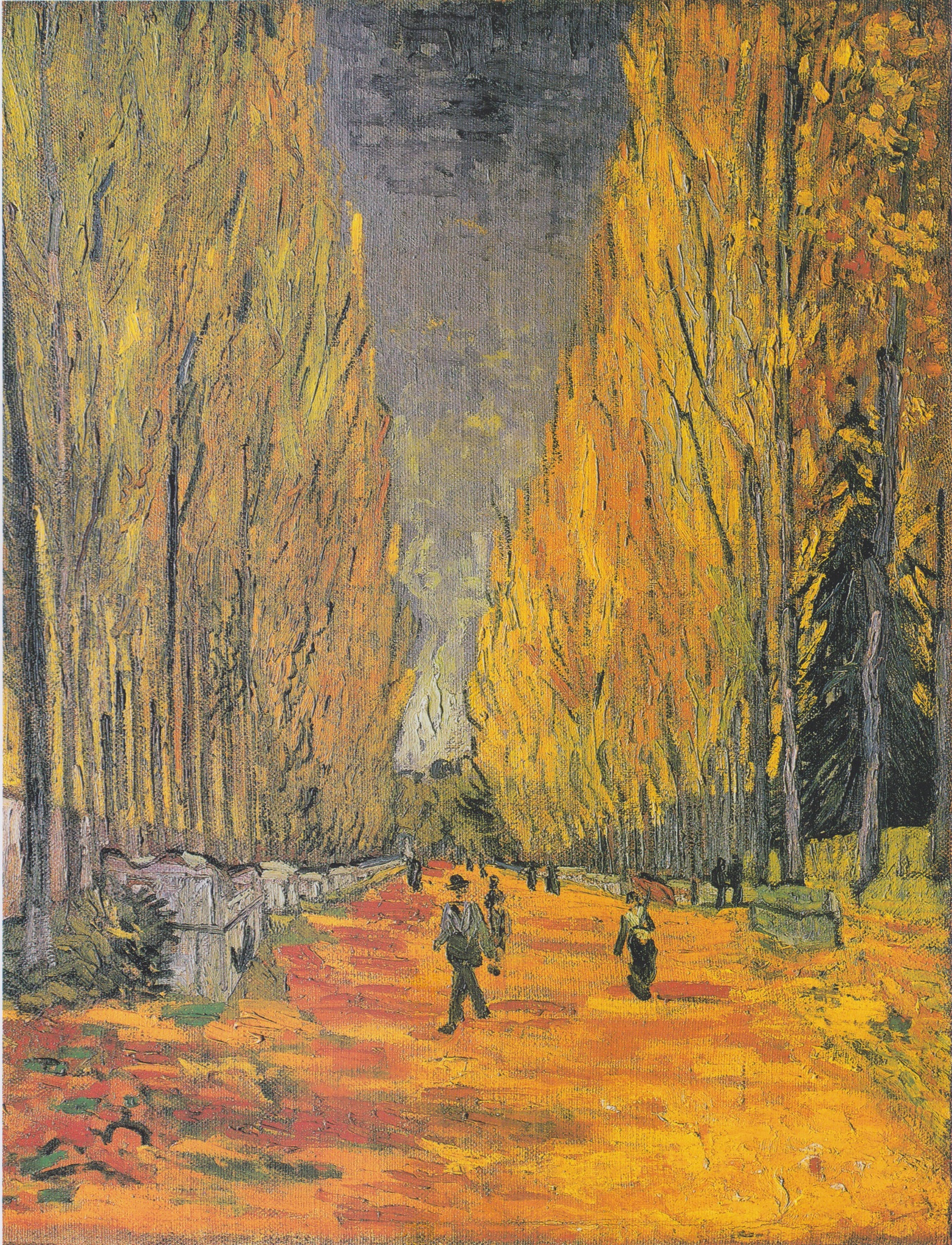
Les Alyscamps (Avenue in Arles) is the painting Vincent van Gogh made in Arles in late October or early November 1888, while Paul Gauguin was staying with him: a straight avenue of tall poplars in yellow and orange autumn leaves, under a narrow dark sky, with a path covered in red and orange leaves, old stone sarcophagi along the left and a few people walking. The original, 92 x 73.5 cm, is in a private collection. We paint it by hand in oil on canvas, in 16 sizes from 40 x 50 to 127 x 160 cm or to your own measurements, and send you a photograph of the finished painting for approval before dispatch.
| Title: | Les Alyscamps (Avenue in Arles) |
| Other titles: | Les Alyscamps · L’Allée des Alyscamps |
| Painter: | Vincent van Gogh (1853–1890) |
| Year painted: | Late October – early November 1888, Arles |
| Original size: | 92 cm x 73.5 cm |
| Original technique: | Oil on canvas |
| Painting style: | Post-Impressionism |
| Located at: | Private collection |
| Our reproduction: | Hand-painted oil on canvas, 16 sizes or made to measure |
Les Alyscamps (Avenue in Arles) – Vincent van Gogh
What does Les Alyscamps (Avenue in Arles) show?
A straight avenue runs from the bottom of the canvas into the distance. On both sides stand tall, thin poplars whose trunks rise almost to the top edge, their leaves turned yellow, orange and ochre by autumn. Between the two rows only a narrow strip of sky remains, dark grey and violet, so the trees seem to open upwards like a funnel.
The path is covered in fallen leaves in red, orange and yellow, with patches of green. Along its left edge lies a row of pale stone sarcophagi, the old Roman tombs of the place. In the middle of the path a figure in a dark hat walks towards us, and further back a few small figures walk along the avenue.
What is the Alyscamps, and why did Van Gogh paint it?
The Alyscamps is an ancient Roman necropolis in Arles, built outside the city walls. What remained of it after factories and a railway took over much of the ground was the Allée des Tombeaux, a lane of poplars lined with stone sarcophagi leading to a Romanesque chapel. The lane was known across France as a lovers’ lane.
Paul Gauguin joined Van Gogh in Arles in October 1888. Between 28 and 31 October 1888 they worked together at the Alyscamps, until heavy rain kept them indoors. Gauguin painted his own Les Alyscamps on the same day as one of Van Gogh’s canvases, from a different spot and without the sarcophagi, as the English Wikipedia article on Les Alyscamps records.
What is the meaning of Les Alyscamps (Avenue in Arles)?
Van Gogh described it himself in a letter to the painter Émile Bernard as a study of the whole avenue, entirely yellow. Yellow is the strongest colour in the painting: it fills the trees and the leaves on the ground, and only the narrow dark sky stands against it.
The scene puts two things side by side: the stone tombs of a Roman burial ground and an autumn walk on a lane where people came to stroll. Van Gogh painted it from the middle of the avenue, looking towards the chapel of Saint-Accurse at its end, so the eye is drawn straight down the path into the distance.
Where is the original today, and how did it get there?
The original is in a private collection. Its first owners were Marie and Joseph Ginoux in Arles; Marie Ginoux is the woman Van Gogh painted as L’Arlésienne. It later belonged to the Paris dealer Ambroise Vollard, to collectors in France and Switzerland and to a private collection in Japan.
On 4 November 2003 it was sold at Christie’s in New York for 11,767,500 US dollars. On 5 May 2015 it was sold again, at Sotheby’s in New York, for 66.3 million US dollars. The full list of owners is in the Sotheby’s catalogue entry for the painting, which records it as L’Allée des Alyscamps, painted on 1 November 1888.
Which Alyscamps is which, and what else to hang beside it?
Van Gogh painted four views of the Alyscamps in 1888. Two of them form a pair in the same upright size: ours, catalogued as F569, in a private collection, and its companion F568, in the Basil and Elise Goulandris Foundation in Athens. The other two, known as Falling Autumn Leaves, are in the Kröller-Müller Museum in Otterlo and in a private collection. Gauguin’s Les Alyscamps in the Musée d’Orsay is a different painting by a different painter.
Other Arles paintings sit well beside it. Café Terrace at Night and Starry Night over the Rhône show the same town at night, The Yellow House shows his own house in Arles, and L’Arlésienne is Madame Ginoux, the painting’s first owner. Choose the avenue for warm colour in an upright format, and the night scenes for deep blue.
How is our hand-painted version of Les Alyscamps (Avenue in Arles) made?
The painter first draws the vanishing lines of the avenue, the trunks and the row of sarcophagi, and checks the proportions against the original, so the path narrows exactly as Van Gogh placed it. Then come the dark sky, the yellow and orange foliage in long upright strokes, the leaves on the path, and last the stones and the small figures. Our oil painting reproduction is painted by hand on canvas, with real impasto: the paint goes on thickly, so the brushstrokes stand up from the canvas as they do in the original and catch the light.
On this painting the relief shows most in the vertical strokes of the poplars and in the short, dense strokes of the fallen leaves, which Van Gogh also laid on thickly. A print is completely flat; on our painting every brushstroke stands out in real paint.
Every painting is a hand-painted copy made for your order, so no two are quite the same.
Which size for which wall?
Short answer: 49 x 60 or 54 x 65 cm for a narrow wall in a hallway, 74 x 94 cm, close to the original size, above a chest of drawers or a sideboard, 90 x 110 or 100 x 120 cm above a sofa, and 120 x 150 or 127 x 160 cm for a high wall in a stairwell or a room with a tall ceiling. The upright format fits between two windows or beside a door.
There are 16 sizes: 40 x 50, 49 x 60, 50 x 62, 54 x 65, 60 x 70, 64 x 80, 70 x 90, 74 x 94, 80 x 100, 85 x 105, 90 x 110, 100 x 120, 105 x 125, 109 x 135, 120 x 150 and 127 x 160 cm (width x height). The original is 73.5 cm wide and 92 cm high, so our 74 x 94 cm size shows the avenue almost exactly as large as Van Gogh painted it. The warm yellow and orange work on a white, cream or warm grey wall, and a dark green or navy wall makes them glow. A painting for the living room should cover about two thirds of the width of the furniture below it.
Hang it with the centre of the canvas about 150 cm above the floor, leaving 20 to 30 cm between the top of the furniture and the bottom of the canvas.
What if I need a custom size or a frame?
If none of the 16 sizes fits your wall, we paint it to measure. Keep the proportions close to the original, about four parts wide to five high, otherwise the tall poplars get squeezed or stretched. Send us the width and height you want and we will quote you a price and a delivery time. Every painting we make is mounted on a wooden stretcher, ready to hang.
Our 3D app shows each of our frame profiles on this painting, so you can compare gold, silver, black, white and natural wood. The app is for choosing the frame only. To see the painting on your own wall, use our separate room placement service. A gold frame picks up the yellow leaves, and a dark wood frame repeats the trunks and the sky.
How does delivery work, and what is the guarantee?
Every painting is made to order in our studio in Slovenia, so allow 15 to 45 days depending on the size you choose. We ship it on its stretcher, carefully packed (and framed, if you chose a frame), across the EU with no customs duty. Before dispatch we send you a photograph of the finished painting to approve, and we correct anything that is not right. Our returns policy applies to every order.
You will find more of Van Gogh’s famous paintings in our Vincent van Gogh gallery, and there is more about the painter in our article on Vincent van Gogh. If you are giving it as a present and are not sure of the size, a wall art voucher lets the recipient choose.
Frequently asked questions
Where is Van Gogh’s Les Alyscamps today?
The version with the yellow poplars and the sarcophagi along the path, catalogued as F569, is in a private collection; it was last sold at Sotheby’s in New York in May 2015. Its companion of the same size, F568, is in the Basil and Elise Goulandris Foundation in Athens, and one of the two Falling Autumn Leaves views is in the Kröller-Müller Museum in Otterlo.
How much did Les Alyscamps sell for?
For 66.3 million US dollars, at Sotheby’s in New York on 5 May 2015. Twelve years earlier, on 4 November 2003, the same painting had been sold at Christie’s in New York for 11,767,500 dollars, below the estimate of 12 to 18 million. Its first owners were Marie and Joseph Ginoux in Arles.
When and where did Van Gogh paint Les Alyscamps?
In Arles, in the south of France, in late October or early November 1888. Paul Gauguin had joined him there in October, and between 28 and 31 October the two worked together at the Alyscamps until heavy rain drove them indoors. The Sotheby’s catalogue dates this canvas to 1 November 1888.
What is the Alyscamps in Van Gogh’s painting?
An ancient Roman necropolis in Arles, built outside the city walls. Factories and a railway later took over much of it, and what remained was the Allée des Tombeaux, a lane of poplars lined with stone sarcophagi leading to a Romanesque chapel. It was known across France as a lovers’ lane, and in Van Gogh’s canvases people stroll along it.
How many versions of Les Alyscamps did Van Gogh paint?
Four views of the Alyscamps, all from the autumn of 1888. Two form a pair in the same upright size of 92 x 73.5 cm: F569, in a private collection, which we paint, and F568, in the Goulandris Foundation in Athens. The other two are known as Falling Autumn Leaves; one is in the Kröller-Müller Museum, the other in a private collection.
Did Gauguin also paint Les Alyscamps?
Yes. Gauguin painted the Alyscamps twice during his stay in Arles. His Les Alyscamps in the Musée d’Orsay in Paris was painted on the same day as one of Van Gogh’s, from a different spot and without the ancient sarcophagi; the other, Allée des Alyscamps, is in a museum in Tokyo. They are separate paintings by a different painter.
How big is the original of Les Alyscamps?
The original is 92 cm high and 73.5 cm wide, an upright format a little under a metre tall. Our 74 x 94 cm canvas painting comes closest to it, so the avenue hangs at almost its real size. There are smaller and larger sizes from 40 x 50 up to 127 x 160 cm, and we also paint to your own measurement.
Is Les Alyscamps a good painting to give as a gift?
Yes, for anyone who likes autumn colours, the south of France or Van Gogh’s Arles years. The upright format makes it easy to place in a hallway, a living room or between two windows, and the story of Van Gogh and Gauguin painting the lane together gives it something to talk about. If you are unsure of the size, a voucher lets the recipient choose.
Does your copy of Les Alyscamps have the raised brushstrokes of the original?
Yes. We paint it in impasto, building up each brushstroke in thick oil, so the surface is raised like Van Gogh’s original. You see this best in the long upright strokes of the poplars and in the short, dense strokes of the fallen leaves on the path, where the relief catches the light.
- Subject: an avenue of yellow and orange poplars in autumn, with fallen leaves, Roman sarcophagi and a few walkers, under a dark sky.
- Original: late October – early November 1888, Arles, 92 x 73.5 cm, oil on canvas, private collection.
- Ours: a Van Gogh reproduction painted by hand in oil on canvas, in 16 sizes from 40 x 50 to 127 x 160 cm or made to measure.