







































Description
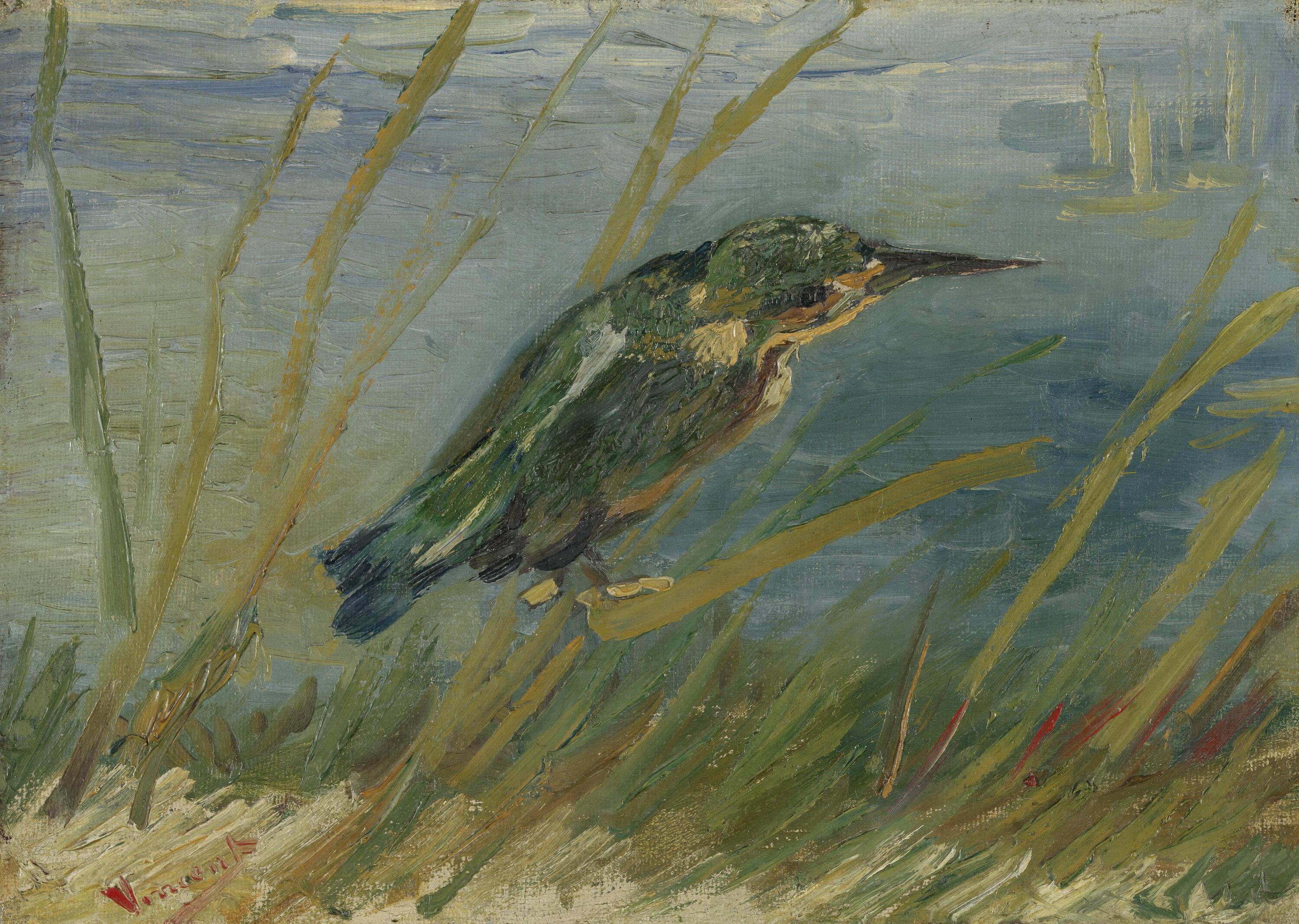
The Kingfisher is Vincent van Gogh’s small painting of a kingfisher perched on a reed stem at the water’s edge, made in Paris: the bird faces right with its long beak raised, its back a dark blue-green and its breast orange, among yellow-green reeds and grasses, with grey-blue water behind. The original, oil on canvas, measures only 19.1 x 26.6 cm and hangs in the Van Gogh Museum in Amsterdam. We paint it by hand in oil on canvas, in 15 sizes from 70 x 50 to 250 x 180 cm or to your own measurements, and send you a photograph of the finished painting for approval before dispatch.
| Title: | The Kingfisher |
| Other titles: | Kingfisher by the Waterside · IJsvogel aan de waterkant |
| Painter: | Vincent van Gogh (1853–1890) |
| Year painted: | July–August 1887, Paris (also dated 1886) |
| Original size: | 19.1 cm x 26.6 cm |
| Original technique: | Oil on canvas |
| Painting style: | Post-Impressionism |
| Located at: | Van Gogh Museum, Amsterdam (inv. s0100V1962) |
| Our reproduction: | Hand-painted oil on canvas, 15 sizes or made to measure |
The Kingfisher – Vincent van Gogh
What does The Kingfisher show?
A single kingfisher, seen from the side, perched on a thin reed stem just above the water. It faces right, with its long, pointed beak raised, as if it has just spotted something below. Its back and wings are dark blue-green, its breast a warm orange, and the small feet grip the stem.
Around the bird, long blades of reed and grass cross the canvas in yellow-green and ochre strokes. Behind it lies grey-blue water in short horizontal strokes, and along the bottom runs a pale strip of bank. The Van Gogh Museum describes the scene simply: the kingfisher sits by the waterside, on the lookout for fish. According to the English Wikipedia article on the painting, the name Vincent is written in the lower left corner.
Why does the bird in The Kingfisher differ from a real kingfisher?
Because Van Gogh changed it on purpose. The Van Gogh Museum notes that he owned a mounted kingfisher, a stuffed bird that still survives, and when the museum compares the painting with that bird it finds a couple of differences. He made the tail slightly longer, probably to balance the raised beak, and he gave the bird feet, which it needs to perch on a reed stem.
The museum also points out that the brilliant blue plumage of a real kingfisher looks a little dull here. In the painting the bird is a darker, deeper blue-green, which sits quietly against the grey water and the yellow reeds instead of flashing out of them.
What does The Kingfisher mean?
It is a close look at one small living thing, painted on a small canvas. There is no story, only a bird, a few reeds and water, and the moment before the kingfisher dives: the raised beak and the bird’s stillness against the restless diagonals of the reeds.
It also belongs to Van Gogh’s years in Paris, where his brother Theo lived and where this canvas stayed in Theo’s apartment. Here the strokes are short and visible, and the colour is built from greens, blues and ochres laid side by side.
Where does the original hang, and how did it get there?
The original is in the Van Gogh Museum in Amsterdam, which lists it as Kingfisher by the Waterside, oil on canvas, 26.6 x 19.1 cm, under object number s0100V1962, in the collection of the Vincent van Gogh Foundation. In the Van Gogh catalogues it carries the numbers F28 and JH1191. The museum dates it to Paris, July–August 1887; Wikipedia gives July to December 1886.
According to the museum, Van Gogh left it at Theo’s apartment in Paris in the summer of 1887. After Theo’s death in 1891 it passed to his widow, Jo van Gogh-Bonger, and their son, Vincent Willem van Gogh, who transferred it to the Vincent van Gogh Foundation in 1962. It was on loan to the Stedelijk Museum until the Van Gogh Museum opened in 1973, and it has been there ever since.
The Kingfisher or another Van Gogh – which should you choose?
This painting is a small, quiet nature study, one subject seen close up. Two other paintings in our range share that close, single-subject view. A Pair of Shoes shows a pair of worn shoes, and Skull with Burning Cigarette shows a skeleton’s skull with a lit cigarette between its teeth.
If it is nature you are after, two later paintings give you flowers instead of a bird: Irises, painted in Saint-Rémy in 1889, and Almond Blossom, painted there in 1890. Choose the kingfisher for blue-green and orange on a calm grey ground, the shoes or the skull for a darker, more unusual subject, and the irises or the almond blossom for strong colour across a large wall.
How is our hand-painted version of The Kingfisher made?
The painter first draws the bird, the reed stem and the line of the bank, and checks the proportions against the original, so that the beak, the tail and the feet sit where Van Gogh placed them. Then come the grey-blue water and the background reeds, after them the bird itself, the dark back first and the orange breast after it, and last the light strokes along the feathers and the grasses in front. Our oil painting reproduction is painted by hand on canvas, with real impasto: the paint goes on thickly, so the brushstrokes stand up from the canvas as they do in the original and catch the light.
On this painting the relief shows most in the reeds, in the short strokes of the water and in the feathers on the bird’s back. A print is completely flat; on our painting every brushstroke stands out in real paint.
Every painting is a hand-painted copy made for your order, so no two are quite the same.
Which size for which wall?
Short answer: 70 x 50 or 80 x 59 cm for a hallway, a study or beside a window, 101 x 74 or 114 x 82 cm above a chest of drawers or a bed, and 140 x 100 or 153 x 110 cm above a sofa. For a large open wall, 195 x 140 up to 250 x 180 cm turns the bird into a striking centrepiece.
There are 15 sizes: 70 x 50, 80 x 59, 90 x 65, 101 x 74, 114 x 82, 120 x 90, 130 x 94, 140 x 100, 153 x 110, 160 x 115, 170 x 120, 180 x 135, 195 x 140, 200 x 150 and 250 x 180 cm (width x height). The original is small, only 26.6 cm wide and 19.1 cm high, so even our smallest size, 70 x 50 cm, is about two and a half times as wide. That works in the painting’s favour: at a larger size the brushwork reads clearly from across a room, and every stroke of the reeds becomes visible. The sizes 70 x 50, 114 x 82, 140 x 100 and 195 x 140 cm keep the original’s proportions almost exactly. A painting for the living room should cover about two thirds of the width of the furniture below it.
The blue-green bird looks good on a white, light grey or pale blue wall. Hang it with the centre of the canvas about 150 cm above the floor; above a sofa, a bed or a sideboard, leave 20 to 30 cm between the top of the furniture and the bottom of the canvas.
What if I need a custom size or a frame?
If none of the 15 sizes fits your wall, we paint it to measure in any width and height you need, including the original’s own small size of about 27 x 19 cm. Send us the width and height you want and we will quote you a price and a delivery time. Every painting we make is mounted on a wooden stretcher, ready to hang.
Our 3D app shows each of our frame profiles on this painting, so you can compare gold, silver, black, white and natural wood. The app is for choosing the frame only. To see the painting on your own wall, use our separate room placement service. A natural wood or white frame keeps the fresh, watery mood, while a narrow gold one picks up the orange breast and the ochre reeds.
How does delivery work, and what is the guarantee?
Every painting is made to order in our studio in Slovenia, so allow 15 to 45 days depending on the size you choose. We ship it on its stretcher, carefully packed (and framed, if you chose a frame), across the EU with no customs duty. Before dispatch we send you a photograph of the finished painting to approve, and we correct anything that is not right. Our returns policy applies to every order.
You will find more of Van Gogh’s famous works among all our Van Gogh paintings, and more about the painter in our article on Vincent van Gogh. If you are giving it as a present – to a bird watcher, an angler or someone who loves the waterside – and are not sure of the size, a wall art voucher lets the recipient choose.
Frequently asked questions
Where is the original of The Kingfisher today?
In the Van Gogh Museum in Amsterdam, which lists it as Kingfisher by the Waterside, oil on canvas, 26.6 x 19.1 cm, object number s0100V1962. It belongs to the Vincent van Gogh Foundation and has been at the museum since it opened in 1973. Before that it was with the family (Theo van Gogh, then his widow Jo and their son Vincent Willem) and, from 1962, with the Vincent van Gogh Foundation.
When did Van Gogh paint The Kingfisher?
In Paris, but the sources give different dates. The Van Gogh Museum dates it to July–August 1887, the summer in which Van Gogh left it at his brother Theo’s apartment. Wikipedia gives July to December 1886, a year earlier. Either way it is a work of his Paris years, after he had left the Netherlands and before he moved to the south of France.
Did Van Gogh paint The Kingfisher from a stuffed bird?
Probably, although the museum does not say so outright. The Van Gogh Museum notes that he owned a mounted kingfisher, which still survives, and compares it with the painting. The differences show that he did not simply copy it: he made the tail slightly longer, probably to balance the raised beak, and gave the bird feet, so that it could perch on the reed stem.
What is the bird in The Kingfisher doing?
It is waiting to catch a fish. In the Van Gogh Museum’s words, the kingfisher sits by the waterside, on the lookout for fish. It perches on a reed stem above grey-blue water, facing right with its long beak raised. Nothing moves yet, and that stillness, just before the dive, is what the small canvas holds.
How big is the original of The Kingfisher?
Small: 19.1 cm high and 26.6 cm wide, a little smaller than a sheet of A4 paper. Our smallest size, 70 x 50 cm, is already about two and a half times as wide, and the range goes up to 250 x 180 cm. The sizes 70 x 50, 114 x 82, 140 x 100 and 195 x 140 cm keep the original’s proportions almost exactly.
Why is The Kingfisher also called Kingfisher by the Waterside?
Because that is the title the Van Gogh Museum in Amsterdam, which holds the painting, uses in English. It translates the Dutch title, IJsvogel aan de waterkant, which describes exactly what the painting shows: a kingfisher at the edge of the water. Both names refer to the same small canvas of 19.1 x 26.6 cm.
Can I order The Kingfisher at the size of the original?
Yes, as a custom size. Our 15 standard sizes run from 70 x 50 to 250 x 180 cm, but we paint to measure in any width and height, including the original’s own size of about 27 x 19 cm. Send us the measurements and we will quote you a price and a delivery time. A larger size, though, lets the brushwork read from across a room.
Which size of The Kingfisher suits a living room?
Above a sofa, choose 140 x 100 or 153 x 110 cm, so that the canvas painting covers about two thirds of the width of the sofa. On a narrower wall or above a sideboard, 101 x 74 or 114 x 82 cm works well. On a long empty wall, 195 x 140 cm or larger turns the small bird into a bold centrepiece with every stroke visible.
Does your copy of The Kingfisher have the raised brushstrokes of the original?
Yes. We paint it in impasto, building up each brushstroke in thick oil, so the surface is raised like Van Gogh’s original. You see this best in the reeds, in the short strokes of the water and in the feathers of the bird’s back, where the relief catches the light.
- Subject: a kingfisher on a reed stem by the water, dark blue-green back and orange breast, its long beak raised, yellow-green reeds and grey-blue water.
- Original: Paris, July–August 1887 (also dated 1886), oil on canvas, 19.1 x 26.6 cm, Van Gogh Museum, Amsterdam.
- Ours: a Van Gogh reproduction painted by hand in oil on canvas, in 15 sizes from 70 x 50 to 250 x 180 cm or made to measure.