







































Description
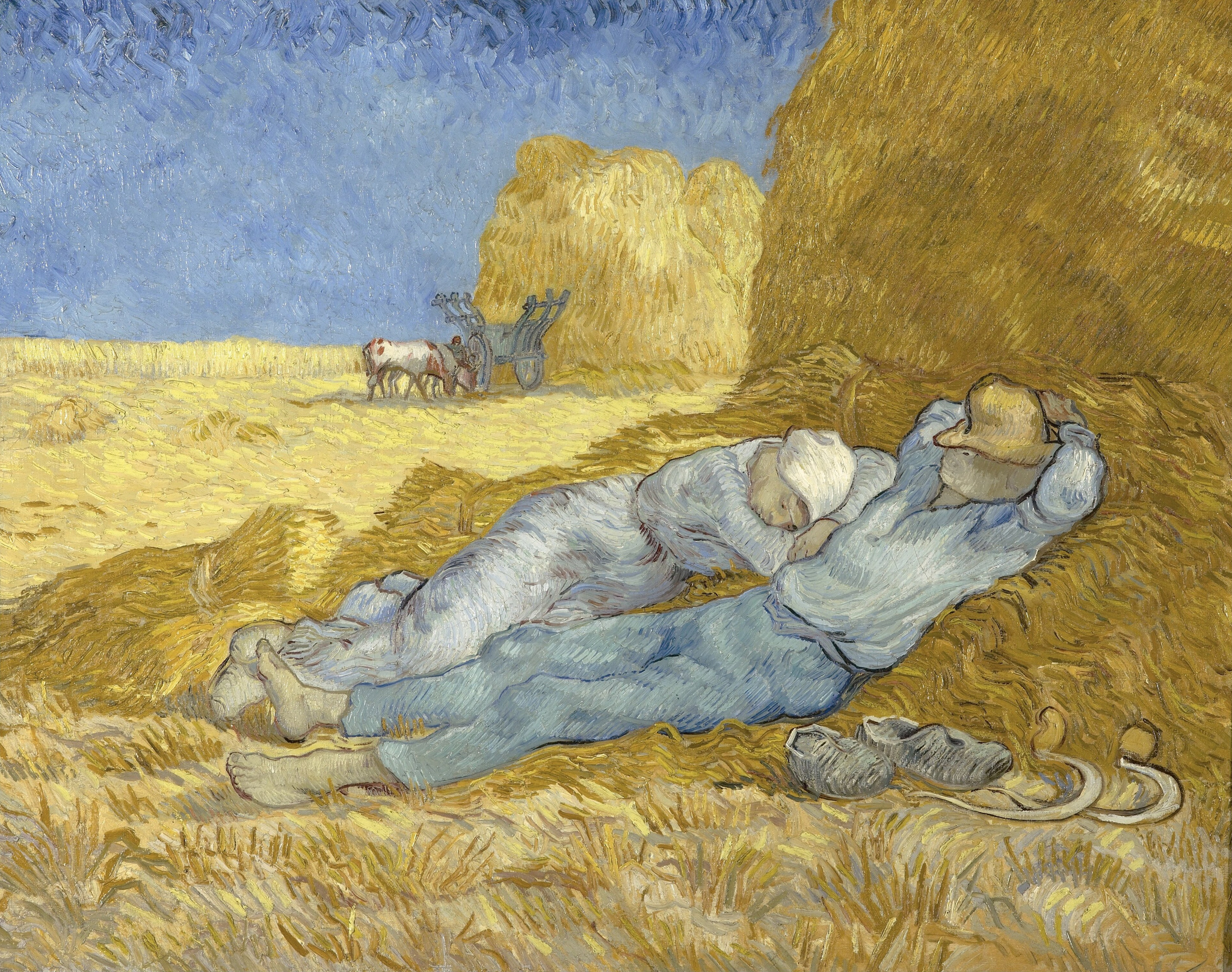
The Siesta (after Millet) is the painting Vincent van Gogh made between December 1889 and January 1890 in Saint-Rémy-de-Provence, after a print of a drawing by Jean-François Millet: a peasant couple asleep in the hay at noon, in the shade of a haystack, under a deep blue sky, with their shoes and sickles set aside. The original measures 73 x 91 cm and hangs in the Musée d’Orsay in Paris. We paint it by hand in oil on canvas, in 16 sizes from 50 x 40 to 150 x 120 cm or to your own measurement, and send you a photograph of the finished work for approval before dispatch.
| Title: | The Siesta (after Millet) |
| Other titles: | La Méridienne · La Sieste · Siesta (po Milletu) · Die Siesta (nach Millet) |
| Painter: | Vincent van Gogh (1853–1890) |
| Year painted: | December 1889 – January 1890, Saint-Rémy-de-Provence |
| Original size: | 73 cm x 91 cm |
| Original technique: | Oil on canvas |
| Painting style: | Post-Impressionism |
| Located at: | Musée d’Orsay, Paris (inv. RF 1952 17) |
| Our reproduction: | Hand-painted oil on canvas, 16 sizes or made to measure |
The Siesta (after Millet) – Vincent van Gogh
What does The Siesta (after Millet) show?
It is noon in the middle of the harvest. A peasant and his wife have stopped work and are lying in the cut hay, in the shade of a tall haystack on the right. The man lies on his back with his hands behind his head and his straw hat tipped over his face; the woman sleeps curled up beside him, her head under a white scarf. Both wear blue work clothes, both are barefoot. Their two pairs of wooden shoes stand neatly in the straw in front of them, next to two sickles laid on the ground.
Behind them the field of stubble stretches away in bright yellow. Further back two oxen stand harnessed to an empty cart beside two more haystacks. Above everything there is a deep blue sky, laid down in short, thick dashes of paint. Nothing moves: the scene shows the quiet hour between the morning’s work and the afternoon’s.
Why did Van Gogh copy a drawing by Millet?
In the winter of 1889 Van Gogh was living at the Saint-Paul asylum near Saint-Rémy. He had no models and could not always go out to paint, so he worked from the prints he kept with him. One of them was a black-and-white wood engraving by Jacques Adrien Lavieille, made after one of the drawings of The Four Hours of the Day that Millet drew in 1858. The Siesta is his version of the noon hour.
He explained the method himself in a letter to his brother Theo in September 1889, while he was copying Millet’s series of field labours: he placed the black-and-white print in front of him as a subject and then improvised the colour on it. He compared it to a musician playing a composition by Beethoven and adding his own interpretation. Copying, he wrote, also meant that without models he did not lose sight of the human figure.
What does The Siesta mean?
The painting is about rest that has been earned. The sickles and the shoes taken off, the cart standing still and the sun at its highest all say the same thing: work has stopped for an hour, and the two people trust the field and each other enough to fall asleep. It is the noon hour of a working day, seen from close by, without any story beyond the rest itself.
The French title La Méridienne means the midday nap. Van Gogh painted this summer noon in an asylum, in the middle of winter, working from a print without any colour. What he meant by that contrast he did not write down, so we leave it to the painting.
Where does the original hang, and how did it reach Paris?
The original hangs in the Musée d’Orsay in Paris under the inventory number RF 1952 17. It is the property of the French State and has been at the Musée d’Orsay since 1986.
After the painter’s death the canvas belonged to Jo van Gogh-Bonger, his brother’s widow. It then passed through several French collections: it was in the collection of Charles Pacquement, who sold it at auction in Paris on 12 December 1932, then with the dealer Étienne Bignou and with Madame Fernand Halphen. In 1952 it was given to the French State, with the donor keeping the use of it for life, and the state records list 1952 and 1963 as its dates of entry.
The Siesta or another Van Gogh – which should you choose?
The Siesta is a quiet scene: two figures at rest in a sunny field. For his country subjects, compare it with The Sower, another peasant figure he took from Millet, painted in Arles in 1888, and with The Red Vineyard, the grape harvest at sunset from the same autumn, full of people at work.
From the same stay at the asylum in Saint-Rémy we also paint the Pietà (after Delacroix), the first of his copies after other artists, and Irises, painted in the garden of the asylum. For a calm, warm scene choose The Siesta; for movement, The Red Vineyard; for flowers, Irises.
How is our hand-painted Siesta made?
The painter first draws the two sleeping figures, the haystacks, the cart and the line of the horizon, and checks the proportions against the original. Then come the sky in blue dashes, the yellow field and the hay in long strokes that follow the straw, the blue clothes with their folds, and last the faces, the hands and the wooden shoes. Our oil painting reproduction is painted by hand in oil on canvas with real impasto: the paint goes on thickly, so the brushstrokes stand up from the canvas as they do in the original and catch the light.
That matters here, because every surface in this scene is a texture: the straw under the couple, the stubble of the field and the sky are all built from separate, raised strokes. A print shows only a flat surface; on our painting the strokes and the layers of paint are real.
Every painting is a hand-painted copy made for your order, so no two are quite the same. Before dispatch we photograph it and send you the photograph to approve.
Which size for which wall?
Short answer: 70 x 56 or 82 x 65 cm above a chest of drawers or a desk, 93 x 75 or 100 x 80 cm above a sofa or a bed, and 120 x 100 or 150 x 120 cm for a large empty wall. The landscape format suits a wide wall above long furniture.
There are 16 sizes: 50 x 40, 55 x 45, 60 x 50, 70 x 56, 70 x 60, 82 x 65, 85 x 68, 85 x 70, 90 x 70, 93 x 75, 100 x 80, 100 x 85, 105 x 84, 105 x 88, 120 x 100 and 150 x 120 cm (width x height). The original is 91 cm wide and 73 cm high; our 93 x 75 cm size is the closest to it, so the painting on your wall is as large as it is in the museum. A painting for the living room should cover about two thirds of the width of the furniture below it, or of the bed below it in a bedroom.
Hang it with the centre of the canvas about 150 cm above the floor. Above a sofa or a headboard, leave 20 to 30 cm between the furniture and the bottom edge.
What if I need a custom size or a frame?
If none of the 16 sizes fits your wall, we paint it to measure. We recommend keeping the proportions close to the original, otherwise the sleeping figures get squeezed or stretched. Send us the width and height you want and we will quote a price and a lead time. Every painting we make is stretched over a wooden stretcher and ready to hang.
For the moulding, use our 3D application: it shows each of our frame profiles on this subject, so you can compare gold, silver, black, white and natural wood before you decide – the application is for choosing the frame only. If you would like to see how the painting will look on your own wall, that is our separate room placement service. The golden hay suits a warm gold profile or natural wood; a simple white or light frame keeps the blue sky fresh in a bright room.
How does delivery work, and what is the guarantee?
Every painting is made to order in our studio in Slovenia, so allow 15 to 45 days depending on the size you choose. We ship it stretched and protected, framed if you chose a frame, across the EU with no customs. Before dispatch you receive a photograph of the finished work to approve; if anything is not right, we correct it while the canvas is still in our workshop. Our returns policy applies to every order.
More famous Van Gogh paintings are in the Vincent van Gogh gallery, and there is more about the painter in our article on Vincent van Gogh. A couple asleep side by side makes a gentle present for a wedding, an anniversary or a retirement; if you are not sure of the size, a wall art voucher lets the recipient choose size and subject.
Frequently asked questions
Where does the original The Siesta (after Millet) hang?
In the Musée d’Orsay in Paris, under the inventory number RF 1952 17. The painting belongs to the French State, which received it as a gift in 1952, and it has been at the Musée d’Orsay since 1986. The state records also list it under the paintings department of the Louvre, which held it before the Orsay opened.
When and where did Van Gogh paint The Siesta?
Between December 1889 and January 1890, at the Saint-Paul asylum near Saint-Rémy-de-Provence, where he had been living since May 1889. It belongs to the series of copies he painted there in the winter after prints of works by other artists, at a time when he had no models and often could not paint outdoors.
Is Van Gogh’s The Siesta a copy of Millet’s work?
Partly. Van Gogh did not see a painting by Millet: he worked from a black-and-white wood engraving by Jacques Adrien Lavieille after one of Millet’s 1858 drawings of The Four Hours of the Day. He kept the composition, but the colours are entirely his own, improvised on the print, as he described it to Theo in a letter.
What is happening in The Siesta?
A peasant couple is taking a midday rest during the harvest. The man lies on his back with his hat over his face, the woman sleeps curled up beside him, and both lie in the hay in the shade of a haystack. Their wooden shoes and two sickles lie beside them, and an ox cart waits in the field behind.
Why is The Siesta painted in yellow and blue?
The painting is built on two colours that strengthen each other: the yellow of the hay and the field against the blue of the sky and the work clothes. Placed side by side, each makes the other look brighter, which gives the scene its strong midday light. The print he worked from was black and white, so every one of these colours was his own choice.
Why is The Siesta also called La Méridienne?
Because the French collection record lists the painting as La méridienne ou La sieste. La méridienne is an old French word for a short sleep in the middle of the day, the noon rest that Millet drew as one of his four hours of the day. In English the painting is usually called simply The Siesta, after the second French title.
How big is the original The Siesta (after Millet)?
The original is 73 cm high and 91 cm wide, a landscape format that suits a wall above a sofa, a bed or a sideboard. Our 93 x 75 cm size is the closest to it, and there are smaller and larger sizes from 50 x 40 up to 150 x 120 cm, as well as custom sizes for a particular wall.
Which room suits The Siesta?
A room meant for rest. A couple asleep in warm yellow hay is at home above a bed, in a living room or in a holiday house, and the landscape format works above a sofa or a sideboard. Because the scene is calm rather than dramatic, a large canvas painting of it stays easy to live with even when it fills a whole wall.
Does your The Siesta (after Millet) have the raised brushstrokes of the original?
Yes. We paint our Siesta in impasto: the paint goes on thickly, so the brushstrokes stand up from the canvas as on Van Gogh’s original. You see it best in the straw of the haystack, in the stubble of the field and in the short dashes of the blue sky, where every stroke catches the light. A print cannot have this relief, because its surface is flat.
- Subject: a peasant couple asleep in the hay at noon in the shade of a haystack, with an ox cart in the field behind.
- Original: December 1889 – January 1890, Saint-Rémy, 73 x 91 cm, Musée d’Orsay, Paris.
- Ours: a Van Gogh reproduction painted by hand in oil on canvas, in 16 sizes from 50 x 40 to 150 x 120 cm or made to measure.
- Worth knowing: you receive a photograph of the finished work for approval before dispatch, and more about the painting is on Wikipedia.