Description
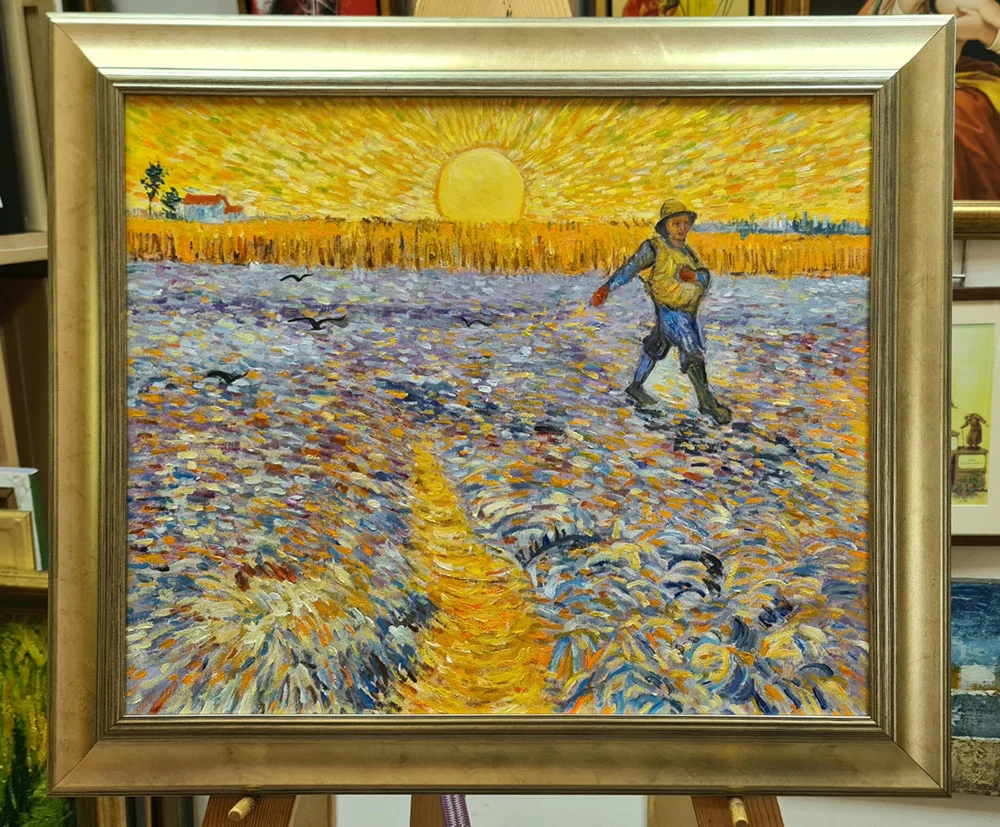
The Sower I is the painting Vincent van Gogh made in Arles in June 1888: a peasant striding across a violet field and scattering seed, under an enormous yellow sun that sets behind a band of ripe wheat. He painted it as his own modern answer to Jean-François Millet’s Sower. The original, 64.2 x 80.3 cm, hangs in the Kröller-Müller Museum in Otterlo. We paint it by hand in oil on canvas, in 15 sizes from 40 x 30 to 150 x 115 cm or to your own measurement, and send you a photograph of the finished work for approval before dispatch.
| Title: | The Sower I |
| Other titles: | De zaaier · The Sower · Sower at Sunset |
| Painter: | Vincent van Gogh (1853–1890) |
| Year painted: | June 1888, Arles |
| Original size: | 64.2 cm x 80.3 cm |
| Original technique: | Oil on canvas |
| Painting style: | Post-Impressionism |
| Located at: | Kröller-Müller Museum, Otterlo (inv. KM 106.399) |
| Our reproduction: | Hand-painted oil on canvas, 15 sizes or made to measure |
The Sower I – Vincent van Gogh
What does The Sower I show?
A peasant in blue work clothes strides across a freshly ploughed field. A seed bag hangs at his side, and with a broad swing of his right arm he scatters the grain over the earth. Black birds follow him to peck at the seed. Behind him runs a band of ripe yellow wheat, with a small farmhouse and a few trees on the left, and above it all the sun sits on the horizon as a huge yellow disc that fills the whole sky with its light.
The field is the part to look at closely. Van Gogh painted its clods of earth in thickly applied blue-violet and orange paint, almost like a relief, and the path that runs towards you glows yellow in the low light. In the sky the brushstrokes curve around the sun in rings, as if the light were spreading outwards from it over the land.
Why did Van Gogh paint a sower after Millet?
Jean-François Millet, the French painter of peasant life, painted his Sower in 1850, and Van Gogh admired him all his life; between 1881 and 1885, in the Netherlands, he had already drawn and painted sowers of his own. In Arles in the summer of 1888 he set out to make a new, modern version of the subject. Millet’s Sower is dark and grey with little colour. Van Gogh’s has radiant colours and sharp contrasts.
He did not find it easy. On or about 17 June 1888 he wrote to his friend, the Australian painter John Peter Russell: “Am working at a Sower. The great field all violet, the sky and sun very yellow. It is a hard subject to treat.” He drew a small sketch of the composition in the letter. The canvas itself was painted between about 17 and 28 June 1888.
What did the sower mean to Van Gogh?
For Van Gogh the sower stood for the cycle of nature and of life. That is why the ripe wheat is still standing behind the man who is sowing: harvest and sowing, an end and a new beginning, share the same field. The sun, low on the horizon, is the eternal source of light and energy that will make the seed grow.
The figure also had a religious meaning for him: in the sower he saw the sower of God’s word, the figure of the parable in the Gospels. You do not need to know any of this to enjoy the painting, but it explains why such a simple scene of farm work is painted with so much force and colour.
Where does the original hang?
The original hangs in the Kröller-Müller Museum in Otterlo, in the Netherlands, where it is on display in the collection under inventory number KM 106.399. It measures 64.2 by 80.3 cm, small enough that from close up you can follow every thick clod of paint in the field.
The same museum also holds the oil sketch for The Potato Eaters, Van Gogh’s peasant meal from Nuenen of 1885, so in one visit you can see how far his colour travelled in three years: from earth browns by lamplight to a yellow sun over a violet field. The letter in which he first described this painting, with its little sketch, can be read in the online edition of Van Gogh’s letters.
The Sower I or The Sower – which one suits you?
We paint two of Van Gogh’s sowers, and they are easy to tell apart. The Sower I is the June painting: a wide, open landscape, the sower in the middle distance, a huge yellow sun on the horizon and a field in violet and orange. The Sower is a later and much smaller canvas from the same year, now in the Van Gogh Museum: a gnarled tree trunk cuts diagonally across it, the colours are bright and unnatural, and the composition most likely owes a debt to Japanese prints.
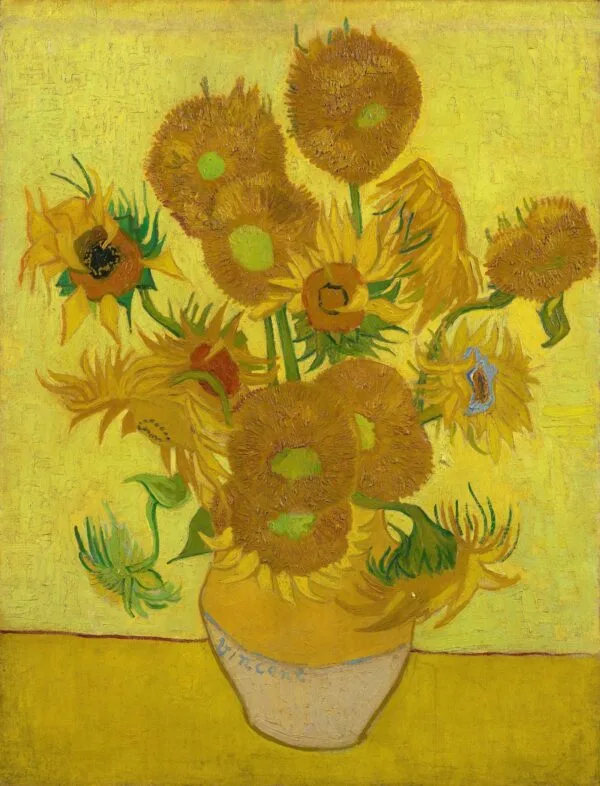
Choose The Sower I for a calm, sunlit field with plenty of space and light, and The Sower for a bold, graphic composition with strong contrasts; both are landscape format. From the same year in Arles come Sunflowers I and Starry Night over the Rhône, with the same strong yellows and blues, if you want a second Arles painting for the same room.
How is our hand-painted Sower I made?
The painter first draws the horizon, the sun and the figure on the canvas, then lays in the sky and the field, and finishes with the sower, the birds and the last strokes of light on the path. Our oil painting reproduction is painted by hand in oil on canvas with real impasto: the paint goes on thickly, so the brushstrokes stand up from the canvas as they do in the original, and the clods of the field get the same raised, almost sculpted surface.
The first photograph shows a finished Sower I in a wide light gold frame, on an easel in our workshop, as you receive it. You can see the rings of yellow strokes around the sun and the short, dense touches of blue, violet and orange in the field.
Every painting is a hand-painted copy made for your order, so no two are quite the same.
Which size of The Sower I for which wall?
Short answer: 120 x 90 or 130 x 97 cm above a sofa or a sideboard, 80 x 60 or 90 x 67 cm above a chest of drawers or in a smaller room, and 150 x 112 or 150 x 115 cm for a large empty wall. It is a landscape format, so it suits long furniture, and the strong yellow of the sky still reads from across the room.
There are 15 sizes, from 40 x 30 to 150 x 115 cm. The original is about 80 cm wide and 64 cm high, so our 80 x 60 cm size is close to the painting in Otterlo, only a little lower. A painting for the living room should cover about two thirds of the furniture below it: 130 x 97 cm above a sofa of about 200 cm. The small 40 x 30 cm size fits a hallway, a shelf or a desk.
Hang it with the centre of the canvas about 150 cm above the floor, and 20 to 30 cm above a sofa or a sideboard.
What if I need a custom size or a frame?
If none of the 15 sizes fits your wall, we paint it to measure, including the exact size of the original. Keep the proportions close to the original, otherwise the sower and the sun get squeezed or stretched. Send us the width and height you want and we will quote a price and a lead time. Every painting we make is stretched over a wooden stretcher and ready to hang.
For the moulding, use our 3D application: it shows each of our frame profiles on this subject – the application is for choosing the frame only. If you would like to see how the painting will look on your own wall, that is our separate room placement service. A light gold frame suits the yellow sky, as you see in the first photograph.
How does delivery work, and what is the guarantee?
Every painting is made to order in our studio in Slovenia, so allow 15 to 45 days depending on the size you choose. We ship it stretched and protected, framed if you chose a frame, across the EU with no customs. Before dispatch you receive a photograph of the finished work to approve; if anything is not right, we correct it while the canvas is still in our workshop. Our returns policy applies to every order.
More famous Van Gogh paintings are in the Vincent van Gogh gallery, and there is more about the painter in our article on Vincent van Gogh. For a gift, a wall art voucher lets the recipient choose size and subject.
Frequently asked questions
Where is The Sower I by Vincent van Gogh today?
In the Kröller-Müller Museum in Otterlo, in the Netherlands, where it is on display in the collection under inventory number KM 106.399. The museum lists it as De zaaier, The Sower. The later, smaller sower with the tree trunk is in the Van Gogh Museum in Amsterdam, so both paintings can be seen on one trip to the Netherlands.
When and where did Van Gogh paint The Sower I?
In Arles, in the south of France, between about 17 and 28 June 1888. On or about 17 June he wrote to his friend John Peter Russell that he was working at a Sower, with the great field all violet and the sky and sun very yellow, and that it was a hard subject to treat. He added a small sketch of the composition.
What does The Sower I mean?
It is about the cycle of nature and of life. The sower puts new seed into the ground while the ripe wheat behind him is still standing, so sowing and harvest meet in one field. For Van Gogh the sower was also a religious figure, the sower of God’s word from the parable, and the sun above him a source of light and energy.
Why is the sun so big in The Sower I?
Because the sun matters as much as the man. Van Gogh made the setting sun a huge yellow disc that dominates the scene, the eternal source of light and energy for the field and the seed. He painted the sky around it in curved strokes that follow the round shape of the disc, so the light seems to radiate outwards over the whole landscape.
How did Millet inspire The Sower I?
Jean-François Millet painted his Sower in 1850, and Van Gogh had drawn and painted sowers after him since 1881. In Arles he wanted a modern version: where Millet’s painting is dark and grey with little colour, his has radiant colours and sharp contrasts, a yellow sky over a violet field. The striding figure with the broad swing of the arm still goes back to Millet.
Why are the field and the sky violet and yellow in The Sower I?
Because yellow and violet are complementary colours: placed side by side, each makes the other look stronger. Van Gogh described the plan himself in June 1888, the great field all violet, the sky and sun very yellow. Sky and earth swap their usual colours, with the field in blues and violets under a yellow sky, and that contrast is what makes the painting glow.
Is The Sower I the same painting as The Sower?
No, they are two different canvases from 1888. The Sower I is the June painting in the Kröller-Müller Museum, with the sower in an open violet field under a big sun. The Sower is a later and much smaller painting in the Van Gogh Museum, in which a gnarled tree trunk crosses the scene diagonally in the foreground. We paint both of them by hand.
Is your version of The Sower I a print?
No. Each one is painted by hand in oil on canvas, with the paint laid on thickly in the field and the sky, as Van Gogh did. The first photograph shows a finished one on an easel in our workshop. So what you receive is a real canvas painting, which we photograph before dispatch, sending you the photograph to approve.
Does your version of The Sower I have the raised brushstrokes of the original?
Yes. We paint it in impasto, so the brushstrokes stand up from the canvas as on Van Gogh’s original, and the thick clods of paint in the field and the rings around the sun catch the light of your room. A print cannot have this relief: its surface is flat. You see the texture best when the painting is lit from the side.
- Subject: a sower scattering seed across a violet field under a huge yellow setting sun, with ripe wheat behind him.
- Original: June 1888, Arles, 64.2 x 80.3 cm, Kröller-Müller Museum, Otterlo.
- Ours: a Van Gogh reproduction painted by hand in oil on canvas, in 15 sizes from 40 x 30 to 150 x 115 cm or made to measure.
- Worth knowing: you receive a photograph of the finished work for approval before dispatch.