







Description
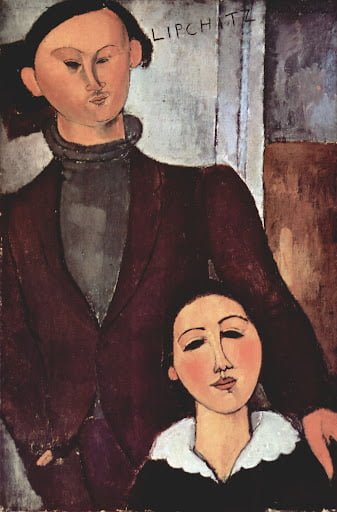
Jacques and Berthe Lipchitz is an oil on canvas painted by Amedeo Modigliani in 1916; the original measures 81.3 × 54.3 cm and hangs in the Art Institute of Chicago under accession number 1926.221. It is a double portrait of the sculptor Jacques Lipchitz and his wife, the poet Berthe Kitrosser. Our canvas painting is a hand-painted copy of that work: an academy-trained painter makes it in oil on cotton canvas, in eight sizes from 40 × 60 cm to 120 × 180 cm or in the size you specify, and before dispatch we photograph it and send you the photograph for approval.
| Title: | Jacques and Berthe Lipchitz |
| Other titles: | Double Portrait · Portrait du sculpteur L. et de sa femme |
| Painter: | Amedeo Modigliani (1884–1920) |
| Year: | 1916 |
| Original size (height × width): | 81.3 × 54.3 cm |
| Original technique: | Oil on canvas; signed upper right, inscribed LIPCHITZ upper centre |
| Painting style: | Modern art, École de Paris |
| Where it is: | Art Institute of Chicago, Helen Birch Bartlett Memorial Collection – museum record (acc. 1926.221), on view in Gallery 391 |
| Our reproduction: | hand-painted oil on canvas, eight sizes from 40 × 60 cm to 120 × 180 cm, custom size on request |
Jacques and Berthe Lipchitz – Amedeo Modigliani
Who do we see on the canvas?
The sculptor Jacques Lipchitz and his wife Berthe Kitrosser, a Russian poet. Lipchitz and Modigliani were friends from the same Paris circle: both came to France young, both from Jewish families, but opposite in temperament — Lipchitz industrious and orderly, Modigliani bohemian and dissolute. In 1916 Lipchitz married, and it was on that occasion that he commissioned the portrait; the commission was also a way of helping a friend who was doing badly with money, without humiliating him. The couple sat in their own Paris apartment, which had earlier been the home of Constantin Brâncuși.
What is on the canvas?
A double portrait. The man stands above in a dark burgundy jacket over a grey-blue high-necked sweater; the woman sits at the lower right in a dark dress with a white scalloped collar. His face is elongated and pale, hers rounder and ruddier — Modigliani did not make them alike, and it is that difference which holds the work together. The ground is grey-blue, cut at the right by a brown vertical. Across the top centre, in large printed letters, stands LIPCHITZ: not the painter’s signature but the naming of the sitter, which is rare in Modigliani, while his own signature is at the upper right. The man’s hand rests on her shoulder but barely touches it — two people on one canvas, each with their own space. The whole stands on a few verticals, as though the couple leaned against architecture.
How was the work made?
We know unusually well. Lipchitz later described it himself: when he asked for the portrait, Modigliani answered that his price was ten francs a sitting and a little alcohol. He came the next day and drew a run of preparatory sheets, one after another, fast and precisely; the pose they finally settled on came from the couple’s wedding photograph. Five of those drawings survive: two of Jacques, two of Berthe and one of both together in the resolved composition. Lipchitz was uncomfortable paying only ten francs for the work, so he invented reasons for the painter to keep going — we sculptors like more substance, he told him. The work occupied Modigliani for nearly two weeks, in Lipchitz’s words probably the longest he ever spent on a single painting; the museum record adds that the canvas was in fact painted in two days, and the rest was his friend’s device for paying him more.
Why is this double portrait rare?
Because it is one of only two double portraits in Modigliani’s painted work. Almost all his painting is the portrait of a single person; here there are two, and the relation between them is the only narrative the work allows. The firm construction is rare too: the verticals of the ground hold both figures in place, and that separates this canvas from the quick portraits he finished in a single sitting. It is a post-impressionist painting in the sense in which post-impressionism meant building the body out of planes rather than describing light. In Paris Modigliani belonged to that circle of immigrant painters we now call the École de Paris. If you look for a joke at the patron’s expense you will find one: Lipchitz’s nose is painted conspicuously twisted, while her face is soft and round.
Where is the original today?
In the Art Institute of Chicago, in the Helen Birch Bartlett Memorial Collection, under accession number 1926.221, on view in Gallery 391. The route there is recorded in full: Jacques Lipchitz took the canvas directly from the painter in 1916, around 1921 it passed by exchange to the dealer Léonce Rosenberg, in 1922 Frederic C. and Helen Birch Bartlett of Chicago bought it, and on her death it entered the museum on 27 January 1926. It had already been shown in December 1920 at the Galerie Montaigne in Paris under the title Portrait du sculpteur L. et de sa femme, and in 1942 at the Museum of Modern Art in New York. A fuller account is gathered in the English encyclopaedia article.
How is our hand-painted version made?
The work is made by an academy-trained painter in oil on cotton canvas, stretched over a wooden frame. It is not a print: every stroke is laid by hand, and your canvas always differs a little from our reference in brushwork and thickness of paint. With this subject the painter takes the ground and the verticals first, because those settle where the two figures will stand; only then come the faces, which have to stay different — make them alike and the work loses its one event. The white scalloped collar is the lightest point on the canvas and goes on last. When the paint is dry we photograph the work and send the photograph for approval.
Which size for which wall?
For most homes the right choice is 54 × 81 cm — that size is practically the original’s, so you receive a canvas at one-to-one proportions. The smallest, 40 × 60 cm, belongs in a hallway or on a narrow wall between two doors. The medium ones, 60 × 90, 70 × 110 and 80 × 120 cm, work above a sideboard or sofa. The large ones, 90 × 130, 100 × 150 and 120 × 180 cm, want a free wall and three metres of distance; there both figures are larger than life and the work takes the room. The format is upright and narrow, so it works where the wall is taller than wide — along a staircase or between two windows. Since the work is dark and cool throughout, it is at its best on a light wall; on a dark one the burgundy jacket merges with the ground.
Custom size, stretcher and frame
If your wall asks for a size that is not on the list, we will make it. Give us the height and width in centimetres; we check whether the proportion carries the original’s crop and tell you what changes at the edges — here it shows first at the top, where the signature and the word LIPCHITZ stand, which cannot be cut away without taking the work’s only word with them. You can choose whether it arrives stretched on a wooden frame, ready to hang, or rolled in a tube, which is cheaper to ship. You pick the frame in our 3D application, which shows it realistically on the work, and on request we set the work into a photograph of your wall. If you are looking for a work we do not carry, see our made-to-order paintings.
Delivery and guarantee
We deliver to your address, the canvas held clear of the outer wall of the packaging. Lead time depends on size and the workshop’s load: we estimate it when you order and tell you if it changes. We guarantee workmanship and materials: if the work arrives damaged or does not match the photograph you approved, we repaint it at our own cost. Because you see it in a photograph before it ships, most questions are settled before it leaves.
Frequently asked questions
Where is the original?
In the Art Institute of Chicago, accession number 1926.221, on view in Gallery 391.
Who commissioned this work?
The sculptor Jacques Lipchitz, on his marriage to Berthe Kitrosser, partly to help his friend financially.
What was Modigliani paid?
His price was ten francs a sitting and a little alcohol. Lipchitz thought that too little and looked for reasons to keep the painter working longer and earning more.
Why does LIPCHITZ appear on the canvas?
It names the sitter; it is not the painter’s signature. The word stands at the top centre, Modigliani’s signature at the upper right.
Which size should I choose?
If you cannot decide, take 54 × 81 cm, the size of the original. For a narrow hallway wall 40 × 60 cm, for a large wall 120 × 180 cm.
Is the original for sale?
No. It belongs to a public museum collection, it is not on the market, and so we put no value on it.
How high should it hang?
With its centre about 145 cm above the floor — a little lower than feels right, with a narrow upright format.
Which other portraits from Modigliani’s circle do you have?
See Portrait of Chaïm Soutine, Portrait of Lunia Czechowska, Portrait of Beatrice Hastings, Portrait of a Polish Woman and The Little Peasant. The full choice is in the Amedeo Modigliani gallery, and we have written a longer article about the painter.
How closely does it follow the original’s proportions?
The original measures 54.3 × 81.3 cm, and that is exactly the size we list: 54 x 81 cm. The proportions are the original’s, with no deviation.
- Subject: the sculptor Jacques Lipchitz standing over the seated Berthe Kitrosser, his hand barely on her shoulder, LIPCHITZ across the top centre
- Original: 81.3 × 54.3 cm, oil on canvas, 1916, Art Institute of Chicago (acc. 1926.221)
- Our version: hand-painted oil on canvas, eight sizes from 40 × 60 to 120 × 180 cm; the 54 × 81 cm size is one-to-one with the original
- Worth knowing: five preparatory drawings survive, and the pose came from the couple’s own wedding photograph
The eyes on this canvas are painted without pupils. We counted all 76 Modigliani works on this shelf: 53 are like that, 17 are not – work by work.