


Description
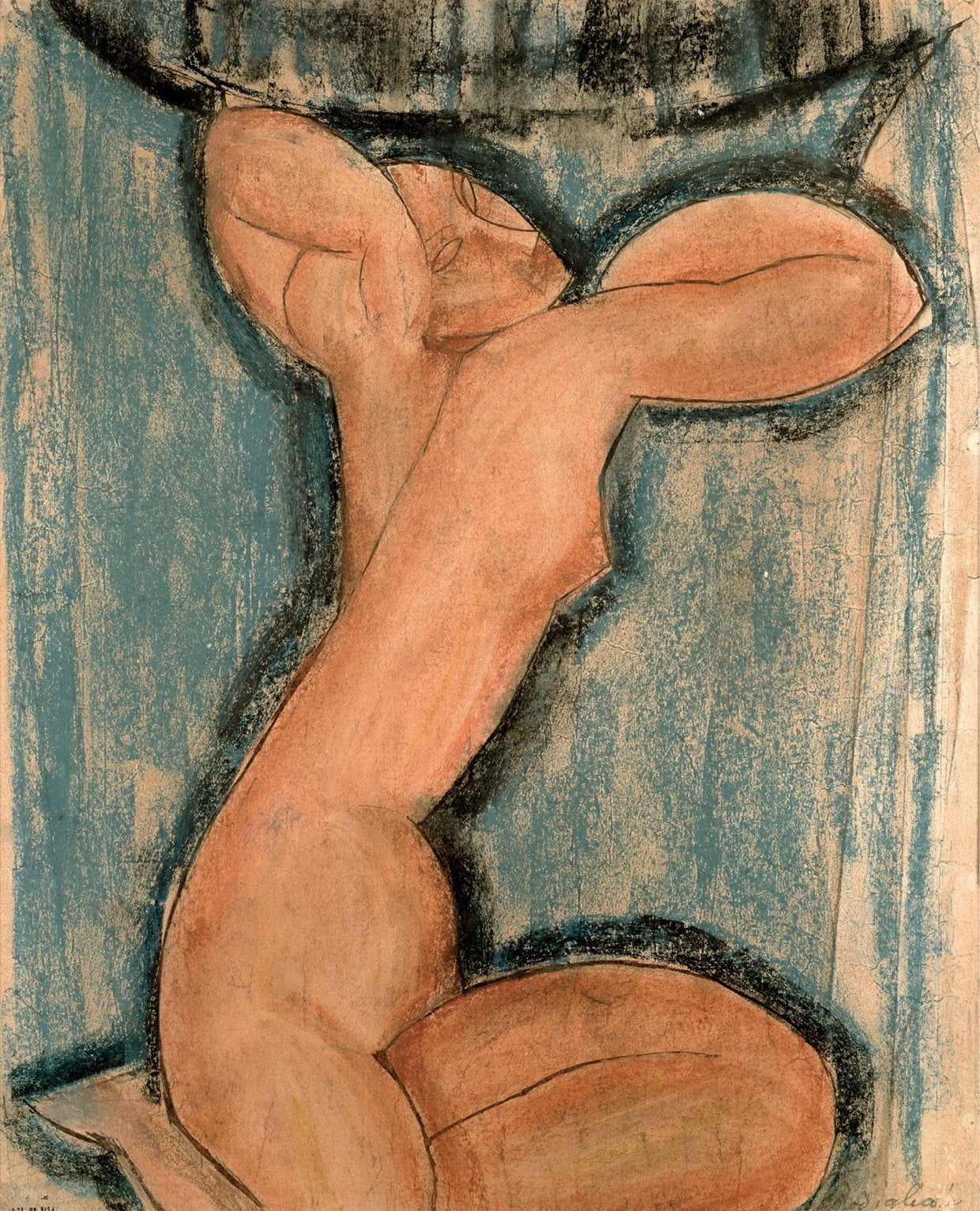
Caryatid is a coloured work on paper made by Amedeo Modigliani in the years when he worked mainly as a sculptor. A crouching female nude lifts both arms above her head to carry a dark lintel; in Greek architecture a caryatid is exactly that, a figure carrying the weight of a building in place of a column. Our canvas painting is a hand-painted copy of that sheet, made as an oil on cotton canvas by an academy-trained painter, in eight sizes from 43 × 53 cm to 120 × 150 cm or in the size you specify. We also say plainly which facts about the original we do not print, and why.
| Title: | Caryatid |
| Painter: | Amedeo Modigliani (1884–1920) |
| Original technique: | Coloured work on paper, signed lower right |
| Painting style: | Modern art, École de Paris |
We print no year, no size and no location for this sheet. Modigliani made about fifty caryatid designs between 1909 and 1915, many of them close to one another, and we have not established which one this is from a source that names it. Rather than repeat a figure we cannot support, we leave those fields empty and say so here.
Caryatid – Amedeo Modigliani
What is on the sheet?
The figure is laid in flat salmon-terracotta and outlined with a heavy black contour that runs unbroken round the whole body. The head tilts onto one shoulder, the eyes are narrowed almond slits, and the face is resolved in a handful of marks. Both arms rise overhead and brace against a dark band that crosses the top edge of the sheet, so the whole weight of the picture presses down onto the shoulders. The ground is a teal blue-green, brushed in vertical strokes with bare paper showing through in places and a pale margin left at the edges. The signature sits lower right. The composition is flat and almost hieroglyphic: hips, thighs and shoulders are reduced to a single continuous curve, with no modelling and no depth. It is a post-impressionist painting in our version, and in the original something rarer — a sculptor’s drawing, made to be cut in stone rather than looked at. In Paris Modigliani belonged to that circle of immigrant painters we now call the École de Paris.
Which caryatid is this?
We do not know, and we would rather say so. Modigliani made roughly fifty caryatid designs, and a great many share this exact vocabulary: the raised arms, the tilted head, the single outline, a warm figure against a cool ground. This page once named a museum, and that attribution was wrong twice over — the institution’s name was misspelled in four of the six languages, and the record we could actually read there described a graphite pencil drawing with no measurements, while this sheet is plainly coloured. We removed it. In preparing this page we tested one further candidate, the Caryatid in the Art Institute of Chicago, and ruled it out: that sheet is a pale watercolour over graphite on buff paper, far lighter in tone than this one. It is a good example of the type, and it is not this sheet.
The facts we print, and the ones we leave out
We print the technique and the style. We give no year, no size and no location, because we have no source that ties those to this particular sheet. That has one practical consequence: on our other Modigliani pages we can often tell you which size matches the original to within a few millimetres, and here we cannot. We make no one-to-one claim on this work. Choose a size for your wall.
The caryatids were the main work, not marginal sketches
For several years before the war Modigliani worked chiefly in stone, and the caryatid was his central motif. The surviving sheets are not sidelines: they are the body of his work in those years, studies toward an architectural ensemble he meant to build. He called the figures columns of tenderness, and a group of them was to stand together in what he named a Temple of Humanity. The drawings are the record of that plan, not its leftovers.
The Temple of Humanity
The temple was never built. Modigliani carved a single caryatid in stone and then stopped: the money was not there, and the dust from carving was damaging lungs that were already tubercular. He went back to painting, and stayed there for the rest of his life. The load-bearing female figure did not leave his work, though — the long neck, the tilted head and the continuous contour of these sheets are the same language he used afterwards on every portrait. A museum essay on one of the other sheets, the Caryatid in Melbourne, sets out the project and its sources in African, Cambodian and Renaissance work.
How is our hand-painted version made?
The work is made by an academy-trained painter in oil on cotton canvas over a wooden frame. It is not a print: every stroke is laid by hand, and your canvas always differs a little from any other. The original is a work on paper and ours is oil on canvas, which is a real difference and we do not pretend otherwise: the painter reproduces the drawing, the colour and the visible strokes of the ground, but a canvas cannot show the grain of paper. What it can show, and what matters here, is the contour. That line is the picture, it is laid in one movement, and it cannot be corrected afterwards without the correction showing.
Which size for which wall?
Because the original’s size is unknown to us, nothing here is a match and everything is a choice. The small sizes, 43 × 53 and 50 × 60 cm, keep the sheet the scale of a drawing and suit a narrow wall, a hallway or a group hung together. The middle sizes, 60 × 70, 70 × 90 and 80 × 100 cm, are the usual choice above a sideboard or a bed. The large ones, 90 × 110, 100 × 120 and 120 × 150 cm, make the figure life-size or larger and turn a quiet sheet into the main thing in the room; they want a free wall and about three metres of distance. Hang it with the centre around 145 cm from the floor. The colouring is a warm figure on a cool ground, so it holds a white, grey or pale blue wall and does not want a warm one.
Custom size, stretcher and frame
If your wall asks for a size that is not listed, we will make it. Give us the width and height in centimetres; we check whether the proportion carries the composition and tell you what changes at the edges. Here it shows at the top, where the dark band the figure is holding runs off both sides and is easy to lose, and at the bottom, where the knee already sits close to the edge. It arrives either stretched on a wooden frame, ready to hang, or rolled in a tube, which is cheaper to ship. You pick the frame in our 3D application, which shows it realistically on the work, and on request we set it into a photograph of your wall. If you are looking for a work we do not carry, see our made-to-order paintings.
Delivery and guarantee
We deliver to your address, the canvas clear of the outer wall of the packaging. Lead time depends on size and the workshop load: we estimate it when you order and tell you if it changes. We guarantee workmanship and materials: if the work arrives damaged or does not match the photograph you approved, we repaint it at our cost. Because you see it photographed before it ships, most questions are settled before it leaves.
Frequently asked questions
Where is the original?
We do not state a location. We have no source that names this particular sheet, and the museum this page once named was the wrong one.
What year is it from?
We do not state a year either. The caryatid sheets span the sculpture years; we cannot narrow the range to this one.
How big is the original?
Unknown to us, and so we make no claim that any of our sizes matches it.
Why do you print so little?
Because the alternative is to print something we cannot support. Four empty fields are more useful than four confident wrong ones.
The original is on paper — why is yours in oil?
Because it is made to hang. Oil on canvas is what our workshop paints and what survives on a wall; the drawing, the colour and the brushed ground are reproduced, the paper texture is not.
Which size should I choose?
Above a sideboard or a bed, 80 × 100 cm. For a hallway or a group of works, 50 × 60 cm.
What is a caryatid?
A carved female figure used in place of a column, carrying the weight of the structure above her.
Which other Modigliani works do you have?
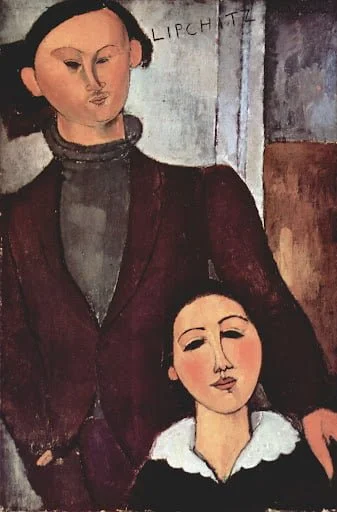
See Jacques and Berthe Lipchitz, a portrait of the sculptor who worked beside him, and among the nudes Reclining Nude II, Red Nude and Nude Sitting on a Divan. The full choice is in the Amedeo Modigliani gallery, and we have written a longer article about the painter.
How closely does it follow the original’s proportions?
We have no recorded size for this original, so we cannot compare the proportions. When the measurement is settled we will give it here.
- Subject: a crouching female figure holding a dark lintel above her head, salmon against a teal ground, the whole body drawn with one black contour
- Original: a coloured work on paper from Modigliani’s sculpture years, signed lower right; year, size and location not established
- Our version: hand-painted oil on canvas, eight sizes from 43 × 53 to 120 × 150 cm, with no one-to-one claim
- Worth knowing: about fifty of these sheets exist; they were studies for a Temple of Humanity that was never built
The eyes on this canvas are painted without pupils. We counted all 76 Modigliani works on this shelf: 53 are like that, 17 are not – work by work.