







































Description
| Title: | The Luncheon |
| Other titles: | Le Déjeuner. Panneau décoratif · The Luncheon |
| Painter: | Claude Monet (1840–1926) |
| Year painted: | about 1873 |
| Original size: | 201 cm x 160 cm |
| Original technique: | Oil on canvas |
| Painting style: | Impressionism |
| Located at: | Musée d’Orsay, Paris (inv. RF 2774) |
| Our reproduction: | Hand-painted oil on canvas, nine sizes or made to measure |
The Luncheon is a hand-painted oil painting after Monet’s garden scene of about 1873: a table not yet cleared after a meal, a child playing on the ground in the shade, and a sunlit path running past. The original measures 201 x 160 cm and is held at the Musée d’Orsay in Paris. We paint it in nine sizes or to your own measurement, with a photograph of the finished work sent for approval before dispatch.
The Luncheon – Claude Monet
What is shown?
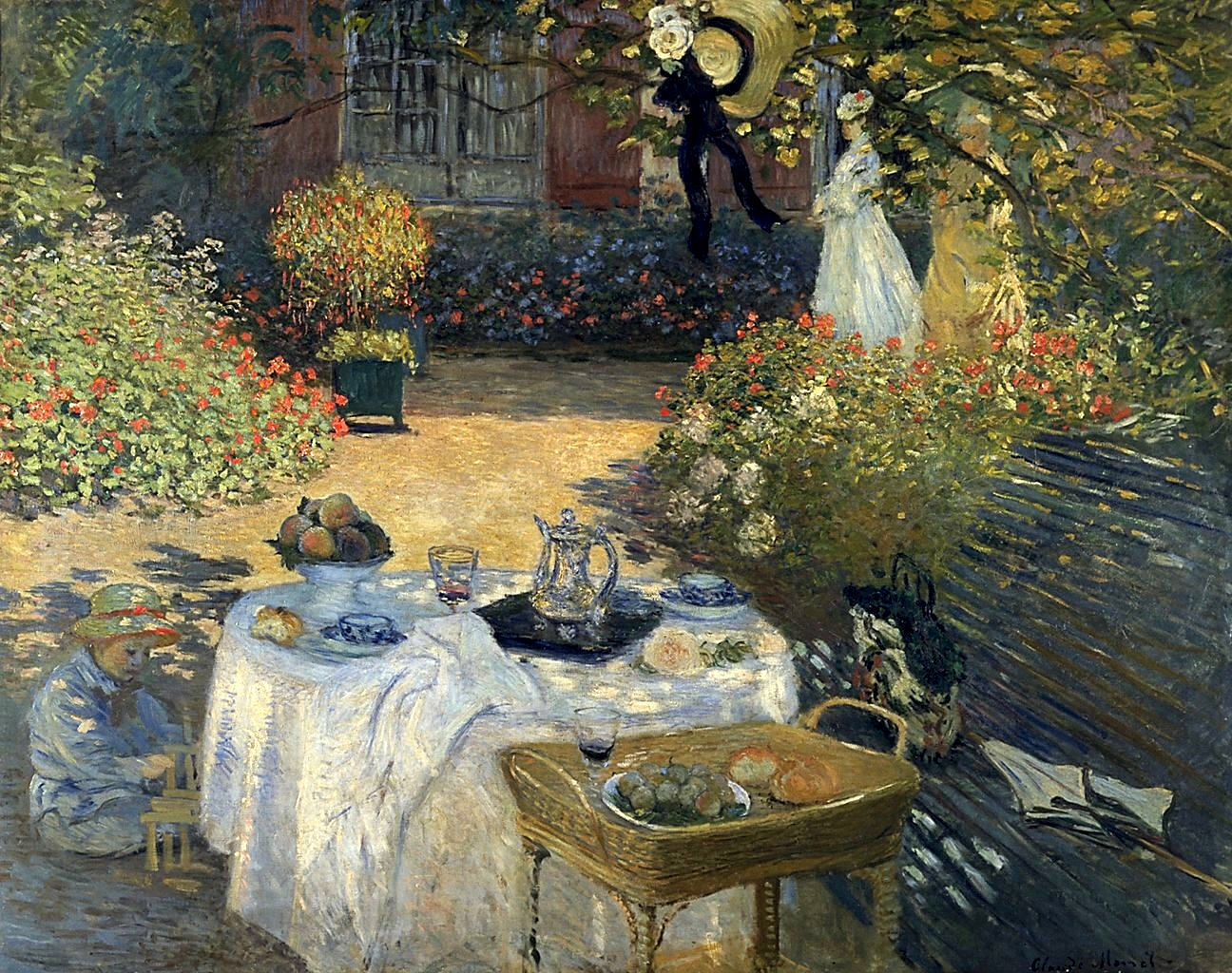
The table is laid with a white cloth and seen slightly from above. On it stand a low bowl of oranges, a tall glass of dark wine, a blue-and-white lidded cup, a silver pot on a dark tray and a plate with a roll; pink roses lie scattered across the cloth. To the right stands a wicker tea trolley in pale cane, carrying a basket of pears and oranges and a second glass. Behind it, in deep shade, is a bench with a white napkin and a dark bag. At the lower left a child in a straw hat with a red ribbon sits on the ground playing with a few pieces of wood. Beyond the table an ochre sand path winds away into the sun, a green flowerpot beside it, and to left and right dense beds rise in red-orange and white. At the upper right a straw hat with a black ribbon hangs from a branch, and further along the path two figures stand. This canvas painting has no event in it — it has the moment when everyone has stepped away.
Why has the table not been cleared?
Because that is exactly what Monet painted. The Musée d’Orsay records that the table was not cleared at the end of the meal, and that the hat on the branch, the bag and the parasol left on the bench seem to have been forgotten there. That is why the scene reads as something just past rather than as an arrangement: the glass is half empty, the cloth is creased, the child plays alone. It makes the subject unusually familiar — you are not looking at an event but at an afternoon you recognise.
The museum’s own record of this canvas
It does not give the year exactly: the record reads “vers 1873”, about 1873, and that is why we write about as well. It entered the museum in 1896 as part of the bequest of Gustave Caillebotte. The museum also records that the canvas was shown in 1876 at the second Impressionist exhibition, and shown there as a “decorative panel” — which is where the second title in the table above comes from. An impressionist painting on this scale is rare in Monet: after 1870 he had largely given up big canvases. The size, the technique and the inventory number are given identically by the public catalogue record.
Our version, and the frame in the photograph
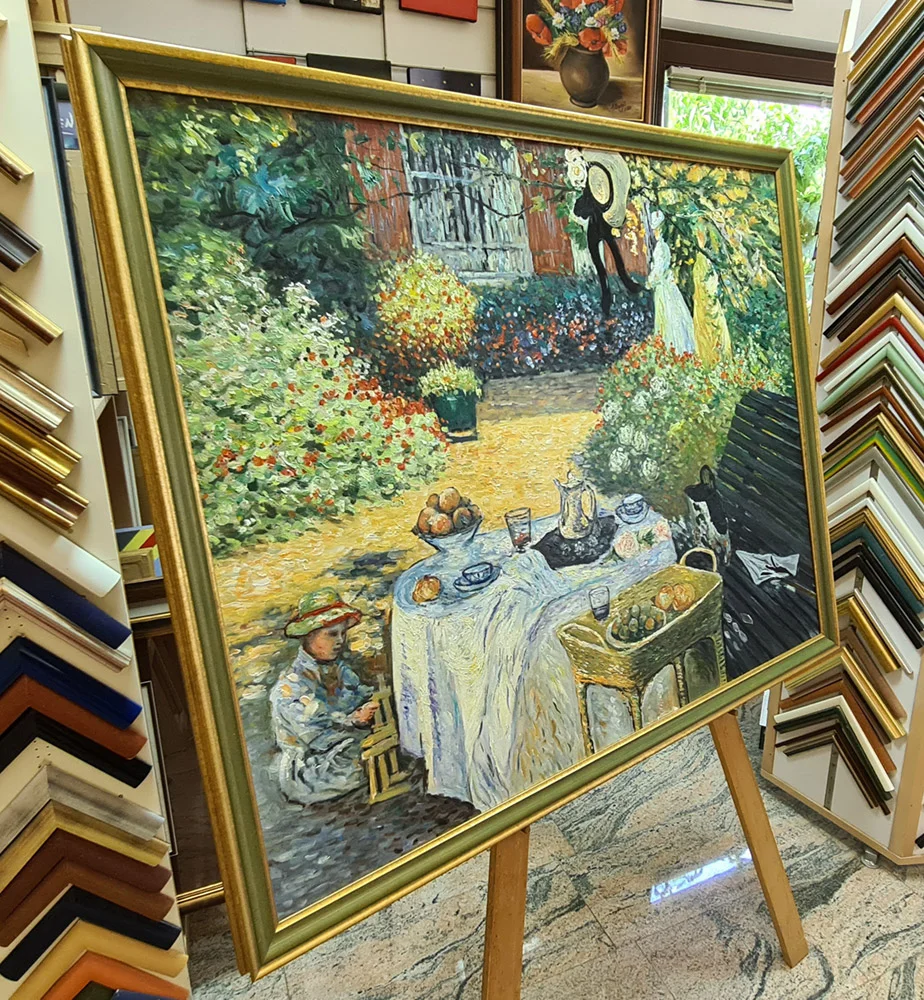
In the first photograph our finished piece stands on a wooden easel in our framing workshop, framed in a green-and-gold moulding, with racks of frame samples on either side. That makes the photograph most useful for choosing a frame: you can see how a gilt edge sits against the yellow path and the white cloth, and how much the frame adds to the final size. The oil painting reproduction you receive is made the way that one was; a work this size takes several days and each comes out a little different from the one in the photograph.
Other Monet subjects from these years
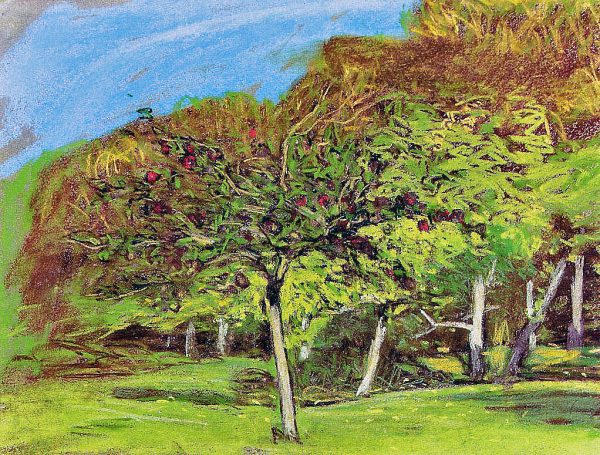
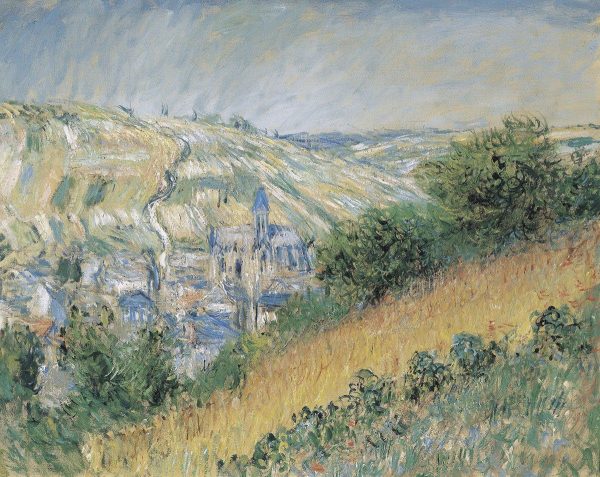
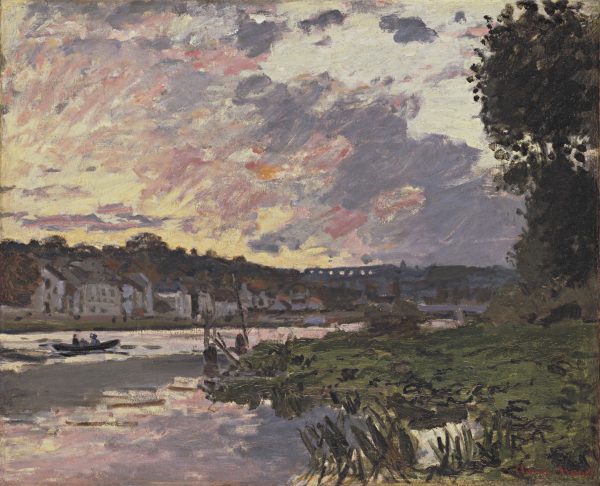
From the same years and the same place comes another subject: Poppies near Argenteuil. Then the bridge over the Seine that Monet saw every day: Bridge at Argenteuil. Some years earlier he had put the same garden figures into a large upright canvas, Women in the Garden. And the same child appears again indoors, a few years later, in A Corner of the Apartment.
How is our hand-painted version made?
This subject is demanding because of the cloth. A white cloth in sunlight is not white: it holds blue, grey and yellow shadows, and if the painter simplifies them the table flattens into paper. So the work begins with the lit path and the cloth, because they set the light for everything else; then come the things on the table, which have to stay small and exact; and only last the flower beds, which are the lightest. The child and the two figures by the path are made in a few strokes — work them too far and they become portraits, and the scene stops. A hand-painted copy this size takes longer than a small one.
Every piece is hand-painted, oil on canvas, made to order. In the photograph you can see the paint on the cloth standing above the surface; a print is smooth.
Which size for which wall?
Short answer: 120 x 90 cm above a sofa; 80 x 65 cm for a smaller wall; 200 x 160 cm for a large open one — our largest, and a single centimetre under the original’s width. A painting for living room walls should take up about two thirds of the width of the sofa. Because the subject lies wide and has depth — the path leads back — it works on a longer wall where you also see it from the side. Impressionist wall art with a subject like this suits a dining room too: the painted table and the real one talk to each other.
How high to hang the painting: put the centre of the canvas about 150 cm above the floor. At the large sizes go a little lower, so the top edge does not leave your field of view when you stand close.
Made to measure, stretcher and frame
If none of the nine sizes suits, we paint to measure — send the width and the height and we will quote a price and a lead time. The canvas is stretched over a wooden stretcher and the edges are painted, so the work does not look unfinished without a frame. As the photograph shows, warm gilt or a green-and-gold moulding suits this subject; a cold silver frame kills the ochre path, which is the main thing here.
Delivery and guarantee
We ship to sixteen countries in the European Union, among them Slovenia, Croatia, Austria, Germany, Italy and Hungary, wrapped in protective film and packed in a rigid box. Before dispatch we send a photograph of the finished work; if something on it is wrong, it is corrected before the piece leaves the workshop. Lead time is longer at the large sizes. You will find our other Monet reproduction subjects in the Claude Monet gallery, and we write about painting and about choosing a subject on the blog.
If the painting is a gift and you are unsure of the size, there is a gift voucher: the recipient chooses the size and the subject.
Frequently asked questions
What year is the original from?
The Musée d’Orsay dates it to about 1873 — its record reads “vers 1873”. Because the museum does not give the year exactly, neither do we.
Where is the original?
In the Musée d’Orsay in Paris, under inventory number RF 2774. It entered the museum in 1896 with the bequest of the painter Gustave Caillebotte.
Who is the child in the picture?
The museum names him: Jean Monet, the painter’s son, playing with a few pieces of wood in the shade. The museum does not name the other figures, so neither do we.
Where was it painted?
In the garden of the house Monet rented at Argenteuil, on the Seine near Paris; he lived there from 1871 to 1878 and painted many of his best-known early Impressionist scenes there.
- Hand-painted. Oil on canvas, no print and nothing applied by machine.
- Nine sizes or made to measure. From 50 x 40 to 200 x 160 cm; the largest is 1 cm narrower than the original and the same height.
- Photograph before dispatch. You see the work finished before it leaves the workshop.
- Figures from the museum. Year, size, technique and inventory number are given as the Musée d’Orsay records them.