
















Description
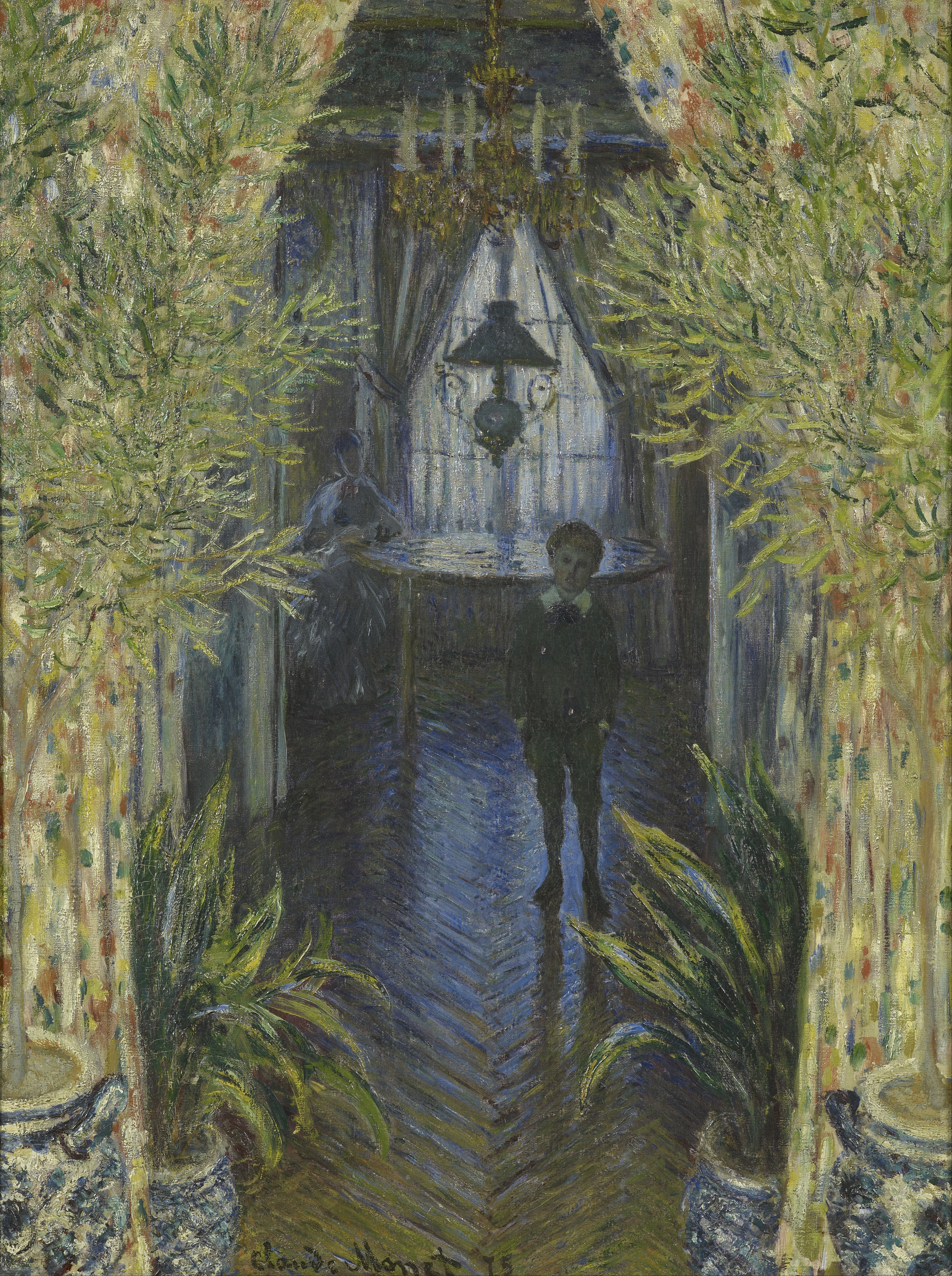
A Corner of the Apartment is a hand-painted reproduction of one of Monet’s rare interiors: a child in dark clothes stands on the parquet in the middle of the room, a round table with a white cloth with a seated woman behind it at the left, and tall small-leaved foliage framing the scene at left and right. The original measures 60 x 81.5 cm, is oil on canvas and is held by the Musée d’Orsay in Paris under accession number RF 2776. The museum dates it to 1875, without reservation, and the canvas is signed “Claude Monet 75”. We paint it in eight sizes or to your own, with a photograph of the finished work for approval before despatch.
| Title: | A Corner of the Apartment |
| Other titles: | Intérieur d’appartement ; Un coin d’appartement (the name in the museum record, with both parts) |
| Painter: | Claude Monet (1840–1926) |
| Year painted: | 1875; the museum record and the signature “Claude Monet 75” agree |
| Original size: | 60 cm x 81.5 cm |
| Original technique: | Oil on canvas |
| Painting style: | Impressionism |
| Located at: | Musée d’Orsay, Paris (acc. no. RF 2776) |
| Our reproduction: | Hand-painted oil on canvas, eight sizes or made to measure |
A Corner of the Apartment – Claude Monet
What is on the canvas?
A view through a dark room towards a bright window. A little right of centre, on a herringbone parquet, stands a child in dark clothes with a pale collar; the face is small and pale, the arms at the sides. Behind stands a round table with a white cloth, and behind the table at the left sits a woman in dark clothes, of whom only the head and shoulders are visible. Above the table hangs a lamp with a dark conical shade, and higher still a candle chandelier on a dark ceiling beam. At left and right tall small-leaved foliage comes down from the top edge and frames the scene; below, in both corners, stand blue-and-white porcelain vessels holding broad spiky leaves. At the back is the window with white curtains, the only bright surface in the scene. A signature runs along the bottom edge, left of centre.
Who are the figures?
The museum record does not say. It gives the title, the dating, the measurements, the technique and the manner of acquisition — the names of the sitters are not in it. So we name nobody either: on the canvas a child stands and a woman sits at a table, and with a source in hand nothing more can be claimed. On a neighbouring work of the same museum another institution supplied a name; here we found none. Neither the museum record nor Wikidata names him, so we have taken the name out. Where the source is missing, an empty field is better than a guess.
Why does the work have two names?
Because the museum gives it both. Its record reads “Intérieur d’appartement ; Un coin d’appartement” — two names separated by the museum’s own semicolon. The first is more general, the second more exact: not the whole interior, but its corner. Our title follows the second. We print both in the table, because both appear in catalogues and a reader searching for the first would otherwise take it for a different work.
How is the work dated, and what does the canvas say?
The museum dates it to 1875, with no range and no cautious “around”. A signature runs along the bottom edge, and on the museum’s photograph we read it as “Claude Monet 75”. The museum record lists no inscription, so the reading is ours, from the photograph — and the two years agree. Each time we say which source says what.
What does the museum record say about the size?
The work is held by the Musée d’Orsay under accession number RF 2776. It gives the measurements in the order height by width, 81.5 x 60 cm; our table puts the width first, so here you read 60 x 81.5 cm. First the order. Where an institution and a database disagree, we follow the institution. With its frame the whole measures 95.5 x 115.5 cm.
The bequest of Gustave Caillebotte, 1896
A single line, and the line is the museum’s: “Legs Gustave Caillebotte, 1896”. Caillebotte was a painter and a collector, and his bequest brought several Impressionist works into the French national collections at once. We carry two of them: Snow Effect in Vétheuil, which the museum holds as RF 3755, and Les Tuileries ; esquisse as RF 2705, which we list as The Tuileries Gardens. For all three the acquisition line reads the same, checkable in the museum’s record.
Monet’s other interior
Monet painted interiors rarely: in the survey of his works we made, only two carry an interior in the title. The other is “Intérieur, Après dîner” at the National Gallery of Art in Washington, numbered 1983.1.26, 65.4 x 50.2 cm — a landscape format where ours is upright, and a canvas with roughly two thirds of our area. The dating differs too: there it is recorded only to the decade, while for ours the museum gives a single year.
How is our hand-painted version made?
Every order is painted individually, in oils on cotton or linen canvas. A canvas painting is made here with no print, no transfer and no machine step in between. This motif is demanding because of the span between dark and light: the window at the back is almost white and the room in front of it almost black, and if the painter lightens the middle too far the depth goes and the scene becomes a flat surface. The leaves of the plants must stay separate strokes, or they stick together into a green patch. Every hand-painted oil painting that leaves our workshop is a little its own. Before despatch you receive a photograph of the finished work for approval.
Which size for which wall?
Eight sizes are available, from 50 x 65 to 120 x 160 cm, and with this work something unusual holds: 60 x 80 cm has exactly the width of the original and is only a centimetre and a half shorter. If you want the canvas at very nearly its true size, that is the one. By proportion 110 x 150 cm is nearest. The scene is upright and deep: it works at the end of a hallway or on a wall seen from a distance. As a painting for a dining room 68 x 90 cm sits well; as a painting for living room walls, 90 x 120 cm. Related motifs are in the Claude Monet gallery: Meditation, Madame Monet on the Sofa and The Luncheon.
How high to hang the painting: the centre about 145 cm above the floor; above furniture, the lower edge 20 to 30 cm above it. We write more about hanging on our blog.
Made to measure, stretcher and frame
If you want the proportion of the original exactly, made to measure is the only route: send us the width and the height in centimetres — though 60 x 80 cm already matches the original in width. The canvas can come stretched on a wooden stretcher ready to hang, or rolled in a tube. The frame is not included in the price. A dark narrow frame suits this scene; a wide gold frame competes with the chandelier and the window. The museum keeps its own original in a frame with which the whole measures 95.5 x 115.5 cm.
Delivery and guarantee
Making the work normally takes two to three weeks, a few days longer at the largest sizes, because the oil has to dry between layers. If the work arrives damaged, or differs noticeably from the approved photograph, we replace it or refund the price. A hand-painted copy is not a factory product and small differences in the stroke are to be expected; damage or the wrong motif are not. We deliver within the European Union.
If the painting is a gift and you are unsure of the size, there is a gift voucher: the recipient chooses the size and the subject.
Frequently asked questions
Where is the original?
In Paris, at the Musée d’Orsay, under accession number RF 2776, where it arrived in 1896 with the bequest of Gustave Caillebotte.
What year is the work from?
1875. This is one of the rare cases where the museum’s year and the year in the signature agree.
What does the work say in one sentence?
That Monet, whom we know for painting out of doors, could catch the light from inside as well, with a dark room as the setting for a single bright window.
Who is the boy?
Jean, Monet’s elder son, born in 1867 and so about eight years old here. The woman in the shadow behind him is probably Camille, his mother.
- Motif. A child on the parquet in the middle of a dark room, a table with a white cloth and a seated woman behind; tall foliage at the sides, porcelain pots in the corners, a bright window at the back.
- Original. Oil on canvas, 60 x 81.5 cm, 1875; Musée d’Orsay, acc. no. RF 2776, bequest of Gustave Caillebotte 1896.
- Ours. Eight sizes; 60 x 80 cm has exactly the width of the original and is a centimetre and a half shorter.
- Worth knowing. The museum record names neither the child nor the woman, so neither do we.