







































Description
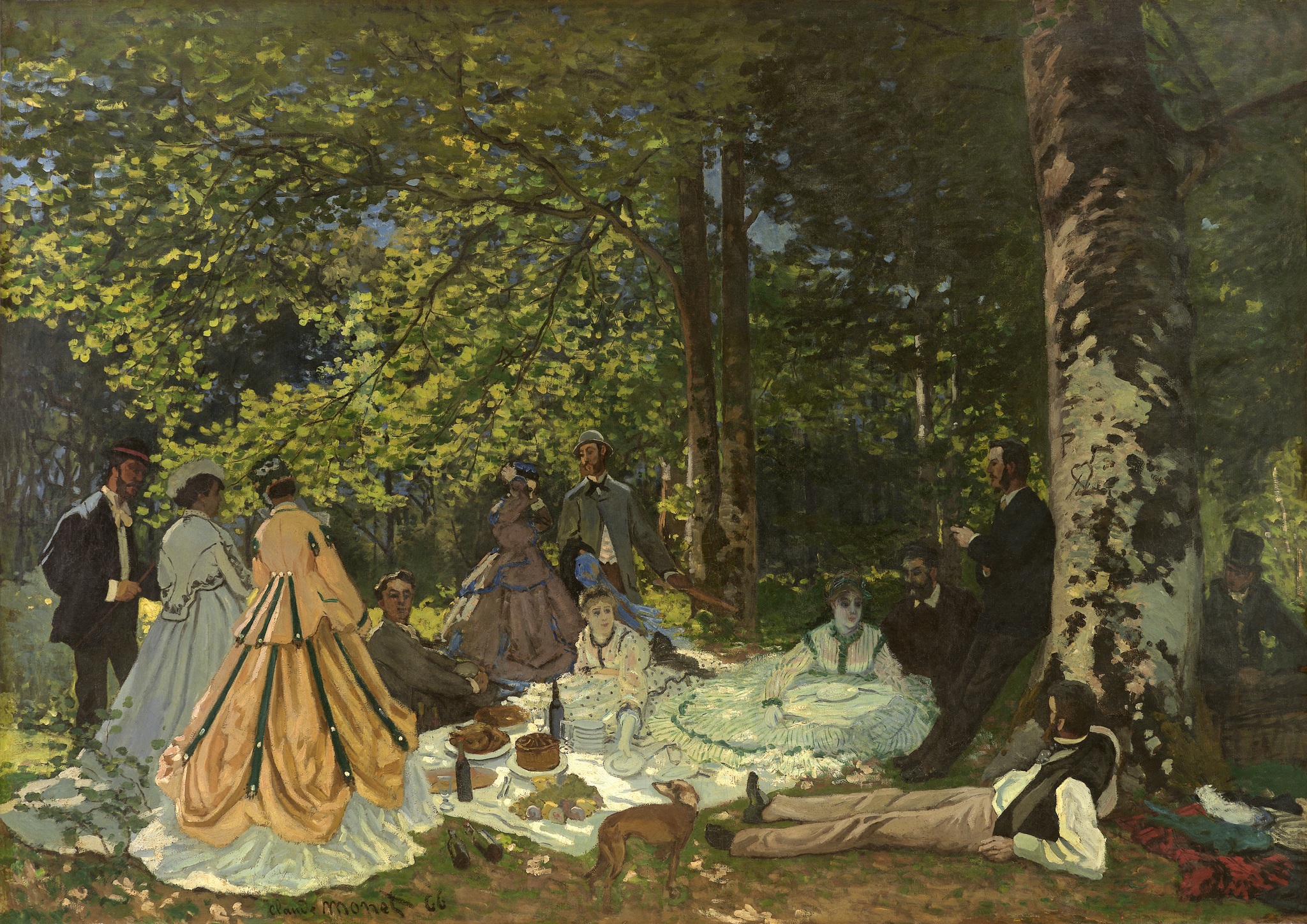
Luncheon on the Grass is Monet’s canvas of 1866: a picnic in the forest of Fontainebleau, with a white cloth spread on the grass, a dozen men and women in summer clothes around it and sunlight falling through the trees. This complete version belongs to the Pushkin Museum in Moscow. We make it as a hand-painted reproduction in oil on canvas, in eight sizes or to your own measurement, with a photograph of the finished work sent for approval before dispatch.
| Title: | Luncheon on the Grass |
| Other titles: | Le Déjeuner sur l’herbe · Das Frühstück im Grünen · La colazione sull’erba |
| Painter: | Claude Monet (1840–1926) |
| Year painted: | 1866 |
| Original size: | 181.1 cm x 129.8 cm |
| Original technique: | Oil on canvas |
| Painting style: | Impressionism |
| Located at: | Pushkin State Museum of Fine Arts, Moscow (inv. Zh-3307) |
| Our reproduction: | Hand-painted oil on canvas, eight sizes or made to measure |
Luncheon on the Grass – Claude Monet
What is shown?
A summer picnic in a clearing of the forest of Fontainebleau. In the middle of the grass lies a white cloth with bread, fruit, a pie and bottles, and around it a party of friends in fashionable clothes: women in wide light dresses, men in dark jackets and straw hats, some sitting, some standing, one reaching up into a tree. Tall trunks close the scene at the back, and the sun breaks through the leaves in bright patches on the dresses and the cloth.
The great canvas that was cut up
Monet planned this subject as an enormous painting, more than four metres high and six wide, for the Salon of 1866. He could not finish it in time. Later he left it as a pledge for unpaid rent; when he got it back it was damaged by damp, and he cut it up. Two fragments survive in the Musée d’Orsay. This version, smaller and complete, is the only one that shows the whole composition as he imagined it.
Why does this painting matter?
It is the young Monet’s answer to Manet’s famous Luncheon on the Grass of 1863: the same theme, but with ordinary, fully dressed people, real daylight and a real forest instead of a studio. It is the first big step towards the open-air painting that became Impressionism, and many of the ideas of the next ten years are already in it.
Who posed for it?
Monet’s friends. Camille Doncieux, who later became his wife, posed for several of the women, and the painter Frédéric Bazille for several of the men; others in the group are not named with certainty. That is why the same faces seem to return around the cloth: two models changed clothes and places.
The Luncheon and its studies
The picnic did not come out of nothing. A study of two of the figures, painted the same summer, is Bazille and Camille (Study for “Le Déjeuner sur l’herbe”); the forest road nearby, where Monet was working at the time, is Le Pavé de Chailly; and the next big open-air figure painting, made a year later, is Women in the Garden.
How is our hand-painted version made?
The painter starts with the forest: the dark trunks and the green shadows, because the sunlight only reads against them. Then the figures as broad patches of colour, the dresses first, and only after that the faces and hands, kept simple as in the original. The white cloth and the patches of sun come last; if they are painted too bright too early, the whole canvas loses its depth.
Every piece is a hand-painted copy in oil on canvas, made for your order. An impressionist painting lives on its visible brushwork, so we do not smooth it away: the strokes stand slightly above the surface and catch the light, which a printed oil painting reproduction cannot do.
Which size for which wall?
Short answer: 105 x 75 cm above a sofa or sideboard, 60 x 40 cm for a hallway or a smaller wall, and 150 x 110 cm for a large empty wall. A painting for the living room should take up about two thirds of the width of the furniture below it. All eight sizes, from 50 x 35 to 150 x 110 cm, follow the format of the original.
How high to hang the painting: put the centre of the canvas about 150 cm above the floor; above a sofa, leave 20 to 30 cm between the back and the lower edge.
Made to measure, stretcher and frame
If none of the sizes suits, we paint to measure — send the width and the height and we will quote a price and a lead time. The original measures 181.1 x 129.8 cm, a ratio of about 1.40 : 1. Every canvas painting we make is stretched over a wooden stretcher with painted edges, so it does not look unfinished without a frame. A dark wood or a classic gold frame suits the deep greens; for a lighter room a narrow natural moulding keeps it fresh.
Delivery and guarantee
We ship to the United Kingdom, Ireland and across the EU, wrapped in protective film and packed in a rigid box. Before dispatch we send you a photograph of the finished work; if something on it is not right, we correct it while the canvas is still in our workshop. Every other Monet reproduction we paint is in the Claude Monet gallery, and we write about the painter and about choosing a subject on our blog.
If the painting is a gift and you are unsure of the size, there is a wall art voucher: the recipient chooses the size and the subject.
Frequently asked questions
Where is the original?
This complete version is in the Pushkin State Museum of Fine Arts in Moscow, under inventory number Zh-3307. Two fragments of the huge unfinished canvas are in the Musée d’Orsay in Paris. The work is recorded in Wikidata, and the photograph we paint from is on Wikimedia Commons.
What year is it from?
From 1866. Monet worked on the subject in 1865 and 1866, and this complete version is dated 1866.
What does Luncheon on the Grass mean?
It shows a modern day out in the country, painted as it would look in real light. It is also a reply to Manet: the same picnic theme, but without a story or a provocation, only friends, food and sunlight in a forest.
Is this Manet’s Luncheon on the Grass?
No. Manet painted his Le Déjeuner sur l’herbe in 1863; it shows a nude woman with two dressed men and hangs in the Musée d’Orsay. Monet’s painting, three years later, shares the title and the picnic, but everyone in it is dressed and the light is real daylight.
- Painted by hand. Oil on canvas, no print and no machine application.
- Eight sizes or made to measure. From 50 x 35 to 150 x 110 cm, all in the format of the original.
- A photograph before dispatch. You see the finished work before it leaves the workshop.
- About the original. Year, size and inventory number as the Pushkin Museum records them.