




Description
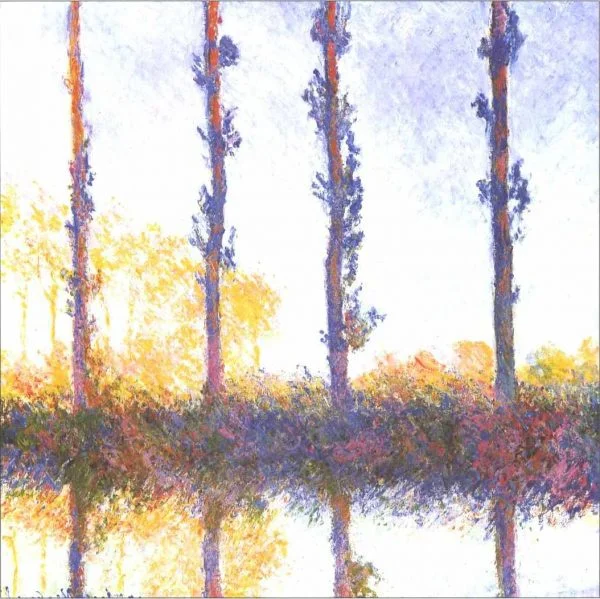
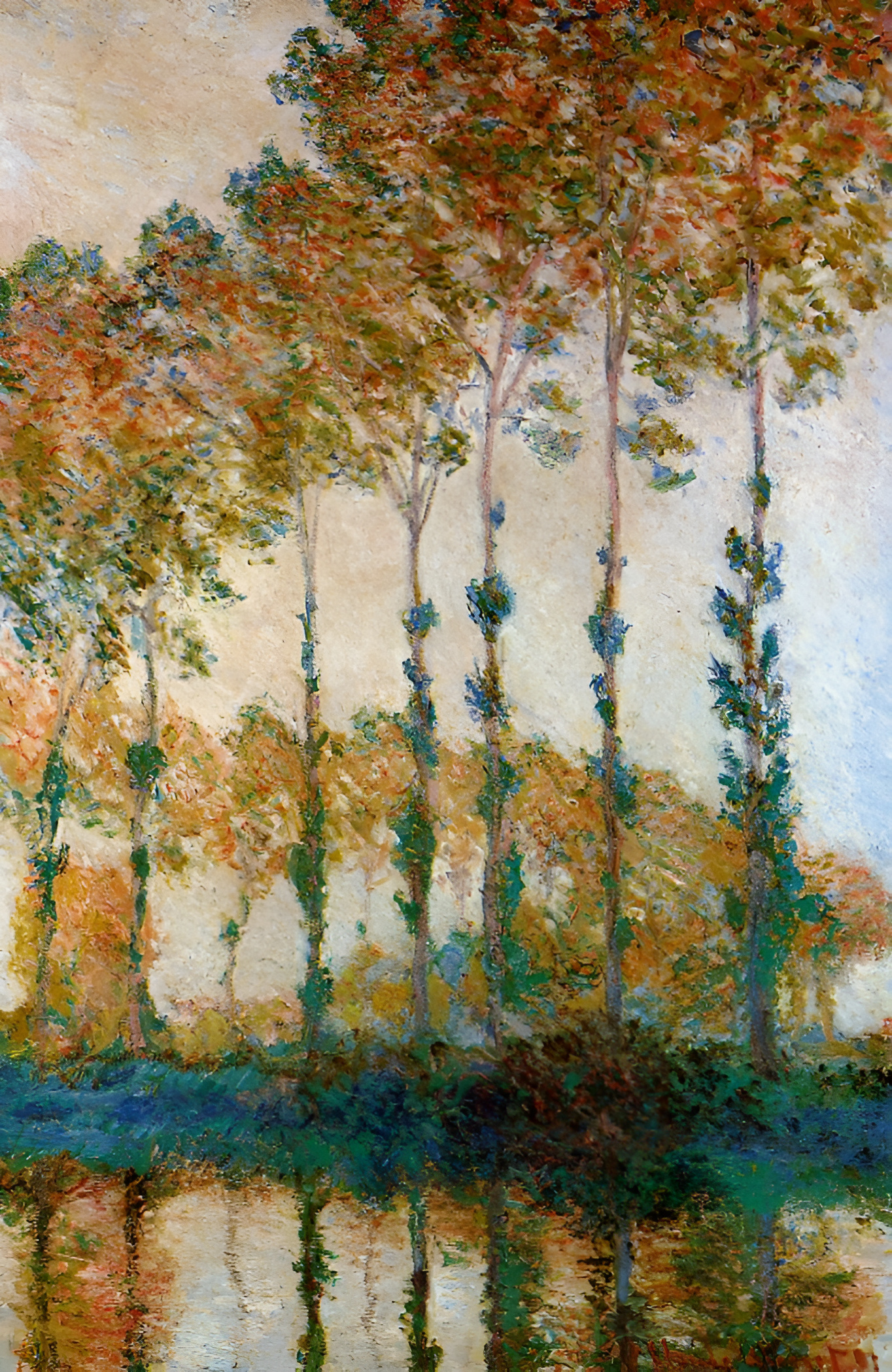
| Title: | A Row of Poplars |
| Other titles: | Rangée de peupliers · Row of Poplars in Autumn |
| Painter: | Claude Monet (1840–1926) |
| Year painted: | 1891 |
| Original size: | 65 cm x 100 cm |
| Original technique: | Oil on canvas |
| Painting style: | Impressionism |
| Located at: | In a private collection — not in any public collection and not on display (Wildenstein catalogue, no. 1293) |
| Our reproduction: | Hand-painted oil on canvas, eight sizes or made to measure |
A Row of Poplars is a hand-painted oil painting after Monet’s autumn canvas of 1891: a row of slender poplars along the Epte, crowns in orange and rust, and a narrow band of water below with vertical reflections. The original measures 65 x 100 cm and is in a private collection. We paint it in eight sizes or to your own measurement, with a photograph of the finished work sent for approval before dispatch.
A Row of Poplars – Claude Monet
What is shown?
The canvas is upright and narrow, and the trees run its whole height. The two tallest trunks stand at the right edge and reach the top; from there the row falls away to the left in a shallow arc, the trunks growing shorter and standing closer together. The trunks are thin pink-grey verticals with dark blue-green foliage clinging to them at intervals. The upper third is filled by the crowns: dense strokes of orange, rust, ochre and green closing the top edge, while at the upper left a pale cream sky still shows between them. Behind the trunks a broad golden-yellow band of lower foliage from the far bank runs the full width. Below is a dark blue-green band of bank, and under it the water, where the trees repeat as broken verticals. There is almost no sky here and no people at all. This canvas painting has no scene in it — it has a rhythm.
Why is the canvas so narrow?
Because the format was chosen for the trees and not for the landscape. An upright, narrow canvas lets the trunks run from the bottom edge to the top, and that is what you see first in this subject: verticals repeating at even intervals. If the canvas lay on its side the eye would spread out over the bank and the water, and the trees would become a border. An impressionist painting here is really a pattern — six or seven verticals crowding towards the left, and one horizontal band of foliage cutting across them. That is why the subject looks more modern than the date 1891 leads you to expect.
This canvas in the catalogue
The work is recorded in the catalogue of Monet’s paintings under number 1293, dated 1891, the technique given as oil on canvas and the measurement as 100 x 65 cm — that is 65 cm wide and 100 cm high. It belongs to a run of some two dozen canvases – sources count twenty-three or twenty-four – that Monet painted in the spring, summer and autumn of 1891 on the Epte near Limetz, some two kilometres upstream from Giverny, where he was living. All of them show the same row of trees on the same bank, each at a different hour and in a different light. The catalogue record for this canvas is here, and one canvas from the same run hangs publicly in the Musée d’Orsay in Paris. This is Monet in his mature years, when he painted the same subject over and over.
The limits of what is known about this original
We cannot tell you where it hangs. The catalogue records it in a private collection in the United States, and that is the whole of the public record: no museum keeping it, no inventory number for us to quote, and no page where you could see the original. Nor can we tell you when it was last exhibited or whose hands it passed through. We write that here because the difference between “nobody knows” and “we did not check” matters to a buyer, and we are not going to blur it. The year, the size and the technique are reliable because the catalogue gives them; the location is not.
Other Monet subjects from these years
From the same run comes Poplars. The year before, Monet painted the grainstacks in the field behind the house the same way — Stacks of Wheat (End of Day, Autumn). The year after, he carried the same method onto a stone façade and painted Rouen Cathedral, Morning Sun. And the same river, further downstream and in morning mist, is Morning on the Seine, near Giverny.
How is our hand-painted version made?
This subject is harder than it looks, and the trunks are why. The painter begins with the sky and the golden band of foliage behind, because they set the light for everything else. Only then come the trunks, and they have to stay thin: a single millimetre too much and the row becomes a wood and the rhythm falls apart. The crowns are painted last, back to front, so the orange stays clean and does not dirty into green. The reflections in the water come at the very end and are broken on purpose — water is not a mirror. The oil painting reproduction you receive is made in exactly that order, and a work this size takes several days.
Which size for which wall?
Short answer: 65 x 100 cm, which is exactly the original’s size and is also one of our eight; 50 x 80 cm for a smaller wall; 100 x 150 cm for a large open one. Because the subject is upright and narrow it goes where a landscape-format one cannot: between two windows, in the narrow strip of wall beside a door, up a stairwell, along a hallway. In this shape, a painting for living room walls also works in a pair, two equal sizes side by side. Impressionist wall art with a subject like this needs little room around it, but it does need height.
How high to hang the painting: a little higher than you would a landscape-format one — the centre about 155 cm above the floor. That puts the band of water at eye level and lets the trees grow upwards, which is what they are supposed to do.
Made to measure, stretcher and frame
If none of the eight sizes suits, we paint to measure — send the width and the height and we will quote a price and a lead time. The canvas is stretched over a wooden stretcher and the edges are painted, so the work does not look unfinished without a frame. A narrow moulding in warm wood suits this subject; a broad frame squeezes an upright format and takes away the very height it was painted for.
Delivery and guarantee
We ship to sixteen countries in the European Union, among them Slovenia, Croatia, Austria, Germany, Italy and Hungary, wrapped in protective film and packed in a rigid box. Before dispatch we send a photograph of the finished work; if something on it is wrong, it is corrected before the piece leaves the workshop. Lead time is longer at the large sizes. You will find our other Monet reproduction subjects in the Claude Monet gallery, and we write about painting and about choosing a subject on the blog.
If the painting is a gift and you are unsure of the size, there is a gift voucher: the recipient chooses the size and the subject.
Frequently asked questions
What year is the original from?
1891. The year comes from the catalogue of Monet’s paintings, where the canvas is recorded under number 1293.
Where is the original today?
In a private collection in the United States. It is not in a public collection, so it cannot be visited; one canvas from the same run is on show at the Musée d’Orsay in Paris.
How many poplar paintings did Monet make?
More than twenty. In 1891 he painted the row of poplars along the Epte near Giverny again and again, in different light and seasons, and fifteen of the canvases were shown together in Paris in 1892.
Why were the poplars not cut down?
The trees were sold at auction for timber while Monet was still painting them. He came to an arrangement with the buyer so that they stayed standing until his series was finished.
- Hand-painted. Oil on canvas, no print and nothing applied by machine.
- Eight sizes or made to measure. From 40 x 60 to 120 x 180 cm, including the size of the original, 65 x 100 cm.
- Photograph before dispatch. You see the work finished before it leaves the workshop.
- Figures from the catalogue. Year, size and technique are given as the catalogue of Monet’s paintings records them.